Flora
Flowers
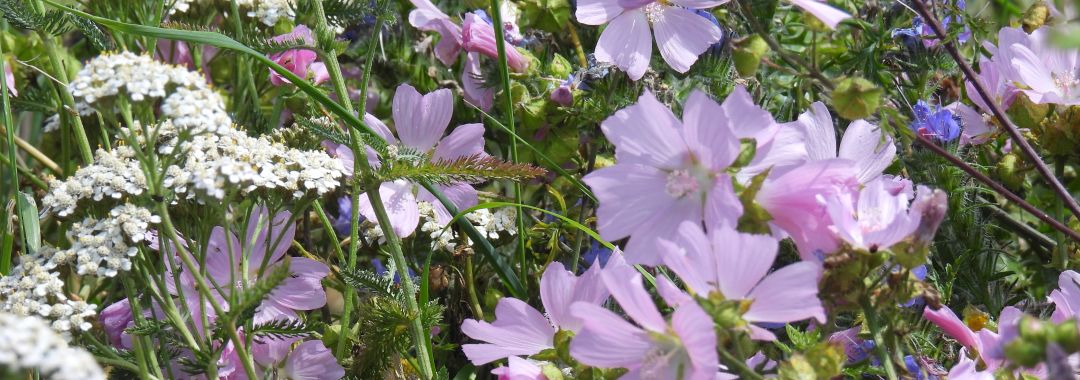
As a nature reserve, it is important that every plant at Sun Rising is native to this area and this soil. Many have been sown by us, with others planted as plugs or larger plants, while some have arrived by themselves – whether in the original seedbank or coming with the wind or wildlife.
As in any natural environment, the seasons are evident in the flowers around. You’ll see wild English Daffodils in the spring, Cowslips by April, then various buttercups, trefoils, bedstraws and vetches. By July, there are knapweeds, cranesbills large and small, scabious, Agrimony, Betony and more.
There are also flowering plants in the mown paths and verges, happy not to be overshadowed by larger plants. Here you’ll find Common Daisies, Cut-leaf Cranesbill, Hop Trefoil, clovers, various speedwells and more.
There are flowering plants in the ruderal margins and along the hedgerows, including Cow Parsley, Tansy, willowherbs, hogweed and more.
You’ll find some flowering plants in areas of woodland. Where trees are young, you may find meadow plants still happy in the sunshine. Once branches are creating summer shade, you are likely only to find spring flowers, such as Primrose and Wood Anemone, and of course our native Wild Daffodils.
The exceptions to our rule about being native are the roses around the Roundhouse and at the Longhouse, which are David Austen, all chosen because they are much loved by bees and other pollinators, and look a little like the native Dog and Field Rose.
We survey the flora regularly to be sure we have good records of how the nature reserve is developing. If you’d like to join a flora survey, or bring a group for a flora walk, just get in touch.
Some of our flowers are photographed here.
Gallery: All photos taken at Sun Rising.
Click on an image to zoom.
Grasses
For many years, the land that is now Sun Rising was used to grow hay for animal fodder. There were very few flowers and the number of grass species was limited. After many years now of managing the grounds as a nature reserve, the number of grasses has increased significantly. Some have been sown, some have arrived by themselves.
Grasses are an important aspect of our native flora, usually dismissed as being not particularly pretty or interesting. However, getting to know grasses can be fascinating - and some are truly beautiful.
At Sun Rising, there are grasses along the hedgerow and woodland edges, around the pond and along our grassy rides. A healthy wildflower meadow needs plenty of grass to maintain the soil structure and soak up rain. There are many butterflies and moths that are dependent on particular grasses.
The first to grow tall in spring are the Sweet Vernal Grass and Meadow Foxtail. Then come the bromes, meadowgrasses, ryegrasses, Yorkshire Fog, Meadow Barley and fescues. Towards July, you’ll see the tall False Oat Grass and golden Yellow Oat Grass, the sturdy Timothy and fine bents. Some are easy to identify, while others require hand lenses or even a microscope.
Here are some photographs of a selection of our grasses. If you’d like to know more, get in touch.
Gallery: All photos taken at Sun Rising.
Click on an image to zoom.
Trees
Being within the Feldon of South Warwickshire, it is quite possible that there have been very few trees at Sun Rising for a thousand years or more, the ground having been in pasture or agriculture for a very long time.
Planting trees into the heavy clay, and watching them grow, is a process that takes a little patience, but gradually we are transforming the soil, bringing back new life. At Sun Rising, we have planted areas of woodland and stretches of hedgerow since 2006. These are either memorial trees planted in memory of someone who has died, or as ‘structural plantings’, where we are creating or extending habitat. The areas of trees behind the pond and near the north car park were planted in 2006, the small woodland area next to the Longhouse was planted in 2017. An English oak was planted for our late Queen Elizabeth in 2022 along the northern boundary.
All the trees planted here are native to this area and this soil. This limits the number of species, but maintains the integrity of the nature reserve. You’ll see plenty of Field Maple, Silver Birch, Wild and Bird Cherry, Hazel, English Oak, Small Leaved Lime, and more.
There are a few exceptions to the rule, notably a Horse Chestnut planted in memory of those who died at Waterloo in northern France; these trees are not strictly native, the first brought to England in the sixteenth century. We have also planted a few Hornbeam, as this species is said to be moving further north with climate change. In 2025, five trees were planted beside the Longhouse to create a mini orchard: three old variety apples, a plum and a pear.
If you’d like to know more, get in touch. You can also look at our Memorial Tree Guide.
Gallery: All photos taken at Sun Rising.
Click on an image to zoom.