Fauna
Birds
Sun Rising takes its place in the wider countryside as part of a farming landscape. While the grounds don't yet provide large areas of mature woodland, the trees and shrubs that we have planted are developing well, with copses growing taller and thicker, becoming increasingly useful for nesting, sheltering and foraging opportunities. Open meadow and grassland are managed to provide an abundance of insect life in summer and seeds in winter. The damp ground in wetter months allows probing beaks to reach the wealth of juicy worms in the soil. Mature and developing hedgerows enclose the reserve and many well-used nestboxes are positioned all around the grounds, supplementing the natural nest holes of the old ash trees that line the road.
In the woodland areas you can expect the usual Bluetits, Great and Long Tailed Tits along with the Robins and Wrens, of course. In Spring they are joined by Blackcap and Chiffchaff. Willow Warblers and Garden Warblers have made the odd very welcome appearance. The hedgerows are home to Yellowhammers, Reed Buntings, Linnets and some lovely summer visitors – Whitethroat and Lesser Whitethroat.
House Sparrows are usually busy around the South Car Park; they regularly nest in the cabin roof here. This is also the place to see our four regular finches – Chaffinch, Greenfinch, Goldfinch and Bullfinch. Dunnocks can be seen along the hedge bottoms, only in springtime flying up to the hedge top where their songs fill the air. All disappear when the Great Spotted Woodpecker or Sparrowhawk arrives.
For twenty years we had large mixed seed birdfeeders along the hedgerows near the South Car Park, but in 2026 we changed our policy. The feeders were encouraging the more common birds, creating a greater gap as their growing numbers outcompeted the rarer species. As a result, we have removed these and will monitor how this changes the various species populations, reviewing the feeding policy every few years.
The pond draws in an occasional Mallard and Moorhen, and a possibly a furtive Heron if it’s toad breeding time. The meadow near the pond is developing into a wetland to provide feeding areas for waders like Snipe and Lapwing. Tucked away at the back of the pond you'll find a viewing screen: a calm space to sit and watch a quiet woodland copse where now and then we'll put up feeders.
The open grasslands and meadows are loved by Skylarks, Kestrels and Meadow Pipits. Green Woodpeckers feed on ants nests around the meadow, and in areas of younger woodland. A Barn Owl can be occasionally seen as light fades. We’ve heard Tawny Owls calling in late winter too. Our owl and kestrel boxes are popular for roosting, but aren't yet used for breeding on a regular basis.
Winter brings Fieldfare and Redwing to bunches of berries and apples in the mature hedgerow, joining their Blackbird and Song Thrush cousins.
The occasional Wheatear will rest here for a few days, fuelling up before continuing its long migration to higher grounds in the North and West. Visit in April and watch the memorial posts –you might get lucky. If you’re after a Pied Wagtail, look at the Roundhouse roof.
The wide open sky is also a habitat for birds that rarely land but hunt mid-air, the summer Swallows and Swifts. There are nest boxes for swallows on the north lintel of the Longhouse. In 2025, we erected a beautiful tall swift tower down by the pond: a caller plays the sounds of a swift community as these migrants start to fly in, hopefully encouraging pairs to stop and nest.
There are also Sparrowhawks, Buzzard and Red Kite. Curlews and Lapwings will fly over on transit between their feeding and roosting areas. Ravens are heard rather than seen most days, with their low crraaw.
Of course there are the usual cast of Crows, Jackdaw, Magpie, Starling, Pheasant, Woodpigeon and often overlooked Stock Dove.
Gallery: All photos taken at Sun Rising.
Click on an image to zoom.
Butterflies
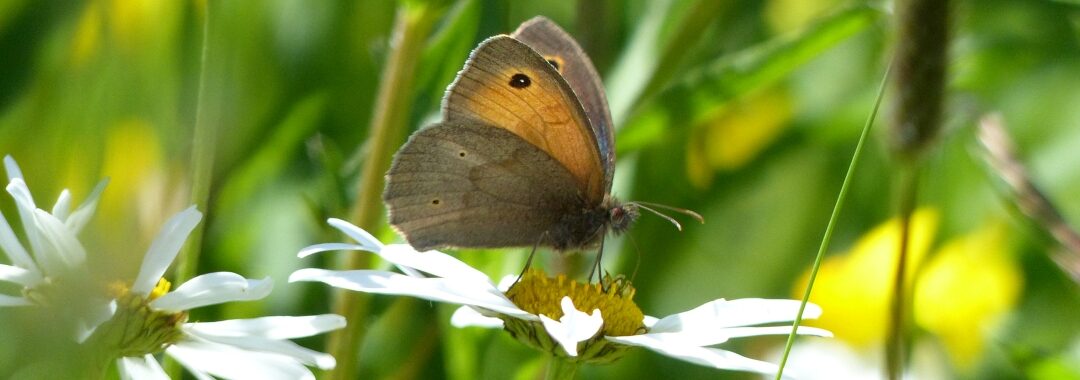
Since the site opened in 2006, 23 of the the 38 species of Butterfly listed in Warwickshire have been recorded at Sun Rising. The gallery photographs on this page were taken at Sun Rising, covering all species recorded.
With plenty of grassland and supporting hedgerows, Meadow Browns, Gatekeepers and Ringlets are all particularly abundant. With a growing canopy of memorial trees and resulting dappled shade, Speckled Wood numbers are also on the rise.
Especially pleasing has been the growth of Marbled White numbers. The upward trend of this elegant butterfly may in part be a result of rotating where and when we cut our grassland, leaving areas of long grass for eggs to hatch untouched.
Another encouraging development is increasing Common Blue numbers. This beautiful small butterfly can now be seen all over the reserve, accompanying our efforts to seed and spread their caterpillar’s favourite food, Birdsfoot Trefoil.
With the growing diversity and maturing of habitats, we expect relative numbers to change and grow. In the longer term, we would hope to record additional species new to the site.
Dedicated Habitats
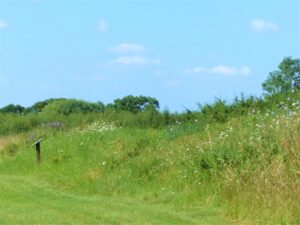
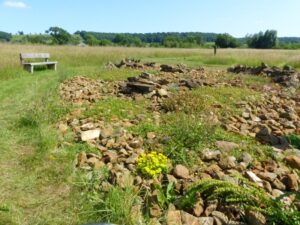
Two habitats have been created and developed particularly with butterflies in mind: the butterfly bank at the northeast end of the site, and the butterfly stones towards the western end of the site.
A great deal of work is needed to ensure butterfly favourites such as wild strawberry and cinquefoil establish and spread against competing grasses, but patient, constant work is bringing results year by year.
Butterfly Bank
Butterfly Stones
Monitoring
In 2017 we began monitoring butterflies as part of the UK Butterfly Monitoring Scheme (UKBMS), using the butterfly transect recording method.
A transect is a fixed route, split into roughly equal sections designed to represent the range habitats that exist or are expected to evolve over time. The transect is walked weekly (ideally) between April and October and the total number of butterflies for each species is recorded for each section. The resulting records are stored in our database and then submitted to to UKBMS for analysis within county and national contexts.

Butterfly transect map with location of Butterfly Stones and Butterfly Bank
Transect Analysis Reports
The summary reports below are produced by the Conservation Officer at Butterfly Conservation Warwickshire. They are useful in providing a county-wide context for the transect data gathered at Sun Rising, and are published by kind permission.
Butterfly Transect Analysis 2025
Butterfly Transect Analysis 2024
Butterfly Transect Analysis 2023
Butterfly Transect Analysis 2022
Butterfly Transect Analysis 2021
Butterfly Transect Analysis 2020
Butterfly Transect Analysis 2019
Butterfly Transect Analysis 2018
Useful Resources
- Activities, information and events within Warwickshire: Butterfly Conservation Warwickshire.
- General information on individual butterflies and butterfly conservation in the UK: Butterfly Conservation.
Thanks
Particular thanks to:
- Mike Slater (Chair and Conservation Officer at Butterfly Conservation Warwickshire), for his guidance and advice on habitat development and transect planning.
- Keith Warmington (Treasurer and Butterfly Recording Officer at Butterfly Conservation Warwickshire), for his guidance and support in collating and submitting records.
Gallery: All photos taken at Sun Rising.
Click on an image to zoom.
Moths
Since 2014, we have been lucky to have Alan Prior and fellow volunteers carry out regular surveys at Sun Rising, in all sorts of conditions, with dedication, knowledge and good humour. Below are some words from Alan, together with his annual survey reports and a selection of photos he and colleagues have taken on-site.
"Moths are those annoying drab brown things that eat your clothes. A quite sweeping and damning statement, about which there is only the minutest grain of truth. As you can see from the gallery they come in all colours of the rainbow and many shapes and sizes. They are endlessly fascinating as you never know what will show up at any time - day or night.
"Moths are vital for the health of our ecosystems, not only because without them our bird populations would crash, but also as major pollinators of many of our wild plants. If there weren’t any moths, our landscapes would look very different, with a lot less biodiversity and the tangible emptiness would be visible. Much of this activity goes on unnoticed under the cover of darkness.
"That’s where a moth recorder comes in. Myself and other enthusiastic volunteers revel in being out when nobody else is and seeing sights that few others do. This recording is extremely important and can tell you much about the health of a habitat, depending on what and how many species are found.
"With particular regard to Sun Rising, it has been wonderful to have been recording the moths since fairly early on in its development into a Nature Reserve. The range of species found grows every year thanks to the diligent, sensitive and considered management of what was once just a farmer’s field. The continued moth monitoring of this particular site is absolutely vital and has without doubt already validated the decisions made as it has slowly developed over the years. The quality and diversity of habitats have been continually improved and so many more species of fauna and flora now call it home. This can only been a good thing for the health of the landscape and ultimately us."
Alan Prior 8th January, 2021
Gallery: All photos taken at Sun Rising.
Click on an image to zoom.