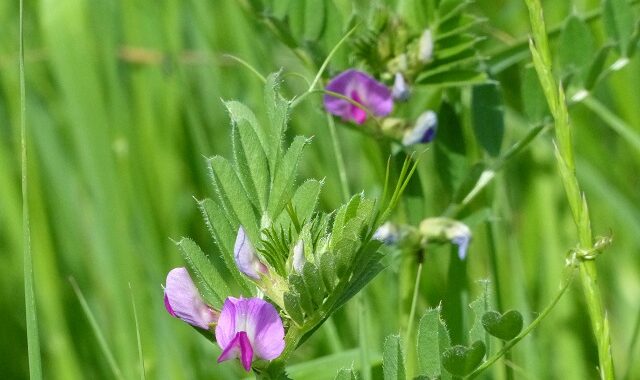
At this time of year, the wildflower meadows are beginning to look lush with the rich growth of early summer. At Sun Rising, that green is now sprinkled with bright yellow Meadow Buttercups, and the soft pink of Ragged Robin. But amidst these is also the deep and vibrant pink of Common Vetch.

Common Vetch in the Wildflower Meadow
The botanical name for this beautiful little wildflower is Vicia sativa. The sativa tells us that it was once more widely cultivated (from the Latin sativum), and indeed, although the peas are fairly small, they are high in protein. Though toxic when raw, well cooked these native peas were readily eaten by our ancestors. In some parts of the UK, they are still known as ‘poor man’s peas’.
In more recent centuries, it has been grown not for human consumption but as a valuable animal fodder. And as a legume, it is still sown as a green manure, especially on allotments, small holdings and in organic farming. The plant creates little nodules on its root that house, protect and feed a bacteria called rhizobia, which in turn coverts nitrogen in the air into a form the plant can use, allowing it to create proteins. If the crop is not harvested, but dug back into the earth, these little root nodules naturally enrich the soil. As a crop sown in agriculture, a common name for it is tares, although technically the word can refer to a number of different vetch species. In some dialects, a tare can simply mean a weed!
At Sun Rising there are two points in the year when it is an absolute joy: right now, in mid May, when it brings those glorious violet pinks to the green of the meadow, and again at the end of the season in July, when its black seed pods are drying in the summer sun – and at the slightest touch they will burst open with a crick!, its black peas flying off into the grass.