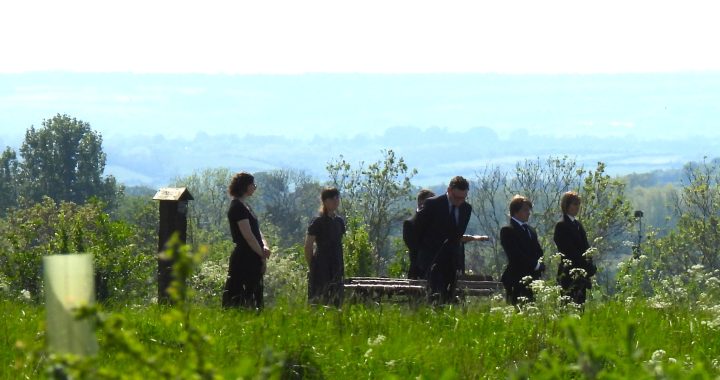
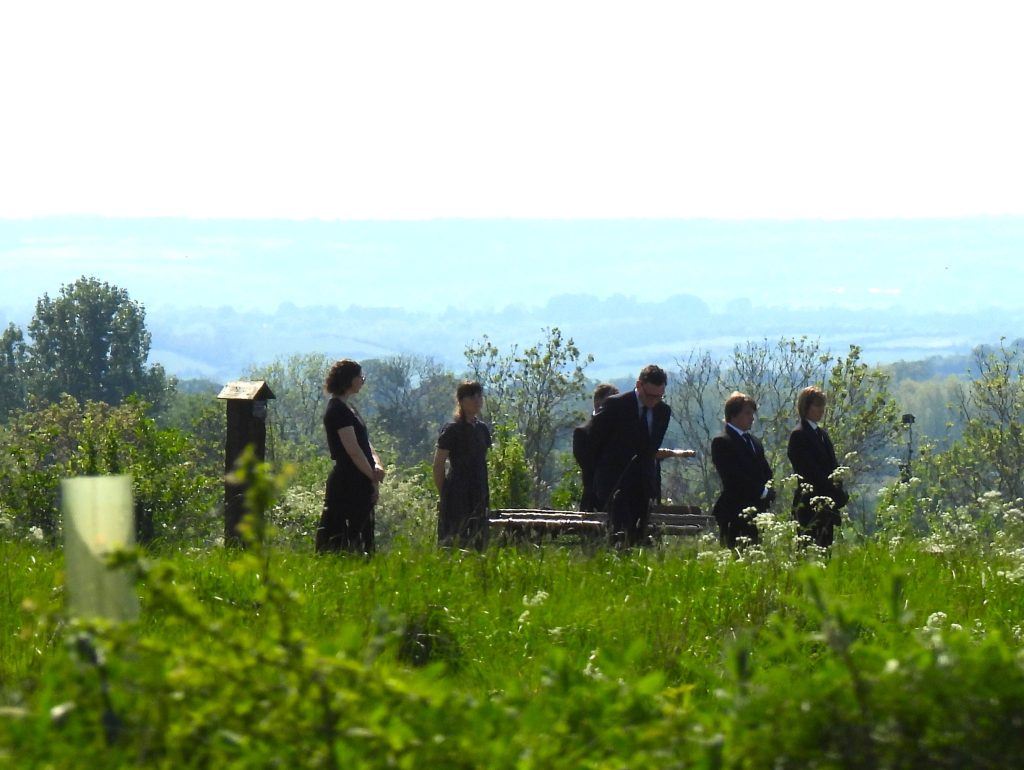
Colin and Emma, with the team, laying Conroy to rest at Sun Rising

The Unnamed Dead

This past week, staff here at Sun Rising had the honour of laying to rest a fellow with no name.

It was, in fact, the articulated bones of the man’s head and upper body, bones that had been in the care of a local doctor for some decades.  They had been given to her as an educational aid when she was working through medical school.   Not only did the bones help her through her own studies, they were used by many of her fellow students.  When her daughter went to medical school, the skeleton went too, aiding her and her fellow students as they learned about the human body.  In addition, a neighbour was grateful for the skeleton when working through an anatomy course, and a colleague through ear, nose and throat postgraduate exams.

It was standard practice to use genuine human bones in medical studies for hundreds of years.  In Britain, the bones are most likely to have come from India and other parts of the former Empire, where criminals, paupers or victims of crime had no family able or willing to step forward and claim the body when the person died.  Thankfully, this became illegal in the mid 1980s.

Colin and Emma, with the team, laying Conroy to rest at Sun Rising

Colin and Emma, with the team, laying Conroy to rest at Sun Rising

However, thousands of human skeletons are still in cupboards and attics around the country.  When the local doctor felt it was time to let this one go, she was sure that there must be a respectful way of doing so, and approached our local independent funeral directors, R Locke and Son.   While an unusual request, Colin Locke felt it was the right route to take and called us at Sun Rising, knowing we would share the same sincerity and compassion.  Together, a burial was arranged.

Nothing is known about the skeleton, other than that it is of a human male.  Nonetheless, on the day, the burial was carried out with as much dignity as if his own family had been present.  We chose a spot along Molly’s Hedge, with glorious views, where in time he will become a part of the shrubs and trees as they develop, surrounded by birdsong.  Emma spoke a few words, expressing thanks to the individual who, unknowingly, had given so much, helping so many in their medical studies.  It was a very real and tender experience, acknowledging that these bones had been a living human being, whom we were able to lay to rest in the peace and beauty of the nature reserve.

While acknowledging that we don’t know the fellow’s name, nor his religion or culture, the team at Sun Rising felt a need to name him, as  a further step in recognising him as a human individual.  We gave him the name ‘Conroy’, a name which some say means ‘wise advisor’, reflecting the many people that his bones have taught.

A slate memorial plaque installed at the grave will read: ‘In gratitude for your contribution to medical education’.
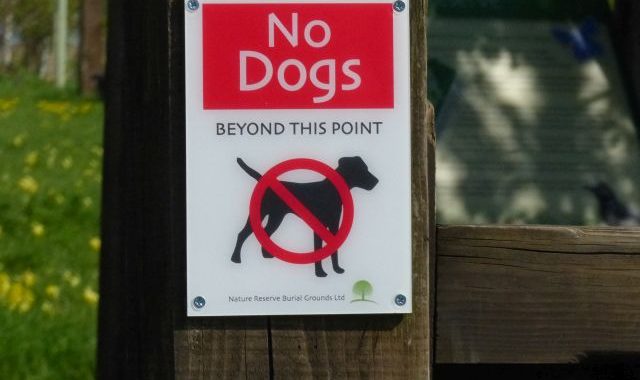
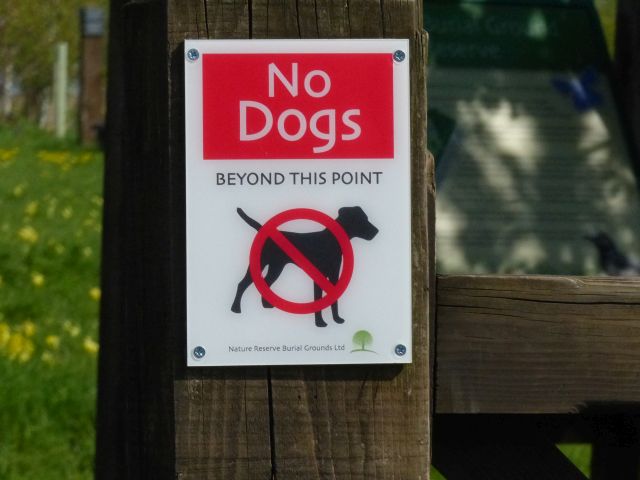
No Dogs Sign

The No Dogs Blog (Please!)

You may have noticed when visiting Sun Rising that we ask that you do not bring dogs to Sun Rising. We know that this can seem a bit draconian to some dog owners, and now and then somebody will get in touch to question the policy.  Sadly, some owners simply ignore the signs.  We promise, we do love dogs! – but the natural burial ground and nature reserve are delicate mixtures of habitat, supporting many species that thrive in the quiet, undisturbed calm of the site.

No Dogs Sign

No Dogs Sign

There are a number of reasons for the policy.  One of the main ones is perhaps the most obvious: what dogs leave behind. Although many dog owners are responsible and pick up after their dogs, the truth is that some do not. Sun Rising is a special, meaningful place to so many who have loved ones laid to rest with us. Finding dog poo on a grave, along the paths, or indeed anywhere on site, is disrespectful to their memory.  It’s as simple as that.

However, it isn’t just about faeces.  Studies have found that not only dog poo, but also urine, can impact wildlife negatively: both over-fertilise the ground. Most natural ecosystems, including our verges and wildflower meadows, are naturally low nutrient environments. Over-fertilisation reduces biodiversity, allowing vigorous plants, such as nettles and hogweed, to outcompete the more delicate flowering plants that many insects depend on, leading to an impact on all the wildlife in that food chain.

Flea treatments used on dogs can also harm wildlife, particularly in aquatic ecosystems. The insecticides used in these treatments, brushed off into long grasses, can then be washed into drain lines and on into the waterways. These chemicals are devastating to invertebrates such as mayflies, caddisflies, dragonflies, damselflies and their larvae, but are also toxic to beetles, bees and other wild pollinators.  The decline of these species then affects wildlife further up the food chain, such as birds and bats. Our pond is a wonderfully busy habitat, home to Great Crested Newts, Toads, Frogs, Great Diving Beetle, Emperor Dragonflies, Water Scorpions, and much more, all of which we are working hard to protect.

Many visitors will have seen and heard our lovely community of Skylarks at Sun Rising, singing away in spring and summer. Skylarks are ground nesting birds, building little cup-shaped nests in long grass. Dogs can harm ground nesting birds by trampling nests and eggs, causing adults birds to abandon a nest, or even worse, attacking the birds.  There are other birds, such as Meadow Pipits, Yellowhammers, Red-legged Partridge, Whitethroat, Chiffchaff, Robin, all of whose nests can be badly stressed and otherwise affected by dogs.

We understand why visitors would like to bring their dogs to walk at Sun Rising – it’s a beautiful place!  However, our duty is to protect Sun Rising, to respect the memory of those laid to rest with us and to ensure the grounds’ long-term protection as an established and ecologically-valuable nature reserve.  So, we respectfully ask that visitors please do not bring their dogs with them.

There are some lovely local walks, such as the Tysoe Windmill Walk, where you can look down and see Sun Rising below you.  Use your search engine for hikes around Tysoe.

Funeral at Sun Rising Natural Burial Ground

Green Living, Green Dying

This week is Great Big Green Week and all across the UK, communities are coming together to swap knowledge and skills for improving sustainable living. It’s a wonderful opportunity, not just to send a loud message to those in power that we sincerely care about our planet’s future, but to remember that individually we can each make a difference too!

While much of the Great Big Green Week focuses on green living, here at Sun Rising our area of expertise is green dying: how to have the most environmentally-responsible funeral possible. How can you make sure that your death doesn’t literally cost the earth?

Funeral at Sun Rising Natural Burial Ground

Funeral in the Peace of the Nature Reserve

Arguably, the most significant choice you can make is to choose a natural burial – not a cremation. Cremation is the most polluting decision that can be made in the funeral process. Crematoria generate huge amounts of climate-changing CO2, when we know we must all reduce our carbon footprint.  They also pump out significant and dangerous levels of pollution, increasing acid rain and worsening breathing difficulties and allergies.  Further, they consume huge quantities of energy: at an average of 1000°c for 75 minutes per person, an entire household might use this much energy in a month!

The ashes themselves are toxic to native wildflowers, potentially harmful to wildlife, polluting water systems if scattered irresponsibly. Many people choose to scatter ashes in beautiful natural areas because they deeply appreciate the peace and serenity that nature brings – yet, by being cremated, they are badly damaging that very beauty they loved so much.

A natural burial is by far the most low-impact type of funeral. A simple and clean return to the earth, with a biodegradable, sustainably or locally-made coffin, free of the poisons and plastics you get from embalming or using a veneered chipboard coffin made with formaldehyde resin. Burial is carbon capture: rather than releasing CO2, it takes your body’s carbon safely into the earth. Living memorials such as trees and wildflowers take away the need for unethical and expensive headstones, and instead create and protect a green space in the land for wildlife and nature.

In the spirit of Great Big Green Week, we encourage you to share all your green tips with your friends and neighbours.  But don’t just talk about gardening for pollinators, or recycling, upcycling, fixing and mending: we ask you to share these facts about cremation.  With large corporations spending millions advertising direct cremation for their own profit, we need each one of you to choose natural burial and encourage others to do so too.  Let’s leave our grandchildren a world greener and cleaner than our parents left us!

If you are interested in knowing more about green funerals, please feel free to get in touch.

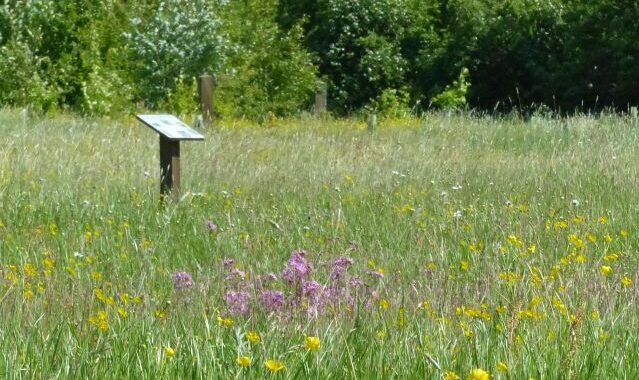
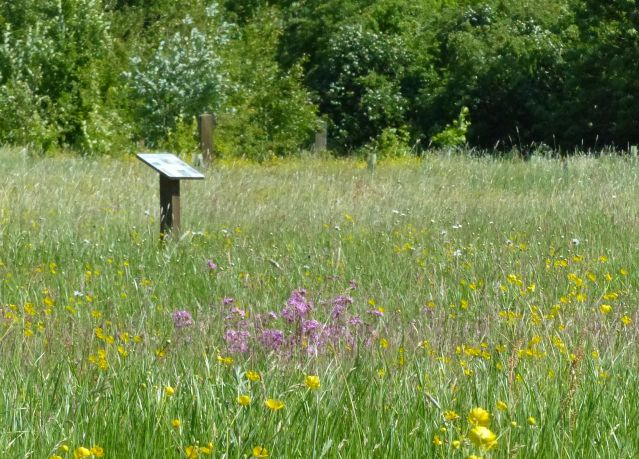
Meadow with Ragged Robin and Habitat Interpretation Board

A Perfect Job

When asked about my occupation and I reply that I work at a natural burial ground, a common response is a pause, followed by, “But what do you actually do?”  In reality, the job we do here is wonderfully rich and varied, and so profoundly worthwhile I can’t think of a more perfect job.There are many meetings with families, in what may be the worst days of their lives, but the opportunity to support people through the necessary steps is a tremendous honour. Equally, meeting with individuals who are facing their own mortality, through age or illness, requires sensitivity and strength, but is deeply rewarding. Arranging, co-ordinating, preparing and supporting families through funerals is also filled with a poignancy and sadness but the opportunity to be there for them is an honour.

Meadow with Ragged Robin and Habitat Interpretation Board

Meadow with Ragged Robin and Habitat Interpretation Board

But those tasks are not all the job entails. There is paperwork, of course, and designing memorial plaques, growing wildflowers from seed, planting bulbs, planting trees, pruning roses, arranging memorial benches, installing plaques, ordering coffins, counting butterflies, creating habitat interpretation boards, weeding the meadows, organising open days, running workshops, tidying graves, giving talks, doing flora surveys and tree surveys, looking for harvest mice, giving time to those visiting graves, managing volunteer days, designing leaflets, working with celebrants, funeral directors, naturalists, and so much more!

As I look to be taking a step back in order to focus on our charity, The Friends of Sun Rising, we’re now looking for someone to take my position. We aren’t expecting to find someone with years of relevant experience, but we are determined to find the perfect person: someone who is really keen to work for an ethical company, who is sensitive to others’ needs, and who is deeply passionate about nature.

… We are delighted to say that this position had now been filled.

Drone View of the Burial Ground, March 2024

The View from Above

Being at Sun Rising, walking down the mown paths through the wildflower meadows and grasslands, along the tracks with the broad views ahead, meandering through the growing woodlands, can be a wonderfully immersive experience. The rest of the world disappears, which, at times, can be a much-needed respite.  We are drawn into the peace and quiet.  Watching the movement of wind on the meadow, following the dance of a butterfly, watching bees and hoverflies, listening to the birds, allows us inner space.

Drone View of the Burial Ground, March 2024

Drone View of the Burial Ground, March 2024

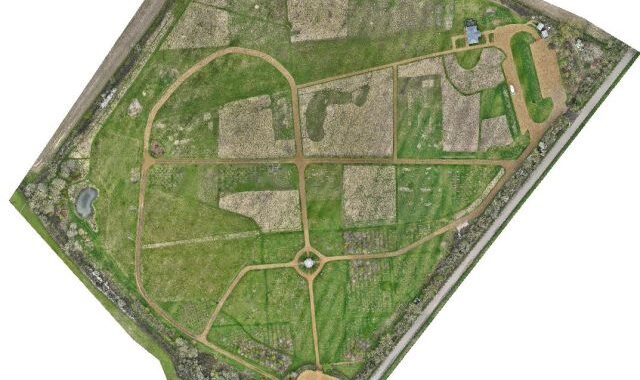
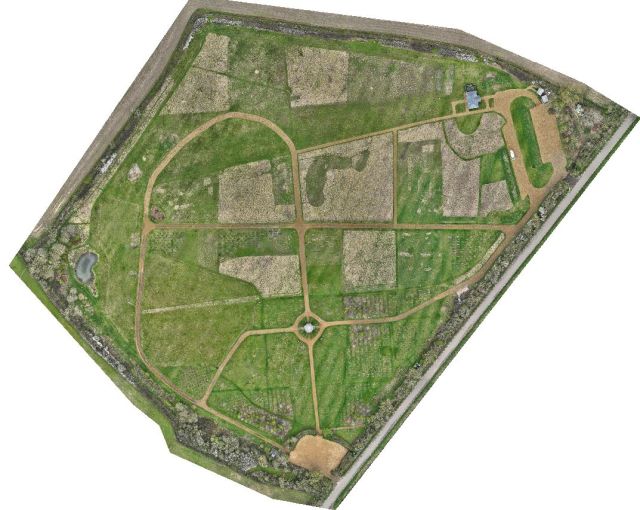
Although day to day our feet are on the ground, in order to map the grounds accurately we have commissioned a view from above.  In March this year, we had drone surveys done that give us exact grid references so that we know just where every burial plot is or will be.  On the photograph above, you can not only see the longhouse, the roundhouse, the pond, the tracks and car parks, you can also see individual graves.

As the survey was done in March, while the trees were still leafless, it is hard to see the difference between meadow and woodland.  The paler areas are pockets of tussocky grass, unmown last autumn.  You can also just see the shape of the hay labyrinth, made last August, which by March had almost disappeared at ground-level.

Wonderfully, in terms of historical interest, you can see the residual ridge and furrow as well – stripes of darker and paler green running diagonally across the map.  This whisper of medieval strip farming will probably remain visible in meadow burial areas, but will gradually slip away beneath the woodland as it matures.  Records like this map are a valuable reminder of centuries past.

As I walk along the tracks and paths, I now carry the image of what the grounds look like from above.  Because I can better imagine the whole, it makes me feel more fully a part of the whole, albeit a tiny part.  And that only goes to increase the glorious sensation of peace.

Scorpion Fly on Stinging Nettle

The Impact of Fertility

When we opened Sun Rising in 2006, the field had been ‘in hay’ for many years, growing grass to be cut in late June or early July which would be baled for winter animal fodder. Our plan was to transform this grassland into a beautiful and diverse nature reserve, supported by the operations of a natural burial ground: burials would fund the developing nature reserve, the nature reserve protecting the graves in the long run, while nature proffered its beauty to both.

We would be changing the ecology of the field significantly.  Planting trees and shrubs, sowing wildflowers, putting in bulbs, digging the ponds, cutting the meadows in August, would all be part of the very positive change.  However, work we were doing beneath the surface would also have an impact: putting in extra lines of drainage, as well as burials and interment of ashes.

While native woodland can cope with a range of soil conditions, a wildflower meadow will only thrive on soil that is very low in fertility. Where soil is rich, what naturally grows are ruderal or wasteland plants: stinging nettles, brambles, docks and thistles.  There is certainly a place for such plants, which are a wonderful habitat for many moths, butterflies, bees and other invertebrates: at Sun Rising, we keep them to the margins.  They aren’t what visitors want to see around their loved ones’ graves.  In meadow burial areas, where we are striving to grow beautiful native wildflowers, we need to keep the soil fertility low.

Scorpion Fly on Stinging Nettle

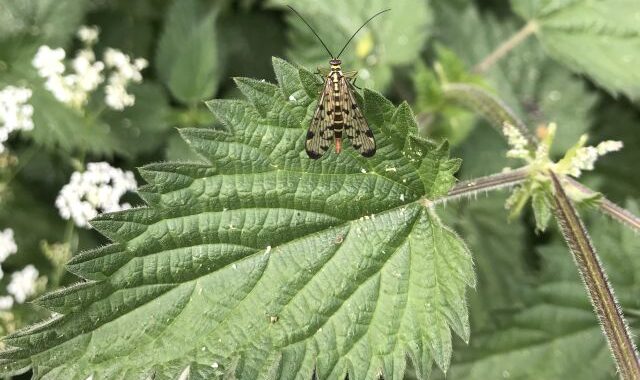
Scorpion Fly (Panorpa communis) on Stinging Nettle

Over the years we have been testing the soil in various areas of Sun Rising to see how both the nature reserve development and the natural burial ground are changing its fertility, specifically looking at levels of  phosphorus, potassium, magnesium and nitrogen.  The results of these studies will be more valuable in another five or ten years, when we have collected more data, but analysing results now is important as a guide for how we make decisions about both the natural burial ground and nature reserve now.  For example, we are now gradually phasing out the option of interring cremated remains, which, as an extremely concentrated source of chemical elements, is just not compatible with the care of wildflower meadows.

Rosehips in Raindrops at Sun Rising

Time Falling Through

With amazement I realise that it is almost six months since my last blog post.  For those who value this short missive from the heart of Sun Rising, those who perhaps live too far away to visit, or who are less mobile, I know that my words and photographs can be a quiet voice from a place where a much loved family member is laid to rest.  I do sincerely apologise for my silence.

The reason for it is simple: this past summer, my father died.  And since then, time has been falling through my life.

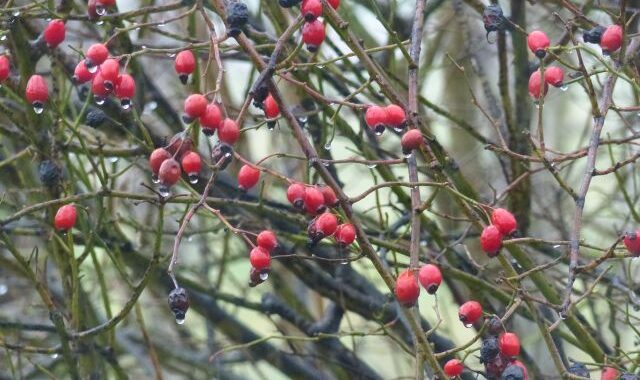
Rosehips in Raindrops at Sun Rising

Rosehips in Raindrops at Sun Rising

During the weeks or months around someone’s death, the mind is very often filled with a fog.  It allows us to stumble on, perhaps even managing to accomplish a good deal of the necessary arrangements and bureaucracy, while at the same time entirely forgetting important tasks, perhaps losing key tracts of conversations, small moments or long stretches of the day slipping away.  It’s bewildering.  Maybe the fog is nature’s way of softening the world for us, when otherwise it would feel just too unbearably harsh.

Slowly, as the months pass, years moving by, the fog appears to clear.  But this is just another sneaky way that nature works, for I suspect I have now become accustomed to the fog’s density.  While in many ways I feel as if I have come through the worst of the grief, I am functioning, getting on with life and work as if I were ‘back to normal’, I am equally aware that there are still great open fields in my mind, upon which the mist lingers, and into which I get lost.  From the outside it may seem that I am fine, but my experience is of moments falling away.  Time slips – like a pebble into a ravine, a snowflake into a stream, a fine glass shattering on a stone floor, the memory of my dad’s warm hand in my own.

It has been my intention to write a blog for months, but that intention has slid from me again and again.  Now, with a little more clarity returning, I determine to return to sharing words and photographs here.  Please forgive me for explaining (or expressing) something of my own grief, but I suspect many of my readers will have had, or a still managing, just the same.  As human beings, and especially human beings who have loved, we stand together in this soft bewilderment of loss, quietly.

Path Beside Seth's Wood at Sun Rising

Ten Myths about Natural Burial

The first natural burial ground opened almost thirty years ago, but many people still have little idea about what a natural burial might entail.  It’s not a conversation most have until it’s needed!  As a result, there is still a fair amount of misinformation around, some of which becomes apparent when visitors ask questions, let slip assumptions or tell us what they’ve been told.  Here are the ten most common myths that we’ve heard.  Believe it or not, I’ve listed them in the order of how common the misunderstanding seems to be.

Path Beside Seth's Wood at Sun Rising

Path Beside Seth’s Wood at Sun Rising

MYTH 1:  At a natural burial ground, people are buried standing up.  Absolutely not!  There would seem few things less natural than upright burial, after all.  At a natural burial ground, the priority is to provide a natural, peaceful resting place.  Certainly there has been some research carried out into how burial might be done with coffins upright, but this is for space-saving reasons at crowded urban cemeteries, and definitely not natural burial grounds.

MYTH 2:  Natural burial grounds are only for people with no religious faith.  This may be true of some, but not many – and definitely not Sun Rising!  Natural burial is available to people of all beliefs, just as it is open to people of any gender, sexuality, age, race and nationality.  As long as there is respect for others laid to rest at Sun Rising, and those who might visit them, anyone is welcome.

MYTH 3: If you have had cancer you can’t be buried at a natural burial ground.  Or, more specifically, the myth asserts that if you have undergone chemotherapy or radiotherapy, you have to be cremated or buried in a sealed coffin.  During the pandemic, this myth also extended to include those who had died of COVID.  I even heard this myth from someone selling a pre-paid funeral plan at a large chain of funeral directors.  It is complete nonsense.  Some worry about hip replacements or pacemakers, and other medical implants.  These should not affect the option of a natural burial.

MYTH 4: A natural burial ground isn’t an option after a post-mortem.  This is not true.  Where a post mortem autopsy is required to establish the cause of someone’s death, this may delay the burial.  However, it shouldn’t otherwise affect it.  Most natural burial grounds don’t allow embalmed bodies, but embalming is not an automatic part of an autopsy.

MYTH 5: Nobody can attend a burial at a natural burial ground.  This is not the case at all.  Some natural burial grounds may have a limit on how many can attend, but this is in order to protect the nature reserve or because parking is restricted.  At Sun Rising, the limit is 80 people.

MYTH 6: At natural burial grounds, people are buried without a coffin.  Most natural burial grounds will allow burial in shrouds, but this is by no means mandatory!  The vast majority are buried in coffins.  These do usually need to be fully biodegradable, with the majority being willow, wicker or other woven materials, cardboard, or unvarnished pine.  The standard MDF, wood-veneered coffins are not permitted, nor the expensive ‘American’ style coffins.

MYTH 7: At natural burial grounds, graves are very shallow.  Most people assume that a grave must be 6′ deep.  This is not the case in Britain.  A depth of 6′ is only needed if a second burial is expected in the same grave.  Where there is to be only one burial, 4′ is perfectly adequate, and many natural burial grounds only offer single graves.

MYTH 8:  Natural burials are for the rich.  Some natural burial grounds are expensive, but these tend to be in the South East and around London, where all cemeteries can be pricey.  Most natural burial grounds are not at all expensive.  At Sun Rising, as an ethical company, we strive to do all we can to make a burial affordable, giving families options that will take the cost down further, such as using our Simple Arrangement Service and using family bearers.  In a beautiful environment, you don’t need to spend lots of money on flowers, limousines and all the extras.  Nature’s peace and beauty makes a funeral special.

MYTH 9:  At a natural burial ground, all graves are unmarked.  This varies at different burial grounds.  At Sun Rising, woodland plots can be marked, so family and friends can always know the exact spot.  Meadow graves are not marked, but a plaque can be placed on a shared pathside post.  By law, we need to know exactly where every grave is, so it is always possible to locate the spot.

MYTH 10: At a natural burial ground, people can walk over the graves.  This isn’t so much a myth about natural burial grounds as it is a question about burials in general.  In most old churches, there are burials under the aisles.  In most churchyards and cemeteries, people walk around the headstones and over the graves.  At Sun Rising, we suggest that if visitors know there is a grave, don’t walk on it; if the grave has greened over, and so isn’t evident, don’t worry!