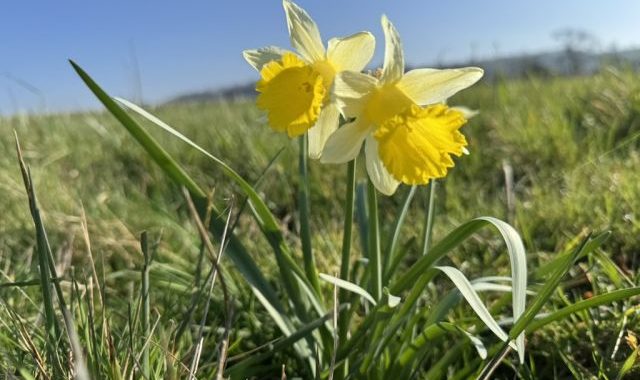
Wild Native Daffodils (Narcissus pseudonarcissus) at Sun Rising

A Host of Golden Daffodils

An English March is so unpredictable, even to the English it can feel baffling.  Beautiful warm days with rich blue skies can turn to pouring rain within minutes, the weight of grey cloud above pushing down, icy winds tearing through.  Trees, though twiggy with new growth, are still leaflessly grey, and clouds of white blackthorn in uncut hedgerows seem at times simply to reflect the white skies above.  Yet, even on the drizzliest, overcast day, the bright yellow of the daffodil positively glows.  It is no wonder that we English so value this flower.

Wild Native Daffodils (Narcissus pseudonarcissus) at Sun Rising

Wild Native Daffodils (Narcissus pseudonarcissus) at Sun Rising, photo credit: Martin Head

When beloved poet William Wordsworth expressed his pure delight at coming across ‘a crowd / a host, of golden daffodils’, he was remembering a walk around Glencoyne Bay in the Lake District, where we might imagine March weather was often dreary, damp and chilly.  It is easy to relate to his joy!  And, being the very beginning of the nineteenth century, some 120 years ago, the daffodils he saw would not have been modern garden cultivars, but the native, wild daffodils that we plant here at Sun Rising.

This year, 2026, we have reached two key milestones: opened in 2006, Sun Rising is now 20 years old, and in January the 2000th person was laid to rest in the nature reserve.  To commemorate both milestones, we are planning to plant two thousand native daffodils, at the bottom of the wildflower meadow just above the pond, one to remember each individual buried here.  (Of course, there’ll be more like 2100 by the time we plant the bulbs in October, so we’ll need to throw in some more!)

The idea is, however, not to do it ourselves, but get our community of families involved.  Two thousand people means almost two thousand families, each one having been through the difficult process of loss and grief, and how wonderful it would be if each one were able to sponsor the planting of a bulb for their loved one.  The value of the flowers would then extend from the nature reserve, with all its early foraging insects, such as queen bees and ladybirds, to all those have been ‘wandered lonely’ in grief.

In January this year, then, we launched our 2026 Daffodil Appeal, giving everyone the opportunity to sponsor one or more daffodils at £10 each – in memory of loved ones and, perhaps as poignantly, in memory of those who have no remaining family or friends, or whose families have lost touch.  To sponsor daffodils or find out more, please go to 2026 Daffodil Appeal.

So far, we have reached almost 40% of our target, which is an excellent start. However, those who have already sponsored daffodils are, on the whole, those who readily get involved and are quick to offer generous support: thank you so much!  The hard part now begins: reaching those who are less involved or not directly in touch.  Please do share this blog post with your own community, encouraging them to sponsor bulbs too!

Alongside daffodil sponsorship, we are looking to find a local company who would be willing to contribute to the purchase of the bulbs and planting materials.  In this way, every penny that comes in for the sponsoring of bulbs will go to The Friends of Sun Rising, adding a wonderful boost in this our twentieth year, celebrating the development of this special place.

For me, daffodils have that extra poignancy when they are in bloom for Mothering Sunday or Mothers’ Day.  My mum, now laid to rest in the wildflower meadow at Sun Rising, was a botanist with a passion for bumblebees.  She was dismissive of most daffodils: they were ‘too blousy’ for her taste, and ‘no good for bumbles’, and garden daffs are indeed generally very poor producers of nectar, so not much good for wildlife.  Native daffodils, however, were just to her taste.  She would have loved to see two thousand bulbs, a host of golden flowers, as Wordsworth said, ‘fluttering and dancing in the breeze’, and humming with bees.   Imagining her smile will help with my own journey of grieving and healing.  I deeply hope it will do the same for you.
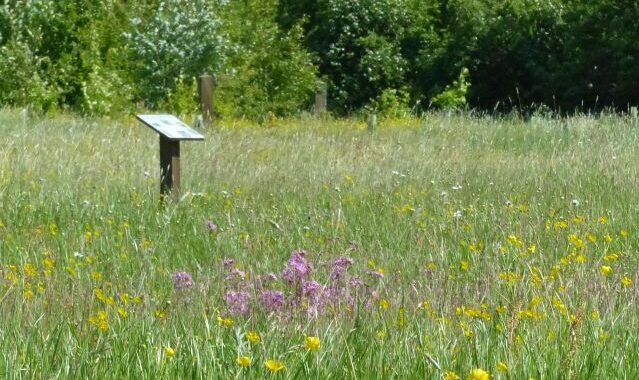
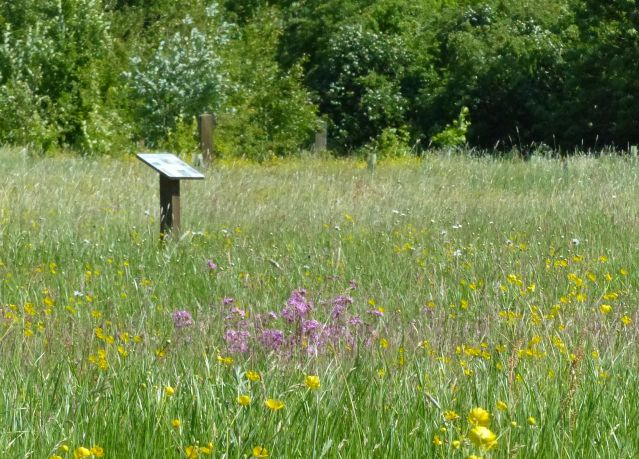
Meadow with Ragged Robin and Habitat Interpretation Board

A Perfect Job

When asked about my occupation and I reply that I work at a natural burial ground, a common response is a pause, followed by, “But what do you actually do?”  In reality, the job we do here is wonderfully rich and varied, and so profoundly worthwhile I can’t think of a more perfect job.There are many meetings with families, in what may be the worst days of their lives, but the opportunity to support people through the necessary steps is a tremendous honour. Equally, meeting with individuals who are facing their own mortality, through age or illness, requires sensitivity and strength, but is deeply rewarding. Arranging, co-ordinating, preparing and supporting families through funerals is also filled with a poignancy and sadness but the opportunity to be there for them is an honour.

Meadow with Ragged Robin and Habitat Interpretation Board

Meadow with Ragged Robin and Habitat Interpretation Board

But those tasks are not all the job entails. There is paperwork, of course, and designing memorial plaques, growing wildflowers from seed, planting bulbs, planting trees, pruning roses, arranging memorial benches, installing plaques, ordering coffins, counting butterflies, creating habitat interpretation boards, weeding the meadows, organising open days, running workshops, tidying graves, giving talks, doing flora surveys and tree surveys, looking for harvest mice, giving time to those visiting graves, managing volunteer days, designing leaflets, working with celebrants, funeral directors, naturalists, and so much more!

As I look to be taking a step back in order to focus on our charity, The Friends of Sun Rising, we’re now looking for someone to take my position. We aren’t expecting to find someone with years of relevant experience, but we are determined to find the perfect person: someone who is really keen to work for an ethical company, who is sensitive to others’ needs, and who is deeply passionate about nature.

… We are delighted to say that this position had now been filled.

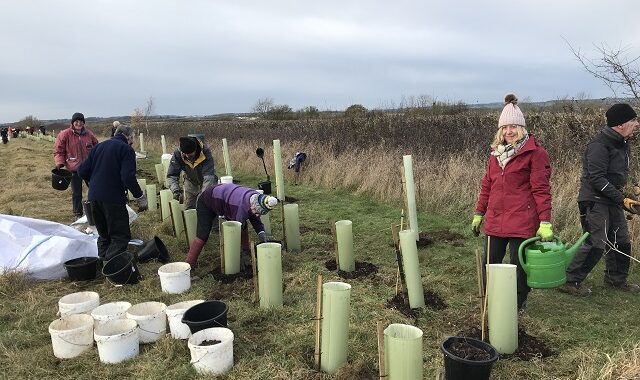
Volunteers Planting the Northern Boundary Wildlife Hedge

Creating a Corridor for Wildlife

For many years, our work at Sun Rising focused on the southern half of the site. The northern half remained grassland, cut for hay. A few years ago, however, we were able to begin the task of transforming this northern half into the developing the nature reserve.

No longer taking a hay cut was the first step, leaving thick tussocky grass for small mammals, birds, moths and invertebrates all year round.  The next step was to address the northern boundary hedge.  This is owned by our neighbour and is cut hard each autumn, which is not optimal for wildlife.  What we wanted to do was create a broad, loose hedge of shrubs and trees that will actively and positively support wildlife throughout the year.

Volunteers Planting the Northern Boundary Wildlife Hedge

Volunteers Planting the Northern Boundary Wildlife Hedge

Last Sunday, with a glorious band of some 35 volunteers, we started the planting of almost 270 trees.  Being heavy clay, we can’t plant with a quick cut-and-heel-in technique as you can on easier soil: each tree needs a proper hole dug, with our special soil mix then used to fill in around the roots, the tree protection put in place, and a good ring of composted bark as a mulch.   It’s not a fast job, but further volunteers headed back on Tuesday.  The finishing touches will be completed over the next few weeks.

The main hedge is a mixture of hawthorn, hazel, bird cherry, wild privet, crab apple, dog rose, guelder rose and dogwood, this being almost 240 little saplings.  Behind that, there are another 20 or so, which will have space to grow into large trees, these being oak, small leaf lime, wild cherry, elm, field maple and wild service.  Between these trees and the boundary hedge, we will allow the blackthorn to encroach, filling in the space, but managing it so that it regularly regenerates and never overwhelms the hedge.

As the trees grow, and the habitat develops, this loose hedge will become an invaluable corridor for wildlife, particularly birds such as yellowhammers, bullfinches, linnets, tree sparrows, greenfinches, as well as the more common robins, blackbirds, great tits and bluetits.

We’d like to express our sincere thanks to all who contributed to the creation of this new habitat: those who have helped fund the cost of the trees and materials, those volunteers who helped plant the trees, and those who funded refreshments for the volunteers as well!  Thank you!

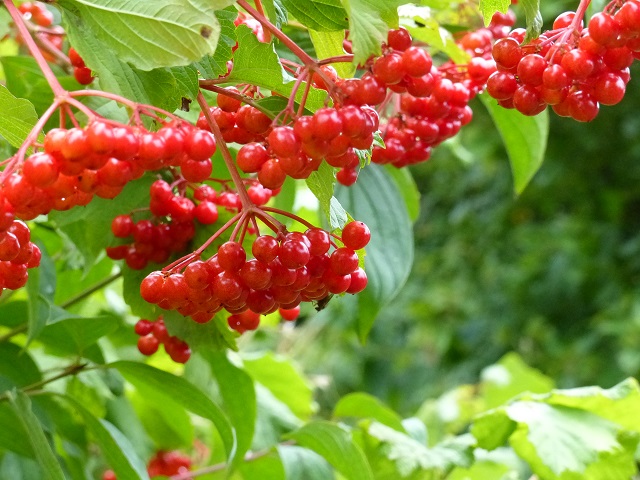
Guelder Rose Berries

Choosing Sustainability

This coming week, 18 – 26 September 2021, has been declared Great Big Green Week, ‘the largest event for climate change and nature ever seen in the UK’.  It’s a website filled with ideas and events, and a wonderful initiative which we hope will inspire a huge number of people.  Understanding how our every decision and every action has a potential impact on the planet, and what that impact might be, is crucial to slowing the crisis of climate change.

Guelder Rose Berries

Guelder Rose Berries at Sun Rising

At Sun Rising, of course, our whole remit is about helping the environment.  We are creating and managing a nature reserve, maintaining different habitats to encourage the greatest possible biodiversity, making a safe haven for wildlife.  With just sixteen acres, it may seem like small fry, but we are aware that what we do affects all who come to lay someone to rest here – and all who subsequently think about their own last wishes.

That’s why our emphasis on burial over cremation is so important.

For some, the choice to cremate is based on religious strictures.  For many, however, it is assumed that cremation is the straight-forward, less expensive and socially expected option.  But cremation is extremely expensive when it comes to the environment.  Crematoria use a huge amount of fuel, generating CO2 which adds to the climate crisis, as well as polluting the atmosphere.  Families then need to do something with the ashes – and to inter these responsibly is an additional cost on top of the cremation itself.  As a result, many scatter them where their highly concentrated fertility is harmful: killing wildflowers, degrading natural ecosystems, polluting waterways.  Cheap online direct cremation services are only encouraging the problem.

Burial is a gentle, natural process.  It doesn’t burn fuel, it doesn’t generate pollution, and it captures CO2 instead of pumping out more.  Where an ethical coffin is used (such as English willow or recycled card), the impact is even less.  At Sun Rising, using our own simple arrangement service, the financial cost can be lower than cremation.  At a natural burial ground, or nature reserve burial ground like Sun Rising, planting of trees or maintenance of wildflower meadows further helps with CO2.  Such places protect land from development, ensuring space for wildlife into the future.

When thinking about your own wishes, please think about our beautiful planet.
For more information, do have a look at our Sustainability Choices Chart.

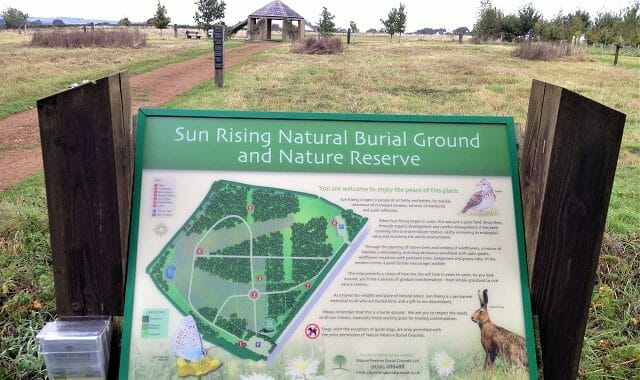
New Interpretation Board

In the process of creating a nature reserve and natural burial ground, over a number of acres and a number of years, it is inevitable that ideas will change. The first design map, imagining what the site would look like, was drawn up in 2005: it was a beautiful possible landscape, with curves and loops, copses and parkland trees.  Yet, immediately we started to work on the land, the land began to teach us.  It didn’t take long before we were simplifying our ideas, learning every step of the way.

Since the first version was put in place by the main car park, in 2006, the interpretation board has been updated and replaced once, in 2012.  However, over the past year or so, when showing visitors around the site, I’ve had to explain how its map was in fact sadly out of date. I was – I promised them – in the process of designing the new one. It is a relief to be able to announce that it is now in place.

New Interpretation Board at Sun Rising, 2019

New Interpretation Board at Sun Rising, 2019

The design, slightly altered, is just as simple, but the map shows more detail.  You can now see just where the areas of wildflower meadow are, and will be, as you can with the woodland, hedgerows and copses. You can also see where we will be leaving a wide grassy ride.  The cairn, Tyr’s stone, the butterfly stones and other features are identified.  Some of the established paths are on there, although others will be added.

You’ll notice that the north-eastern corner is not complete.  In years to come, what is now the top car park will become the main entrance, and we are still in the process of designing exactly how that will be.  When our ideas are clearer, we’ll be showing you the plans and asking for your feedback.  And when those plans start coming into being, of course, it’ll be time for a new interpretation board!

Until then, I look at the photograph above.  The wildflower meadow is mown, but for small pockets for little creatures to hide in.  The trees are a dark dull green, some leaves starting to turn and fall.  The sky is pale.  It’s a dreary autumn day in the heart of England, damp and chilly.  But even on such a day, the map shows hope and promise: of wildflower meadows in full bloom, butterflies, bees, and the skylark in full song.  It won’t be long – winter is before us, but summer will return …

Introducing the Crunch

When we first created the main car park and laid the stone tracks at Sun Rising, the question of what material to use was a key issue.  We decided to go with the most local stone: Hornton ironstone, from the quarries just up the hill.  This would bring to the natural burial ground the rich red-gold of our Cotswold stone, minimise any necessary miles of haulage, and keep business local.  It was a little chunky for a while, but with vehicles driving over it, with frost and sun, the stone gently broke down, creating a perfect surface.  Most of the tracks through the site have also reached – or are on the way to reaching – that state too.

The main car park, however, gets too much use.  Instead of remaining perfect, the ironstone started to break down to the point where, in wet weather, it was getting muddy with puddles.  In icy weather, it could be slippery.  A further coating of small stone was a short-term fix, these breaking down into dust all too quickly.  Last winter, although the land desperately needed rain, the dry weather helped us get through without too many problems.  A solution needed to be found.

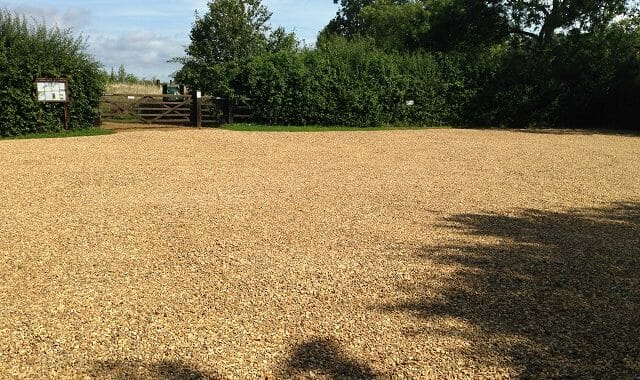
Main Car Park Resurfaced with Gold Gravel

Main Car Park Resurfaced with Gold Gravel

Over the past few days we have resurfaced with a ‘gold’ gravel, again from a local quarry.  Our hope is that this will remedy the situation with regard to those cold and wet weather problems of mud, puddles and ice.  We hope you like the look of it too: it is lighter than the ironstone, but not too bright, and over time the ironstone dust should darken it further.

We are aware, however, that there are a few setbacks to gravel.  Although it is not thick, it can be harder to walk on for those with limited mobility and tricky for wheelchairs: please let us know if you need help.  Heavy vehicles can leave ridges, but we’ll keep an eye on this and rake when and where we need to do so.  Finally, and what we were hoping to avoid, there is a crunch.  Cars and feet are no longer quiet as they were on ironstone.

However, that crunch does create a marked difference: when you walk through the gate into the burial ground, you walk from gravel to ironstone.  As such, you go from noise to a quiet underfoot. It’s a quiet that somehow amplifies the peace of the nature reserve.  In that respect, it’s rather wonderful.

If you have any queries, or concerns, do let us know.

The Coming and Going of Bees

Many visitors will have noticed that our honeybee hives are no longer at Sun Rising.  It was a difficult decision but a mixture of weather and the abundance of oilseed rape crops locally was making the normally happy bees rather tetchy.  Then a handful of people were stung, so we have had them taken offsite.  There is always a balancing with bee hives in places where there is public access, and the balance just slightly tipped.

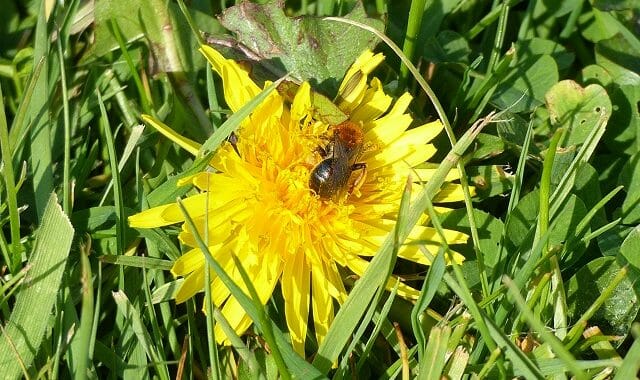
Although we’re sorry to have no honeybees, we do have a huge variety of wild bees, all busy getting on with the job of pollenating the flowers and topping up on energy for their own benefits.  There are bumblebees, mining bees, carder bees and many more.  This one is an orange-tailed early mining bee, Andrena Haemorrhoa, covered in dandelion pollen.  They are only seen through spring and early summer, being the first of the mining bees to emerge from its underground nest. 

Andrena haemorrhoa

Orange-tailed Mining Bee on a Dandelion

We’re talking with our beekeeper to look at options with the honeybees.  It’ll be lovely to have them back.  When the oilseed rape has gone, and they’re feeding on the wildflowers, it is possible we’ll have a few hives return.  We’ll let you know.  

Our New Website

On 21 February we were proud to publish our new Sun Rising website.  The old site had been designed back in 2006, and although we had regular positive comments about it, the reality was that it was starting to look and feel out of date.  Instead of trying to get a new feel ourselves, we engaged an excellent young web designer called Niki Peach (well, younger than we are!), who listened to our brief and came up with a design that beautifully presents all we do here at Sun Rising.  She made it wonderfully easy for us to share so many more of out photos too.  Thank you, Niki!

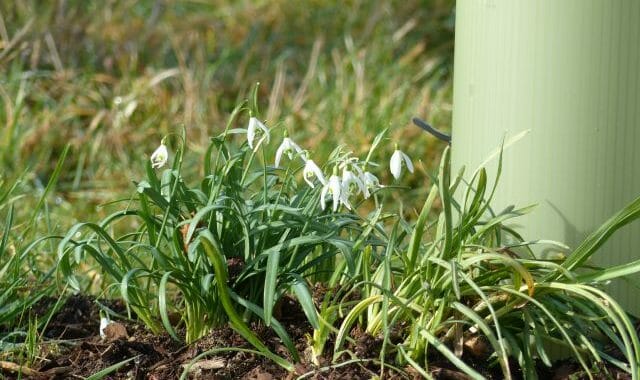
Snowdrops in February Sunshine at Sun Rising Natural Burial Ground and Nature Reserve

Snowdrops in February Sunshine

Do have a good look around the site, explore the gallery, and other pages.  If there are hiccoughs, please forgive us – there are a few snitches and glitches that are still being smoothed out.

New Year Tidy

Laying a wreath on the grave of a loved one at Christmas is a tradition that many families want to share.  It’s a heart-felt gift, a sharing of the festive season, with that special person who won’t physically be present.  It’s one of the little things can help with the experience of loss, easing the pain of this difficult time of year. At Sun Rising we have done what we can to encourage families to lay wreaths that are in keeping with the nature reserve: no glitter and oasis, painted leaves, wires and plastics!  This year florists Jacqui (Hope and Glory Flowers) and Jayne (Vale Garden Flowers) offered beautiful, simple, natural, ethical and wholly biodegradable wreaths for sale, with a proportion of the takings going to The Friends of Sun Rising.

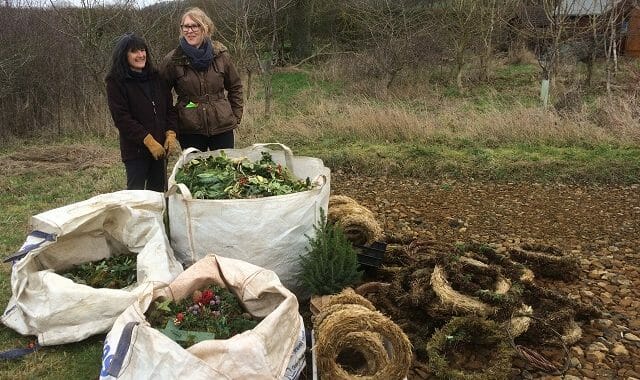
Wreaths Dismantled and Sorted, 6 January 2019

Wreaths Dismantled and Sorted, 6 January 2019

When 6 January arrives each year, it is time to clear them all away.  In the past, this has been a long, cold, disheartening job, with far too much rubbish that we’ve had to send to landfill.  This year, with some welcome helpers (see Jacqui with me in the picture above), we cleared and dismantled over 80 wreaths.  You can see all those frames on the right, made of straw, wood and moss (no wires) which can be re-used.  The bag at the back is all the evergreen and woody material that will go into a brushpile: a habitat onsite that will be used by small mammals and invertebrates.  Some of it will then be burned next autumn.  On the left, the bag is compost: flowers and soft greenery that can go on our compost heap.  The bag at the front is rubbish that has to go to landfill: wreaths constructed of wire, oasis, painted cones, plastic berries and so on.  Let’s see if next year we can reduce it even further! Next job: looking out for the first snowdrops.  There are primroses in flower, peaking out through the tatty winter grass.  It won’t be long.

Wheels for Wobblies

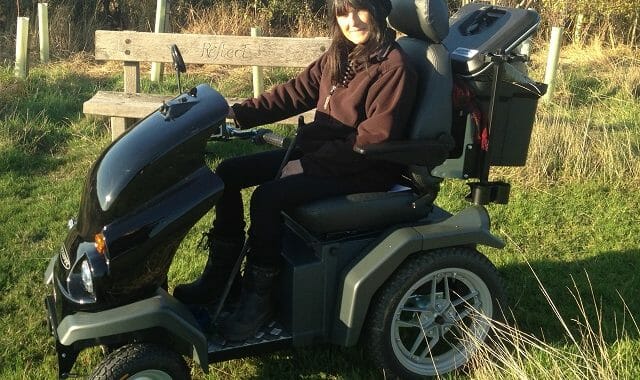
Last week we took delivery of our first Tramper – an off-road mobility scooter.  Not only will it allow me to get around the site where otherwise I needed a car, but it can be available for others whose mobility is limited.

Our new Tramper off-road mobility scooter at the Reflect bench

Our new Tramper off-road mobility scooter at the Reflect bench

Whether visiting a loved one laid to rest here, or coming for a funeral, with enough notice and preparation, we can have the Tramper onsite for you.  We’ll give a short lesson in how to use it, and then leave you to explore.  If the person needing it can’t manage to operate it, it is also possible for someone to walk slowly alongside and operate it for them.

It doesn’t take away the bumps, and it isn’t foolproof, but if driven gently and slowly it can take all the way to the far side of the nature reserve those who haven’t managed to get there before.  For those who are a little wobbly on their legs, as I am, this extra help is a real joy.  Pausing for a quiet moment, with a very different view before us, a very different perspective on the landscape, can be so enormously valuable.