A day at Sun Rising rarely passes without the sight of a kestrel hunting over the grassland, hovering motionless as it searches for small mammals scurrying between the grass tufts. One of Britain’s most widespread and numerous birds of prey, the kestrel has an estimated population of around 30,000 breeding pairs and can be found almost everywhere (source: BTO). However, alarmingly, numbers have declined by over a third this century.
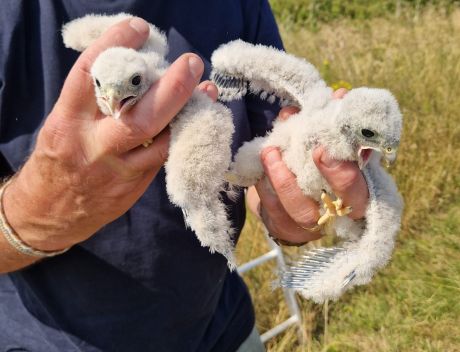
Fluffy Kestrel chicks being ringed by the licenced handler
We were delighted, therefore, to have a successful nest this June, with four chicks fledging from a donated nestbox attached to a telegraph pole erected a couple of years ago with help from Upton Farm and one of our volunteers. The fluffy babies, looking like tiny dinosaurs, were ringed under licence at about two weeks old by Roger and Patrick who monitor our owl box (in which they found a Stock Dove nest – can’t win them all).
This is the first kestrel nest at Sun Rising since 2018, at which point the nest box was on the same telegraph pole as our Tawny Owl box. We’d be told that these two species tolerate each other, and having the nestboxes so close wouldn’t be a problem. That we had a successful nest the year after we moved the box indicates that we may have been wrongly advised!
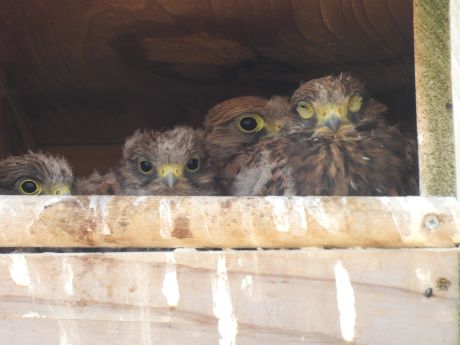
The four Kestrel chicks growing well in the nestbox
It was fascinating to watch the young birds developing over their first weeks and lovely to watch as they grew large enough to peek out, then step out, flapping onto the nestbox roof, the parents doing a magnificent job raising them to independence. Watching them take their first hesitant flights was a delight. We sadly did find one dead at the roundhouse last month, identified by its leg ring. It was in perfect condition, a truly beautiful bird, and we assume the cause may have been starvation, not uncommon for kestrels and a reminder of the fragile boundary wild creatures navigate between death and survival. While a kestrel in captivity can live for over 20 years, the average lifespan of a kestrel in the wild is around 4 (source: Hawk and Owl Trust).
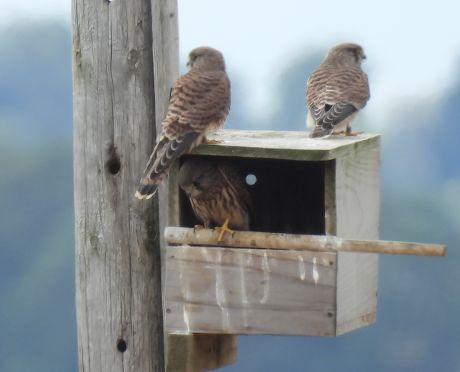
Perched on the nestbox, considering flight
Once a couple have raised a successful brood in a particular nestbox, it is not uncommon for them to breed again the following year, using the same box. We do hope so. They are such elegant birds, flying with such skill and grace: that’s why we have often given them the name of Yadriel, with its connotations of divine or magical strength and nobility.