For many years, there were large birdfeeders near the entrance of the burial ground which we filled twice a week with a rich seed mix. These attracted a wide range of birds. The more common great tits, bluetits, chaffinches, robins were joined by less common bullfinches, greenfinches and marsh tits. There was the occasional woodpecker having a go and, in the muddy grass and leaves under the feeders, there were pheasants, yellowhammers, wrens and blackbirds.
Of the remarkable visitors were the tree sparrows, and with a healthy population of breeding tree sparrows at Sun Rising, we were keen to support this locally endangered bird. However, house sparrows began to flock in. These slightly larger birds quickly outcompeted the smaller tree sparrow, and a few years ago, in an attempt to dissuade the former, we removed the feeders. Sadly, nonetheless, we lost our tree sparrows completely.

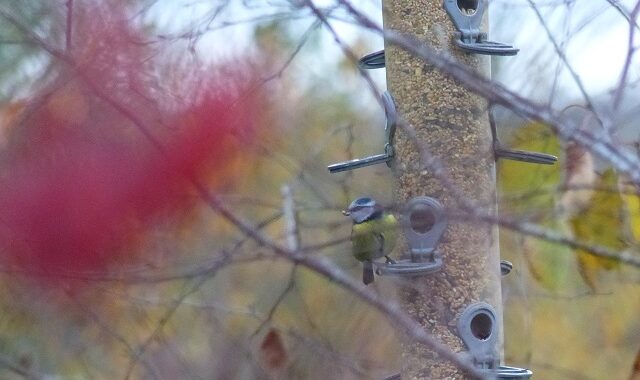
Bluetit at the Birdfeeder
All attempts to encourage them back have so far failed, and as winter approaches, we have taken the decision to return to filling the large feeders by the south car park, as well as putting back the field feeders at the other side of the grounds, in order to support the wider bird populations. We’ll see whether the house sparrows return to dominate.
It always takes birds a little while to find a new feeder, and the first to come are the bravest. I have found this to be, without exception, the bluetits. Extremely fast flyers, they can afford to be courageous, but their little size also means that they need to be brave. Birds don’t lay down many layers of fat, as mammals do, simply because they need to remain light and agile in order to fly. In fact, small birds, like bluetits, may only ever have enough energy stored to last a single night. Which means most of the day they are looking for food, and they can often find it before the larger birds.
During the summer and autumn, there should be plenty of food at Sun Rising and in the surrounding fields. But with frosts beginning, and the temperatures dropping, it’s wonderful to be able to support the local bird populations again.