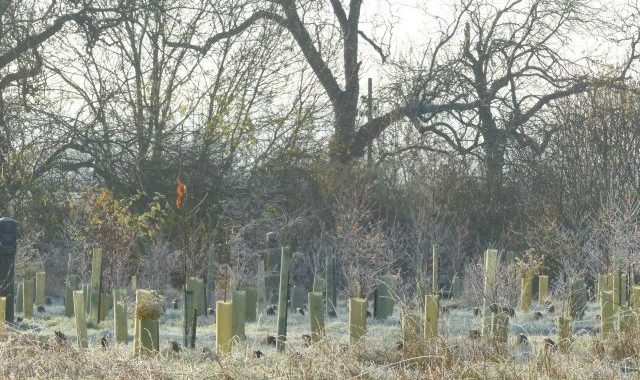
During December this year we planted over 100 more memorial trees here at Sun Rising. Each year, the new additions are wonderful to see, extending woodland burial areas and helping us imagine the woodland in years to come. All but 14 were planted with families and friends attending, some days beautifully calm and bright, but others were planted in the midst of Storm Darragh, with winds of nearly 60 mph. Two weeks before we were under 4 inches of snow, so it’s been an interesting end to the year!
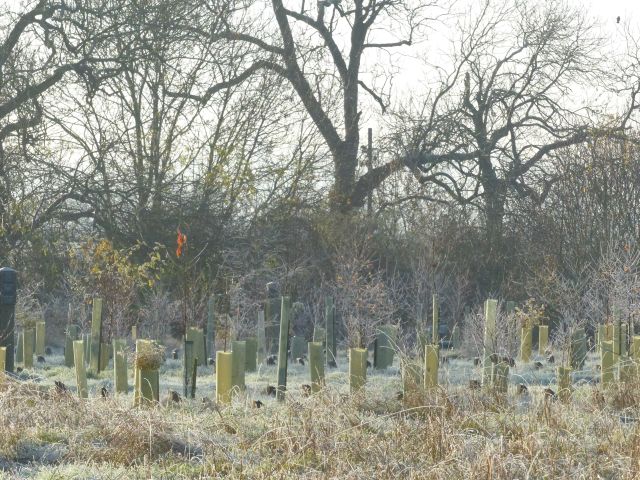
Frosty Young Winter Trees at Sun Rising ( – I’m amazed to find I have no photos of trees in the wind. No doubt I simply wasn’t out with my camera!)
Most reports say that trees can be uprooted in winds over 55 mph, but thankfully, apart from a few broken tree stakes, and some very wind-blown visitors, the storm left no damage at Sun Rising. Some families were worried nonetheless – it’s hard to see a precious tree bending in high winds. Yet, having evolved over millions of years to stand still (not run for shelter like us animals), trees are generally extremely resilient.
Our tree guards mainly protect the young trees from being nibbled, most commonly by deer. They also provide a warmer damper microclimate for their first years. To some extent, they also keep the youngest saplings out of the wind. However, trees exposed to wind from an early age grow to cope with it. In exposed areas, without shelter from buildings or other trees, they grow thicker in the trunk instead of putting on height. They may add a clever twist to the grain of the wood, in order to give some additional flexibility. Furthermore, trees grow structural roots deeper on one side and grow roots broader (branching out) on the other, allowing the tree to be better anchored according to the prevailing wind.
All of which suggests that they are a great deal better adapted than we are, as we struggle to wrap up, anxiously looking about for damage or danger. I particularly like the twist in the grain: that’s something that we humans really should work on!