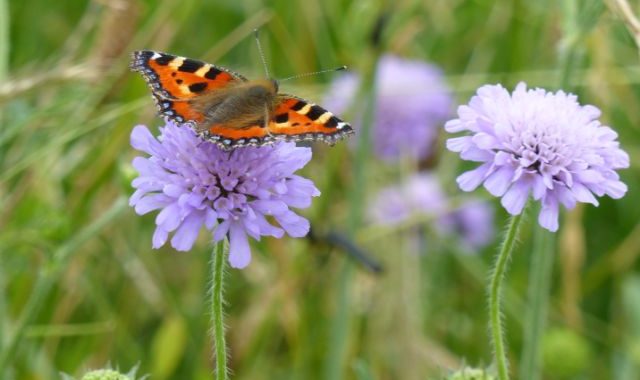
One of our most widespread and recognisable butterflies is the Small Tortoiseshell, Aglais urticae. It doesn’t require a specialist habitat that is difficult to find – anywhere where there are some nettles for its caterpillars to eat will do. Because it overwinters as an adult, it can be seen all over the country at any time of year. It can sometimes be seen flying on a warm calm January day. Yet this year its numbers are drastically down everywhere. The photograph below was taken last year. At Sun Rising, so far this year, we have seen just two.
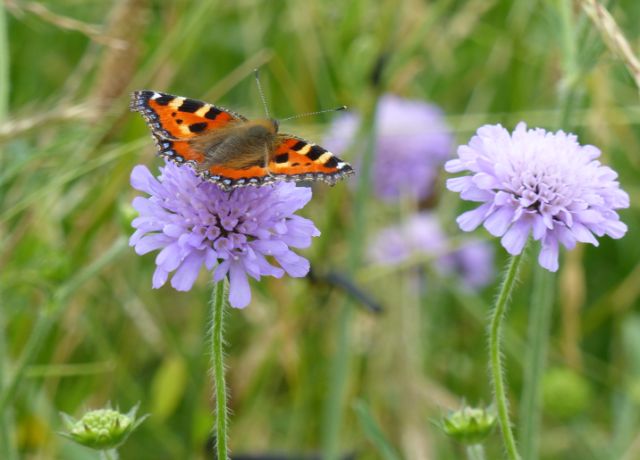
Small Tortoiseshell on Field Scabious
The cause of this decline isn’t entirely understood, but one theory points to a parasitic fly that has established in the UK in our now warming climate. The tiny fly eggs are ingested by the Small Tortoiseshell larvae and complete their lifecycle inside its body, eventually killing it before the adult fly bursts out. Given time, nature may find a way to balance this phenomenon, in the meantime we continue to be concerned about the future of this beautiful butterfly. You can see more information on the UK Butterflies website: https://www.ukbutterflies.co.uk/species.php?species=urticae
There is slightly better news for the Large Tortoiseshell, Nymphalis polychloros, which had been declared extinct in the UK following Dutch Elm Disease, the caterpillar foodplant being elm leaves. There have continued to be sporadic records of Large Tortoiseshells in England, but these were attributed to unofficial breeding releases or vagrants finding their way across The Channel. This year Butterfly Conservation have included it on their list of breeding butterflies, albeit restricted mainly to the south of the country. Perhaps in the next decade it will spread further north and find its way to Sun Rising, where we have a few elms that are so far proving to be resistant to the disease.
We do have a true migrant at the nature reserve, however: the beautiful Clouded Yellow, Colias croceus, has been flying over the meadows for the past month. You should be able to see it for another month at least. Look for a rich yellow, medium-sized insect, which gives the impression of black wingtips as it busily flutters by, although you would be very lucky to see it resting with upper wings open. Our other migrant, the Painted Lady, Vanessa carduii, has also had a good year but is now dwindling as the nectar-rich thistles set seed.
We continue to monitor butterfly numbers with weekly counts until the end of September. It will be interesting to see what the results will be following this long, hot, dry spell. Certainly, we can be sure that populations will continue to change, as nature strives to adapt.
For more information and photographs of our butterflies at Sun Rising, have a look at our butterflies page.