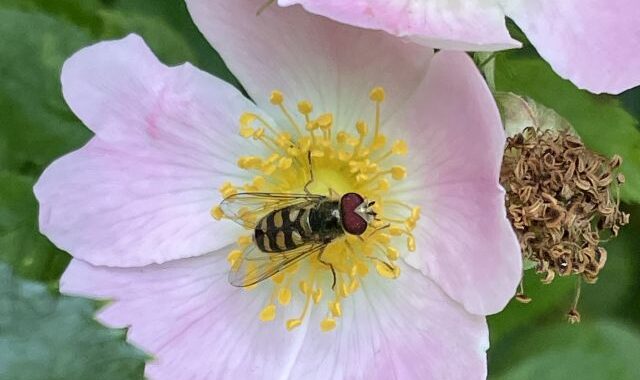
Migrant Hoverfly on Dog Rose

A Perfect Enthusiasm

The word enthusiasm is derived from ancient Greek, and is all about being inspired by (a) god.  Sitting on a bench at Sun Rising on a gentle English summer’s day, looking out over the wildflower meadow, with its dancing bees and butterflies, the skylarks singing, the swallows swooping, I see before me what can only be described as sacred.  Whatever our understanding of god (or God), this beauty is a part of it.

But when it comes to the tiny details that make up that beauty, it is the hoverflies that most fill me with awe.  If there were indeed a god who designed nature, I suspect hoverflies would have been one of their favourite tasks.

As part of Insect Week, today is our day to focus on these little buzzing, zooming, flitting, dancing, hovering creatures.  They are part of the family of Diptera, the True Flies, but are often mistaken for small wasps or bees.  In fact, they are not only fascinating but completely harmless.  As pollinators, they are also a valuable part of any ecosystem.  While we don’t often see their larva, it is equally useful – feeding on decaying matter or aphids.

Migrant Hoverfly on Dog Rose

Migrant Hoverfly on Dog Rose

I’m clearly a long way down the line of naturalists who have been a little bit obsessed with hoverflies.  Steven Falk has a marvellous Flickr account with photographs that help identification.  Mostly the scientific names are used for the various species, but there are some marvellous common names too: we have the Marmalade, the Footballer, the White-footed, the Pied and many more.  They can be black and yellow, black and white, or soft toffee and russet colours, in all kinds of stripes.

There are over 270 species in Britain, and I’m only just beginning to learn how to identify each one.  But sitting quietly within nature, a hoverfly will often come up close, as if filled with curiosity, investigating what this human observer is.  Some are braver or more curious than others, but each seems to me to be an individual, exploring what I am.  Aware that, from their perspective, I must be very large and very slow, their interest only fills me with yet more wonder.
White-tailed Bumblebee on Common Knapweed

Furry Sky Tigers

The tag line for Insect Week is ‘The little things that run the world’ – which is a deliciously simple descriptive phrase that appears to encapsulate the unimaginably vast.  The importance of insects can’t be overstated.  They are crucial for our survival.  Yet because they seem to be everywhere, we take them for granted.  We even revile many of them as creepy or dirty.

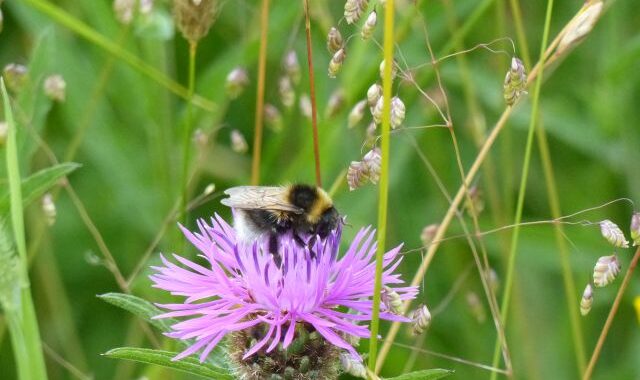
One of the most attractive of the insects is, of course, the bumblebee.  They are the beautiful furry tiger of the insect world!  As such, we started our Insect Week by looking at which species of bumblebee we have at Sun Rising.  We aren’t experts, so we may well be missing or misidentifying species, but we think we found four today: Common Carder Bee, the White-tailed Bumblebee, the Red-tailed Bumblebee, the Buff-tailed Bumblebee.  We may have seen a Tree Bumblebee too, which would make five.  Adding Wasps and Bees in more generally, we also saw a Common Wasp and a good handful of Honeybees.

White-tailed Bumblebee on Common Knapweed

White-tailed Bumblebee on Common Knapweed

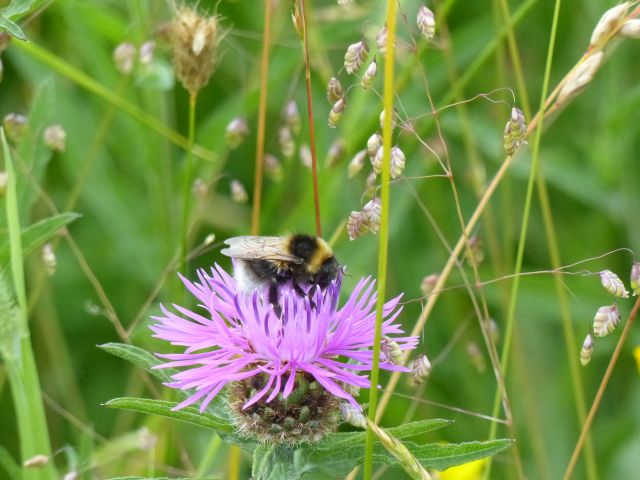
There are around 270 species of bee in the UK, and 24 species of bumblebee.  This photograph here shows the White-tailed feeding on a Common Knapweed.  You can see the delicate seedheads of Quaking Grass all around.  There were a good number of these bees in the wildflower meadows and around the Roundhouse, being fairly common around the UK and Europe, feeding from spring through until autumn.

To get involved in Insect Week, check the Royal Entomological Society’s website here: https://www.insectweek.org/

Muddled Dragonflies (and Insect Week)

Dragonflies are often considered to be water creatures, and there is validity in this idea: they start out as aquatic. The females lay their eggs on pond vegetation; or, more accurately, some insert the eggs into the leaves and stems of plants on and around bodies of water, while others lay them in a jelly on the water surface.

Emerging as tiny tadpoles, they grow into larva (known as nymphs) which may stay in the water for some months, or even years, before transforming into the flying dragonflies and damselflies we know.

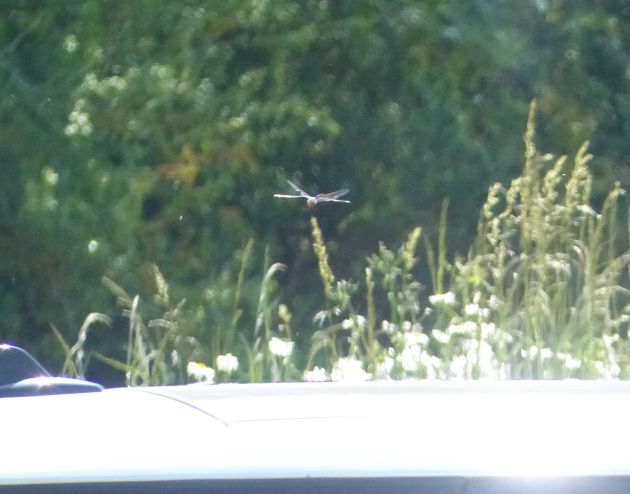
One of the most beautiful dragonflies of this area is the Emperor, which lays its eggs on the water surface.  Searching for open water, they are attracted by the sparkling of sunshine on the water’s surface, and this is when we are most likely to see them during the summer months, dancing over ponds and lakes, looking for a partner with whom they can mate, where the eggs can then be laid.

Emperor Dragonfly over Shining Car Roof

Emperor Dragonfly over Shining Car Roof

The trouble is, sunshine on a shiny car roof can, to a dragonfly, look very like water.  So it is that it’s often possible to find dragonflies dancing over car parks on hot and sunny days!  Except, in a car park, there is nowhere to lay eggs.  It’s just another way that humankind are confusing the non-human world …

Next week, 19 – 23 June, is national Insect Week.  Do explore the website which is enormously interesting: Insect Week.  We will be running daily posts on Instagram, exploring different aspects of the insect world each day.  Do find us and follow us here: @sunrisingnaturalburial.

Bluetit at the Birdfeeder, Wild Cherry Behind

Making a Difference

Yesterday was a beautiful day – a sharp north-easterly wind softened with sunshine, the bright green of newly leafing trees, the white flowers of cherries, the yellow carpet of cowslips, golden studs of dandelions, the snow-white of blackthorn blossom along the uncut hedgerows, all adding to the joy that is an English spring.

And with it, every member of our small team here at Sun Rising seemed to come up to me beaming with exclamations about having seen their ‘first peacock butterfly’, ‘first orange-tip’ or ‘three brimstones’. With International Earth Day tomorrow, 22 April, my aim was to present here the first Sun Rising butterfly photograph of the year, but the wind was too high, and today the rain came in, just to remind us that this beautiful greenery needs regular watering.

My favourite picture of yesterday is this one: a small bundle of feathers that is a bluetit, flying through the wind to the birdfeeder, with such determination and courage, the wild cherry blossom blown sideways, the blue skies above, only confirming the context as spring.

Bluetit at the Birdfeeder, Wild Cherry Behind

Bluetit at the Birdfeeder, Wild Cherry Behind

The purpose of Earth Day is to raise awareness of the natural world and the crisis we are now in, and most positively to remind us that we can all contribute to the solution. At Sun Rising we are doing our best to make a difference. We have many new plans to improve specific habitats for birds and butterflies this year, taking another step with the creation of more wildflower meadow.  But it’s easy to forget that the simple things are important too: putting out seed for the birds like this bluetit, now feeding chicks in a nest somewhere along the hedge.  We can all do that, and in doing so we can literally save lives, little bluetit lives.  What a wonderful thought on a rainy day.

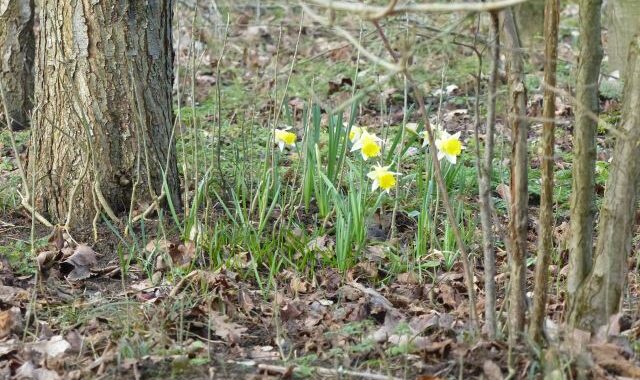
Lenten Lilies, our native daffodil

Lenten Lilies

In order to keep the integrity of the nature reserve, it is important that every plant at Sun Rising is native, including every bulb.  That’s why we don’t allow any garden daffodils, not the sweet little Tete-a-tete and Jonquilla, nor the big blousy golden cultivars, nor the pretty new orange ones.  All our daffs are the old wild one, the one that is truly native to these lands, Narcissus pseudonarcissus.

Lenten Lilies, our native daffodil

Lenten Lilies, our native daffodil

Because it flowers at this time of year, the old name is Lenten lily.  In fact, this name has been recorded as far back as the sixteenth century in Elizabethan England.  Other versions found around the country are Lenticups, the Lent rose, or simply Lents.

Some families do plant garden daffodils at Sun Rising, and one of our tasks at this time of year is to dig them up!  It’s a ‘tough love’ job, essential but always done with sadness.  Knowing which is which isn’t usually difficult: cultivated daffodils commonly have much greener leaves, the wild ones being soft grey-green and slender.  Now and then, we have to wait until the daffodil comes into flower, then the garden varieties show their colours. The wild ones have a lemony trumpet with six creamy petals, and as such manage to express a beauty, grace and sunshine while never being showy.  Perfect.

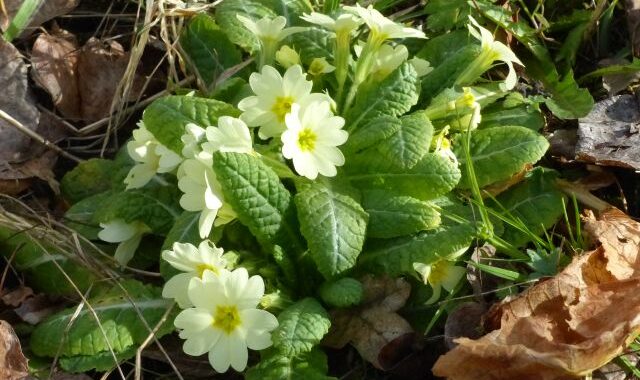
Primrose in Leaf Litter

Light in the Leaf Litter

Here at Sun Rising, each month we carry out a flora survey. We take four or five different areas and habitats, these changing in succession year on year, so we can maintain a record of how habitats develop over time. Most of the months of the year, this is simply about noting what is flowering or fruiting, while in the high summer months we record every plant, including the trees and shrubs. Today was our February survey.

All around the natural burial ground, snowdrops are now coming into flower.  Some are in groups that were planted some time ago and are gently multiplying, which is wonderful.  In other areas, especially wet and clayey areas, they tend not to last long, but replanting with new bulbs is worth the joy of their little flowers.

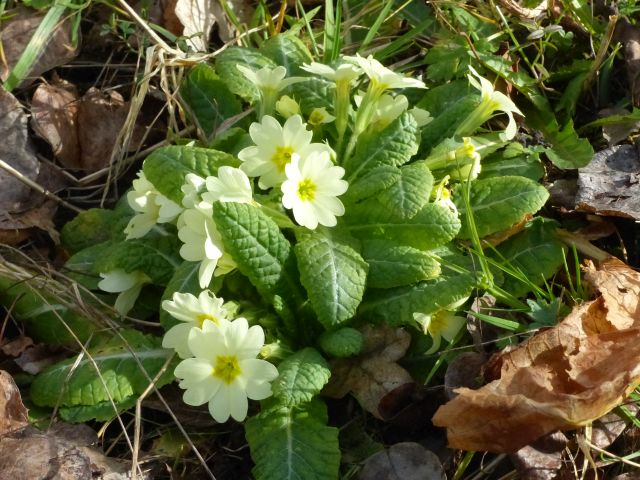
The other plant that is giving such delight at the moment is the wild primrose (Primula vulgaris), and I think they look never better than a the tatty old leaves of the woodland floor.  Here their other name of ‘fairy cup’ seems even more apt.

Primrose in Leaf Litter

Primrose in Leaf Litter

These pale yellow flowers can be seen at any time from December to April, at which point the surrounding vegetation usually hides the last of their blooms.  Pink primroses are usually cultivars and hybrids with garden primroses, not fully native, but some believe the pink may be a genetic variant.  Most non-native primroses are obviously not wild, coming in a variety of brighter colours from white to red: when a family plants one of these, we do remove it.  However, frequently the hares and rabbits will eat them first!  We think these garden cultivars must be much tastier, the wild ones having evolved a natural bitterness.

As some of the first flowers, primroses are important for the first insects that are emerging.  The name derives from the Latin, prima rosa, the first rose.  I’ve seen honey bees on ours, and a rather slow and chilly bumblebee. If butterflies that hibernate through the winter, such as small tortoiseshells, awake on unseasonably warm days in February or March, these early flowers are an important source of food.  My sense is that they feed us too, nourishing the soul when we’ve had enough of the cold winter greys, shining with their soft yellow light.

New Interpretation Board

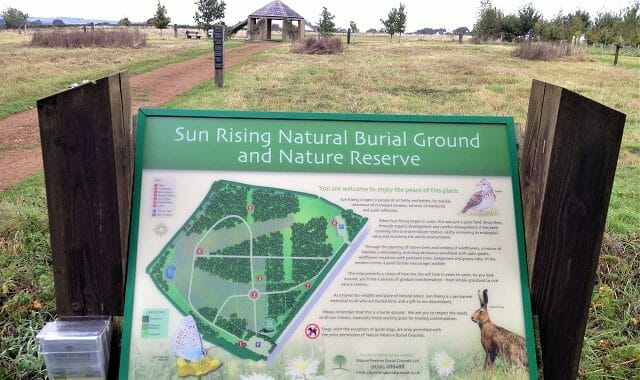
In the process of creating a nature reserve and natural burial ground, over a number of acres and a number of years, it is inevitable that ideas will change. The first design map, imagining what the site would look like, was drawn up in 2005: it was a beautiful possible landscape, with curves and loops, copses and parkland trees.  Yet, immediately we started to work on the land, the land began to teach us.  It didn’t take long before we were simplifying our ideas, learning every step of the way.

Since the first version was put in place by the main car park, in 2006, the interpretation board has been updated and replaced once, in 2012.  However, over the past year or so, when showing visitors around the site, I’ve had to explain how its map was in fact sadly out of date. I was – I promised them – in the process of designing the new one. It is a relief to be able to announce that it is now in place.

New Interpretation Board at Sun Rising, 2019

New Interpretation Board at Sun Rising, 2019

The design, slightly altered, is just as simple, but the map shows more detail.  You can now see just where the areas of wildflower meadow are, and will be, as you can with the woodland, hedgerows and copses. You can also see where we will be leaving a wide grassy ride.  The cairn, Tyr’s stone, the butterfly stones and other features are identified.  Some of the established paths are on there, although others will be added.

You’ll notice that the north-eastern corner is not complete.  In years to come, what is now the top car park will become the main entrance, and we are still in the process of designing exactly how that will be.  When our ideas are clearer, we’ll be showing you the plans and asking for your feedback.  And when those plans start coming into being, of course, it’ll be time for a new interpretation board!

Until then, I look at the photograph above.  The wildflower meadow is mown, but for small pockets for little creatures to hide in.  The trees are a dark dull green, some leaves starting to turn and fall.  The sky is pale.  It’s a dreary autumn day in the heart of England, damp and chilly.  But even on such a day, the map shows hope and promise: of wildflower meadows in full bloom, butterflies, bees, and the skylark in full song.  It won’t be long – winter is before us, but summer will return …