Many human-made landscape features can have negative or at least non-beneficial effects on nature, but one which has many positives is a regularly maintained and well laid hedge. Since the middle of the last century, 118,000 miles of UK hedges have disappeared through neglect, damage and removal. Around 500,000 miles remain, some in better condition than others (source: The Woodland Trust).
A healthy hedge should contain a variety of native tree and shrubs, with low, thick, bushy growth, and mature trees at intervals. It will store carbon, breathe out oxygen, provide some protection from flooding, shelter livestock from winter winds and summer sun, be a corridor for wildlife to move between habitats, be a source of food for foraging animals and humans, have places for birds, insects and mammals to live and breed, as well as having rich cultural and historic importance.
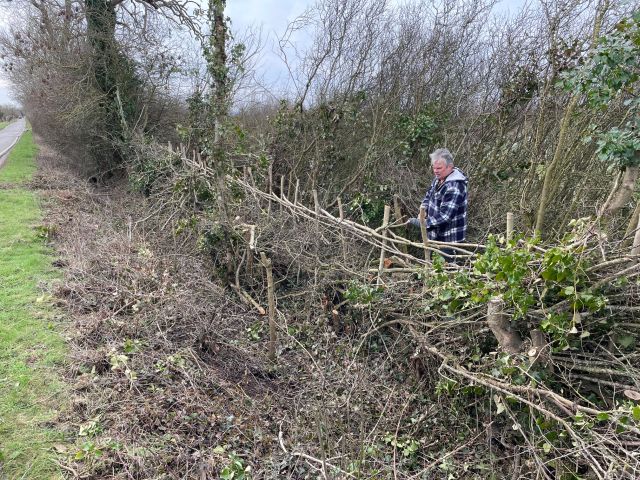
Laying the Eastern Boundary Hedge
Hedgerows came about as a way of dividing up parcels of land and keeping livestock where it should be. Modern alternatives – a post and wire fence, say – will do the exactly the same job, seemingly at a fraction of the cost and without having to wait for it to grow and be looked after. Except a post and wire fence provides none of the benefits listed above. After 15-20 years, the posts will begin to rot and, because of the wood preservatives they contain, they can’t be recycled; the steel wire comes with a high carbon footprint due to its manufacture, transport and recycling. However, a hazel tree, for example, might live for 80 years if left to grow naturally, but if cut in a certain way it can live, in theory, forever. One estimate suggests 40% of UK hedges are ancient – age unknown – and are of fantastic value to wildlife.
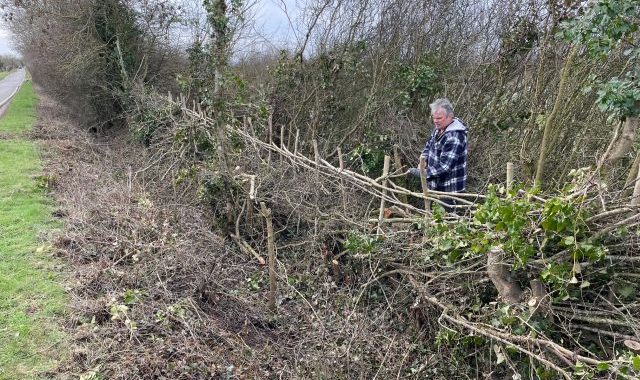
The hedge along the eastern boundary and the lane at Sun Rising is just such an ‘ancient’ hedge. No doubt the oldest residents of the local villages remember when it was thick with elm, creating a canopy over the road. You can see at its base that at least once in its very long history it was laid. However, as the hedge bottom has gradually grown thinner over time, we are gradually regenerating it, improving it as habitat.
This month, our volunteer group helped us lay 40 metres of the hedge. The first step was to reduce the height of the mid-sized trees, removing a lot of side branches, to see the structure clearly. The key then is to cut the stems so they are still attached by a thin strip of wood, then lean the tree on its side. These are then woven through hazel stakes, and further hazel bindings along the top hold it together. It looks rather brutal but the trees soon push up new vertical growth, and in a couple of years it will be bushy and looking great.
We were joined and advised by Myles Thornton from The Campaign for the Protection of Rural England (CPRE) Warwickshire Branch. The branch aims to lay 500m of hedges in the county this winter together with many more metres of new hedge planting CPRE Hedgerow Targets. Thank you, CPRE, for suppling hazel stakes which along with our own hazel binding rods will support the hedge in its new growth stage.
In order to minimise the impact from within the burial ground, we have kept a thick screen of blackthorn, hawthorn and rose on the inside, as you can see from the photograph above, taken in the last stages of the work this week. Regular visitors will know that, beyond this screen, there is a belt of young trees which will further extend the hedgerow and its habitat.
Once this stretch has settled, we’ll be looking at doing the same with another section, until the hedge from our south entrance to the north entrance is properly laid once more, helping to keep it healthy for decades, perhaps hundreds of years, to come.