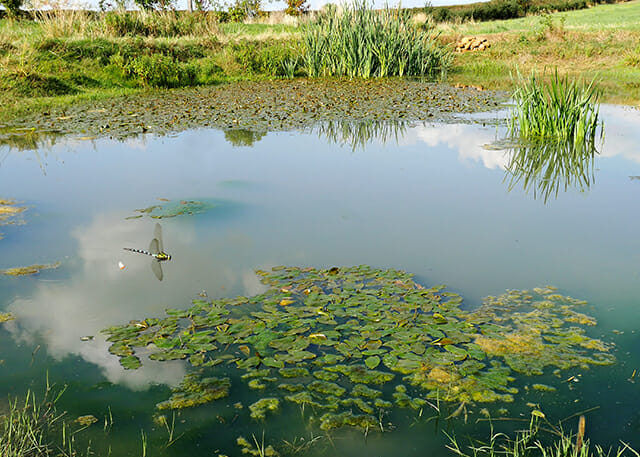
This is a beautiful photograph I wanted to share, taken by Steve Sykes a month or so ago, of the pond at Sun Rising. I love the clouds reflected in the water, but the emperor dragonfly is just beautiful. The detail picked up by the camera is amazing. Thanks for sharing the picture, Steve!
Category Archives: Nature Notes
Beautiful Moths
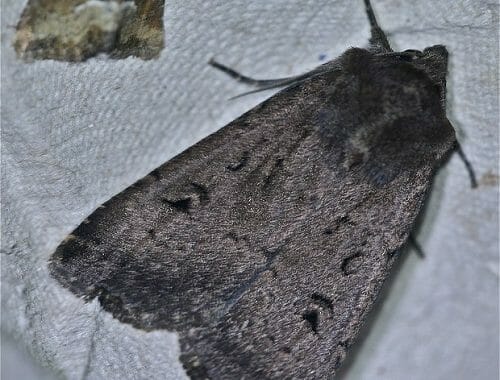
Another moth survey this week was carried out by moth man Alan Prior, whom we joined in the early hours of the morning as he emptied the traps and counted the little creatures who had made their way to the light traps. I wanted to show you a photo of this beautiful fellow : a peppered moth (Biston betularia).
Look at the little stripy legs and the feathered antennae: what an amazing creature. Some readers may remember it from biology class at school, as peppered moths are a species that showed the process of evolution. Individuals became increasingly dark during the years of industrialisation and its pollution, until the wholly dark melanistic form (f. carbonaria) became dominant in areas of the north of England. As our manufacturing industry declines, so the darker form is declining too.
Thank you, Alan, for the survey and the extraordinary photograph.
The Meadow
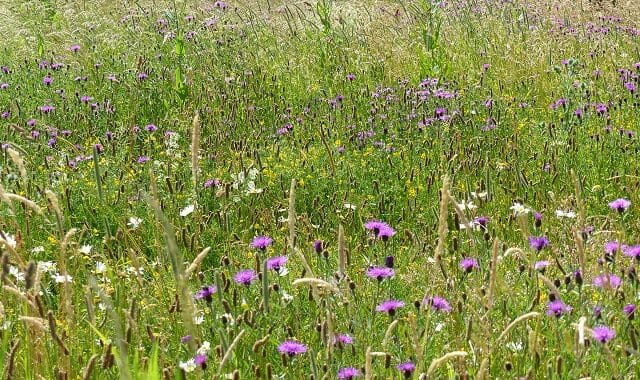
The meadow is humming with life at the moment – hoverflies and bees, and countless other creatures that I can’t identify, not to mention the mice and voles, butterflies and moths. It is impossible to take a photograph that fills the soul with all the joy that the meadow does when we stand before it, breathing it in …
As we begin to mow the areas that have more grass than wildflowers, tidying up the burial areas, I realise that I am beginning to consider how the next month will flow, when the meadow will go to seed, and when we will cut it. Like many, I am not nearly ready for that moment, still needing to inhale the beauty of it all, still bathing in the sunshine and colours of summer.
Double Darts and Other Wonders
While we have regular monthly moth surveys, on 27 June we held our first moth survey night open to all, led by Warwickshire county moth recorder David Brown. With a good handful of families with loved ones laid to rest at Sun Rising, and another handful of regular mothers (that’s moth-ers), on the most perfectly warm and still summer night, the prospects looked good. In fact, the results were outstanding, with over 70 species of large moth recorded, and many micromoths as well.
Perhaps the most exciting was the sighting of a double dart moth (Graphiphora augur), a moth that is struggling to maintain its presence in South Warwickshire. With a sense of success, having found one double dart in a trap by the pond, there were half a dozen more at the trap in the NE corner of the site. This picture is a little fuzzy, but it was taken on the night – many thanks to Scott, the mother and photographer.
At one of our regular moth survey nights ten days later, over 125 species were counted by Alan Prior and his team – many of which were not found at that previous event, and including two double darts. This, I believe, brings our total species count of moths seen at Sun Rising to the fine total of 201, some of which haven’t been recorded in the area for many decades. It’s a good start for a fledgling nature reserve and less than a year of serious moth records. Thank you to all our wonderful surveyors!
Now, if I could only find someone to be as fastidious and knowledgeable about flies and beetles and spiders …
Lapwing
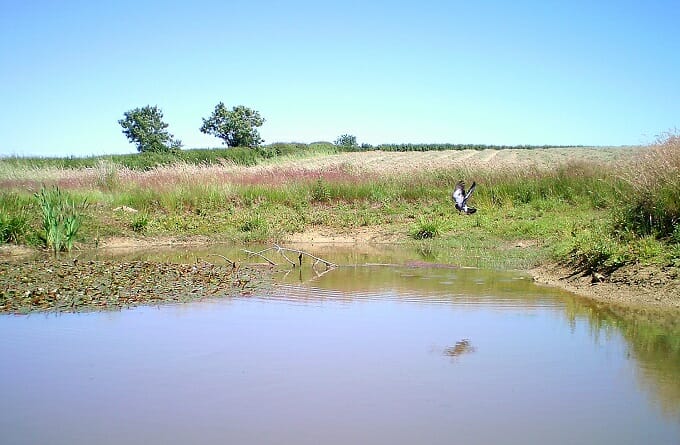
The sound of lapwings is often heard at Sun Rising – a sound well worth listening out for (a YouTube clip of the sound can be found here : https://www.youtube.com/watch?v=Te10HfbBycw). We have an idea of where they are nesting, some years it is very close and others it is a little further away. Their flight is as extraordinary as their song.
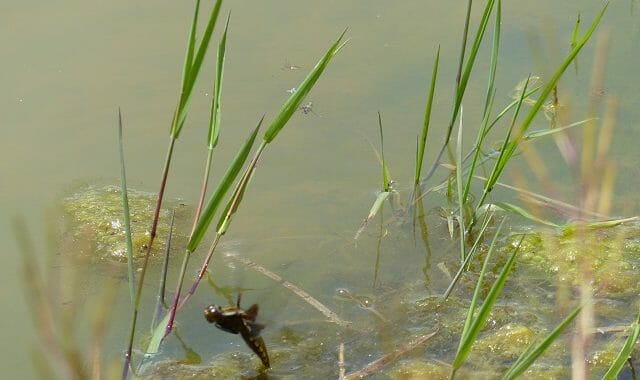
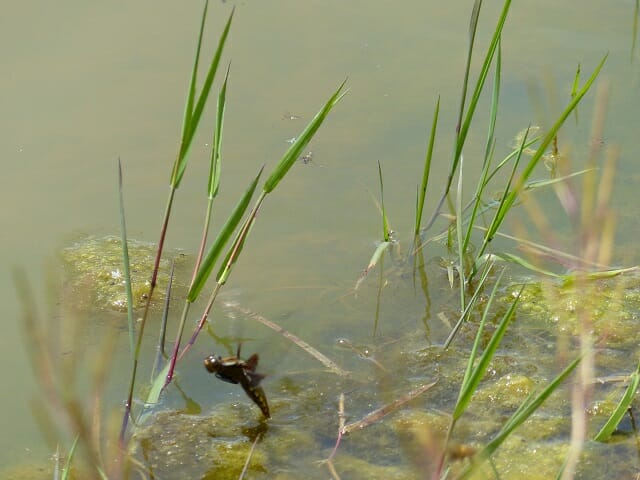
In this photo we caught one as it dived towards the pond. It’s a poor quality picture, but you can just make it out, with its reflection in the water below. Just beautiful.
In this picture you can also see that we have mown the grassland at Sun Rising now, taking the bales off this week. The site always looks a little awkward at this time, like a shorn sheep, but with a little rain it will green up and start to grow again. We are also starting the long summer process of tidying up burial areas where there is little ecological biodiversity. With the cutting of the hay comes the beginning of harvest …
Dragonflies
The pond is a delight at the moment, with rushes and sedges, pondweed, cuckoo flowers and water mint. There are a few irises coming through, the first of what may be many in the future, and on the bank the oxeye daisies, clovers, knapweed and other wildflowers are coming into bloom. It won’t be long before the willowherb is in flower as well. Countless little insects are flying over the surface of the water, and swallows are diving down, just touching the water, with wonderful grace.
This is a female broadbodied chaser dragonfly that has been laying her eggs. While the females are a bright sunshine yellow, the males are a brilliant sky blue. We’ve seen a fair few around the pond, while the females seem to roam further at Sun Rising, coming up into the new woodland.
Looking Closer
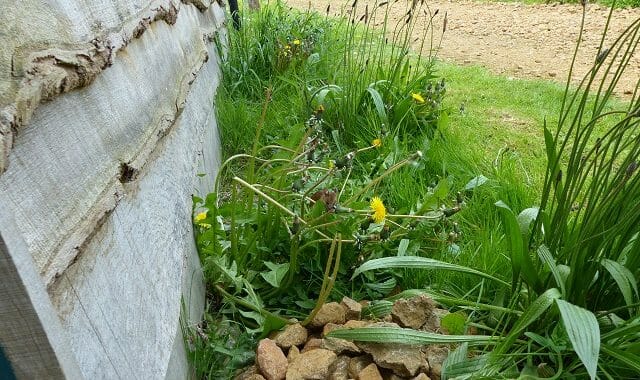
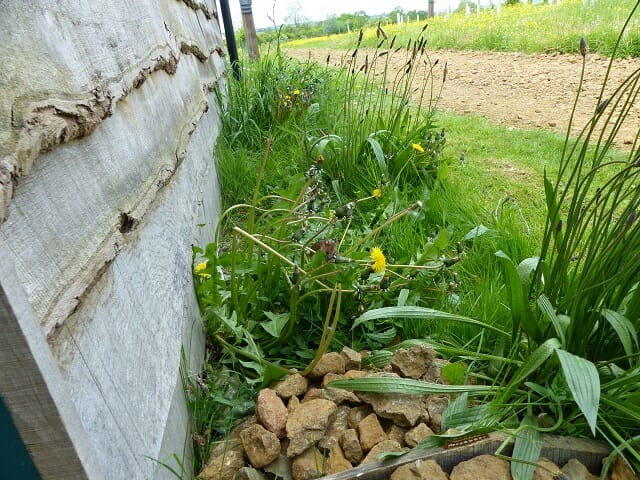
Here is a picture that, at first sight, looks like the naturally rather untidy side beside the step of the cabin at Sun Rising.
But look closer and you’ll find a mouse, who has sneaked through the vegetation to munch on crunchy green dandelion leaves. He was so close to me when I took the photograph, I could hear his teeth on the leaf.
And don’t miss the caterpillar. This is the larva of a drinker. Such a beautiful creature should evolve into an adult drinker moth within the next few weeks, but if you look even closer, you’ll see there is an egg on its back. It’s fuzzy blowing up the picture, but it is a little white circle a third of the way along, just by the yellow stripe. This may be a parasite, perhaps a wasp, which is sadly likely to turn this beautiful creature into food before he flies.
Apple Blossom
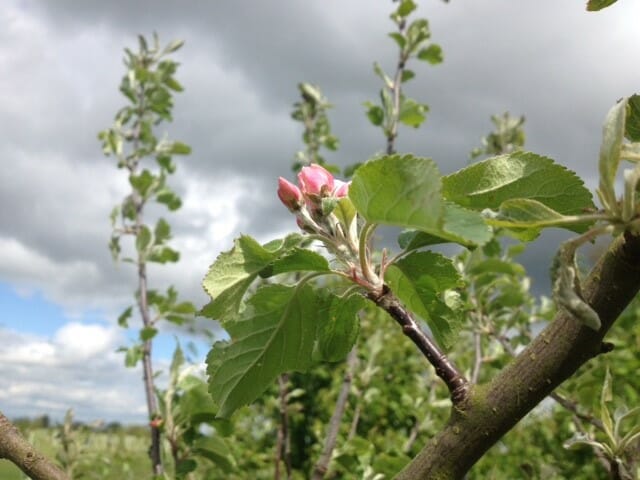
April showers didn’t happen this year. In fact, although the expression goes back centuries (some say to Chaucer), we often find that April is a dry month. This year it was exceptionally dry, which has set back the blossom a good few weeks. The first hawthorn flowers are beginning to open this week, in the blustery rains of May, and the first apple blossom too.
Thank you to David for this beautiful photograph of a crab apple at the burial ground planted as a memorial tree, the tender pink set against the wild dark grey of rain clouds. You can see the wild service tree in the background coming into leaf too – that elegant tall straight tree, too seldom seen now in our countryside.
Dandelion Season
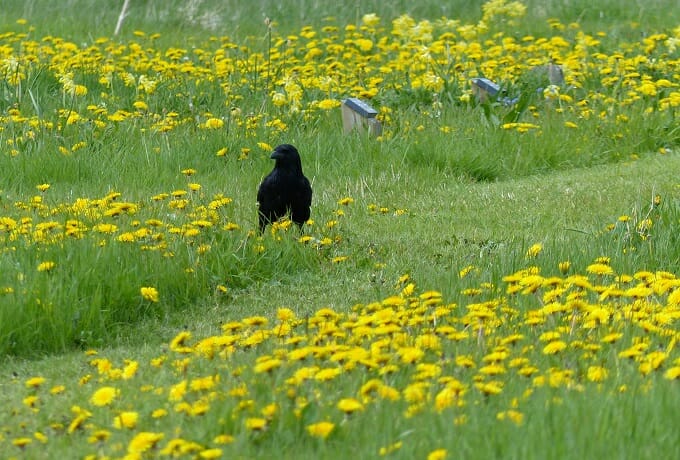
There comes a point in late April when Sun Rising is ablaze with dandelions. I love this shot of a crow, paused on the edge of a mown path, as if contemplating the vivid yellows in comparison with his own rich black. It’s as if he were thinking, ‘the cowslips were one thing, but this is quite unnecessary’ …
The dandelions are one of the few plants that we try to manage, for unmanaged there are areas where they would simply dominate. We’ll mow the flower heads off some they go to seed – so if you’re aiming to collect flowers to make a special Sun Rising dandelion wine, now is your chance …
Spring Cowslips
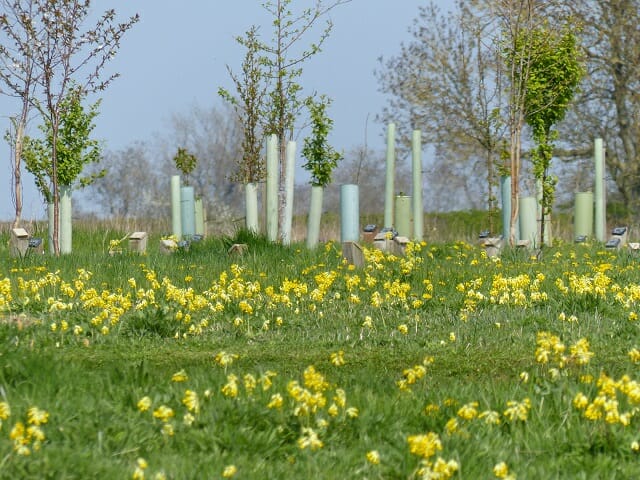
The cowslips at Sun Rising are just beautiful at the moment. Here’s a shot of the wildflower meadow, with young memorial trees beyond. Each year, the cowslips spread, bringing not just the soft yellow colour, but important food for the bees and other insects, and a lift to the human soul as well.
You may be able to see, too, that we have taken the heavy tree protection off some of the older saplings this year. Having nurtured these little trees from the beginning, I felt their vulnerability acutely, but after just a few weeks they are starting to settle, feeling stronger, especially in the spring sunshine.
The clay is cracking though, having had so little rain. Even though it will be hard to lose the sunshine, if the rain does come this weekend we must celebrate its coming – the earth, trees and spring flowers do need it.