We would be in trouble without fungi. One reason for this is that, without fungi, we would be buried under tonnes of decaying matter. When something dies – whether a plant, animal, even us humans – fungi play an important role in breaking down the physical matter into useful things, like nutrients and minerals. They are also integral to how the majority (some 90%) of plants and trees grow. Don’t bother to try to dig up a wild orchid to grow in your garden, unless you are prepared to bring a substantial amount of the surrounding earth with you, undisturbed, as this will contain the microscopic mycorrhizal network without which the orchid will not survive. You can find out about this amazing relationship in Peter Wohllenbens’ The Hidden Life Of Trees.
This month we hosted a fungi walk at Sun Rising, looking for the fruiting bodies of fungi that push up above ground, typically at this time of year, which we know as mushrooms (or toadstools – the terms are interchangeable). There are an estimated 15,000 species of fungi in the UK, but without mature woodland and ancient pasture, Sun Rising is not yet as rich in fungi as we’d like. We are discovering new species every year, however: we’ve recorded about 30 species so far.
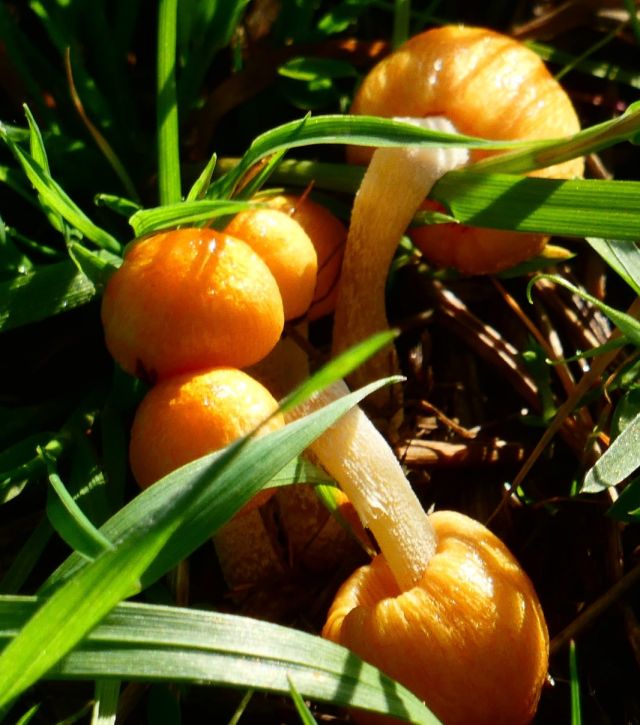
Yellow Field Cap Mushrooms
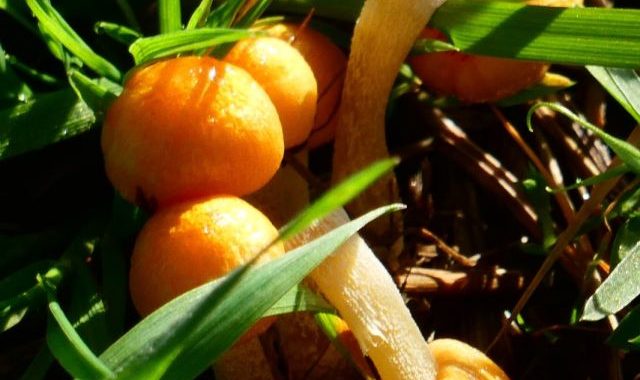
One mushroom found across the nature reserve this year has been the Snowy Waxcap (Cuphophyllus virgineus) which is a nice indicator of healthy grassland. Another is the Weeping Widow (Lacrymaria lacrymabunda). This has been found on a good number of last year’s graves, clearly favouring disturbed ground; the name comes from the black watery droplets which can be seen on the cap and gills when it’s moist. The Yellow Fieldcap (Bolbitius titubans) is a bright yellow mushroom which prefers richer soil, and won the prize for being the most colourful – it’s also called Egg Yolk Fungus.
There has not as much variety as last year in terms of fungi at Sun Rising, probably because of the dry summer and recent frosts. However, we saw about 10 species on the walk, and a couple of new ones.
Thank you to Peter Landsman for the wonderful photograph above.