October Trees Still Green

A Dark Green October

There is a benefit to a mild October: we aren’t wrapped up in half a dozen layers, muddy boots, woolly hats and aching joints.  But when we recognise that such weather is another indication of climate change, that momentary personal benefit seems fairly small.  The sense of ‘being lucky’ to have another warm, dry day rightly falls away.

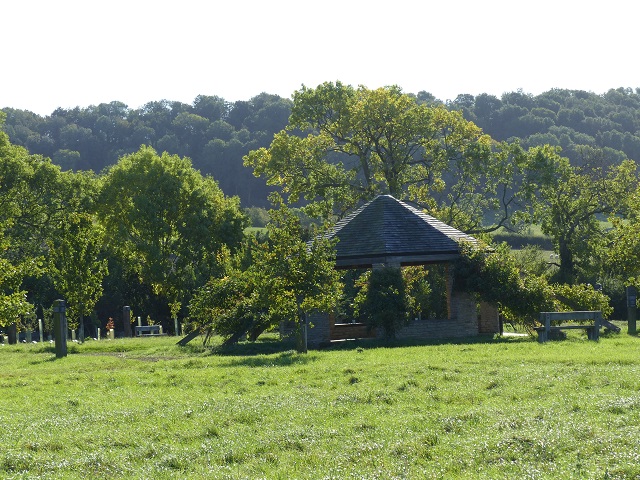
This year, October has not been the month of changing colours: most of the leaves are still green, albeit losing their vibrant sheen.  At the tops of the young maples and oaks, and on most of the cherry trees, the leaves are drying and, a dull and brittle brown, they are falling heavily within a day or so.  This is not as year of autumn colour.
October Trees Still Green

October Trees Still Green

What makes the leaves of our deciduous trees so beautifully green is chlorophyll, that magical pigment which allows trees to convert sunlight, carbon dioxide and water into the sugars they need – and the oxygen we breathe.  Throughout the winter, with shorter days and less sunlight, the tree stops producing chlorophyll and prepares to ‘sleep’ through the darker months. Withdrawing nutrients from the leaf, it grows a layer of cells at the end of the leaf stem (the abscission) which helps the leaf to detach and fall.

The many hues of yellows and browns in autumn leaves are actually already present in the tree leaf: throughout the summer months, the green chlorophyll masks them. When the amount of chlorophyll reduces as the days grow shorter, those underlying colours simply show through.

The quality of red, however, is quite different.  This is a pigment (called anthocyanin) which the tree has to create afresh each autumn.  Exactly why trees decide to do so or not is an area still being researched.  It is clear that when the weather is cold, crisp and bright, with plenty of sunlight, ideally with overnight temperatures heading for zero, we are likely to see those rich tones of red that make such beautiful autumn canopies.

Some scientists are suggesting that the red is a sunscreen, protecting the leaves from bright sunlight during their last weeks, so the tree can safely withdraw nutrients into its wood and roots; however, the cold temperature is also necessary.  Some have observed that trees on poor soils are more likely to produce the anthocyanin than on rich fertile soils: red leaves remain longer on the trees, allowing the last of the nutrients to be used.

Whatever the reason, as we move through a mild October, it may be that this is not a year for splendid autumn colours.  While the British climate continues to warm, it may be that such colours become a memory.  I sincerely hope not.

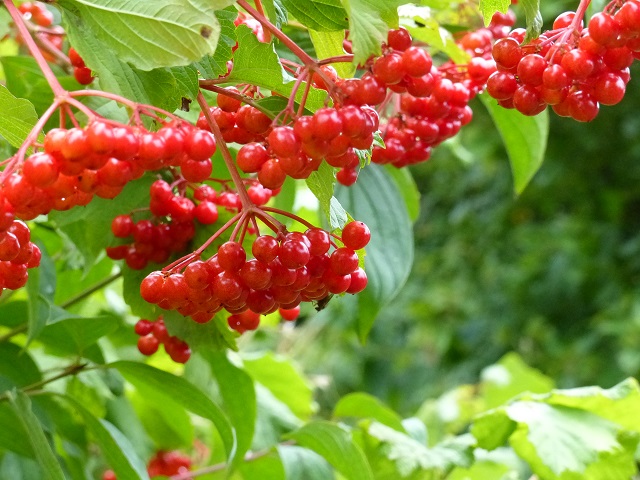
Guelder Rose Berries

Choosing Sustainability

This coming week, 18 – 26 September 2021, has been declared Great Big Green Week, ‘the largest event for climate change and nature ever seen in the UK’.  It’s a website filled with ideas and events, and a wonderful initiative which we hope will inspire a huge number of people.  Understanding how our every decision and every action has a potential impact on the planet, and what that impact might be, is crucial to slowing the crisis of climate change.

Guelder Rose Berries

Guelder Rose Berries at Sun Rising

At Sun Rising, of course, our whole remit is about helping the environment.  We are creating and managing a nature reserve, maintaining different habitats to encourage the greatest possible biodiversity, making a safe haven for wildlife.  With just sixteen acres, it may seem like small fry, but we are aware that what we do affects all who come to lay someone to rest here – and all who subsequently think about their own last wishes.

That’s why our emphasis on burial over cremation is so important.

For some, the choice to cremate is based on religious strictures.  For many, however, it is assumed that cremation is the straight-forward, less expensive and socially expected option.  But cremation is extremely expensive when it comes to the environment.  Crematoria use a huge amount of fuel, generating CO2 which adds to the climate crisis, as well as polluting the atmosphere.  Families then need to do something with the ashes – and to inter these responsibly is an additional cost on top of the cremation itself.  As a result, many scatter them where their highly concentrated fertility is harmful: killing wildflowers, degrading natural ecosystems, polluting waterways.  Cheap online direct cremation services are only encouraging the problem.

Burial is a gentle, natural process.  It doesn’t burn fuel, it doesn’t generate pollution, and it captures CO2 instead of pumping out more.  Where an ethical coffin is used (such as English willow or recycled card), the impact is even less.  At Sun Rising, using our own simple arrangement service, the financial cost can be lower than cremation.  At a natural burial ground, or nature reserve burial ground like Sun Rising, planting of trees or maintenance of wildflower meadows further helps with CO2.  Such places protect land from development, ensuring space for wildlife into the future.

When thinking about your own wishes, please think about our beautiful planet.
For more information, do have a look at our Sustainability Choices Chart.

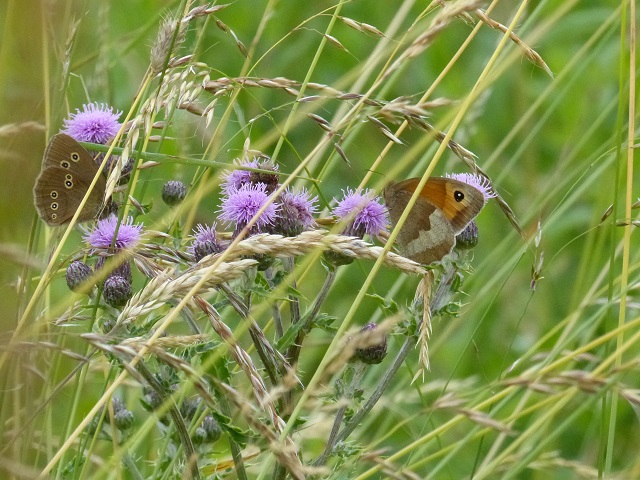
Ringlet and Meadow Brown on Creeping Thistle

Hot Sun and Butterflies

After a cold wet May, and a variable June, we have now landed in the midst of a very warm few weeks.  With temperatures in the late twenties and early thirties, many are staying indoors in the cool.  Not so the butterflies!  After such a slow start, there are now abundant butterflies here at Sun Rising.  Not all the usual species are evident, but it’s wonderful to see those that are.

In particular, the Ringlets and Meadow Browns are flying in good numbers now: you can see these two species feeding companionably here on Creeping Thistle, amidst the seeding grass wonderfully called Yorkshire Fog.  There are also plenty of Marbled Whites, a striking black and white butterfly which has been doing well at Sun Rising for a couple of years.  The various orange skippers are also flying now, Small Tortoiseshells, the first of the Gatekeepers and 6-Spot Burnet moths.  There are a few Painted Ladies and Common Blues in the new wildflower meadow too.

Ringlet and Meadow Brown on Creeping Thistle

Ringlet and Meadow Brown on Creeping Thistle

The wildflowers of the meadow are quickly changing in the heat: flowers of early summer, the Oxeye Daisies and vetches, are now going to seed, while the late summer flowers are baking in the sunshine, tickled by butterflies, hoverflies and bees.  The pale lilac of the Field Scabious and the deep pinks of knapweeds contrast with the rich yellow Lady’s Bedstraw.  Strands of pure yellow Agrimony stand straight amidst the grasses, now drying and shedding seed.

In the fields around, the tractors are out, cutting and baling the grass for hay.  It won’t be long before the combine harvesters are rolling through the arable, bringing in the cereal crops.  For our forebears these were busy days of working from dawn until dusk, scything, turning, rowing and stacking.  Feeling this hot, it’s hard to imagine that kind of physical toil.

In this intense heat, if we have the luxury and/or the discipline to do so, these are days to take life not just slowly but with a deep inner calm.  To do so while watching the almost constant activity of the butterflies and bees is pure delight …

Don’t forget Butterfly Conservation’s Big Butterfly Count too, running this year from 16 July to 8 August.  What a lovely reason to get out and see what butterflies are about, not just in our gardens, but local parks, woods and meadows.  Of course, you’re welcome to do your count at Sun Rising.

Deep in the Meadow

Many years ago, standing in the middle of an intricate corn circle, I was asked if I felt the ‘magical’ energy of the place. I did, I felt myself filled with a glorious sparkling exuberance, but leaving the mysteriously-made circle and walking into the adjacent field, with the summer breeze, the birdsong and sunshine, I felt just the same sense of vibrancy and wonder. It wasn’t the corn circle, it was the English countryside that was magical. Looking out over Sun Rising, with the meadow grasses now 4 or 5 foot tall in the grassland, moving in the wind like water, I am equally filled with life.

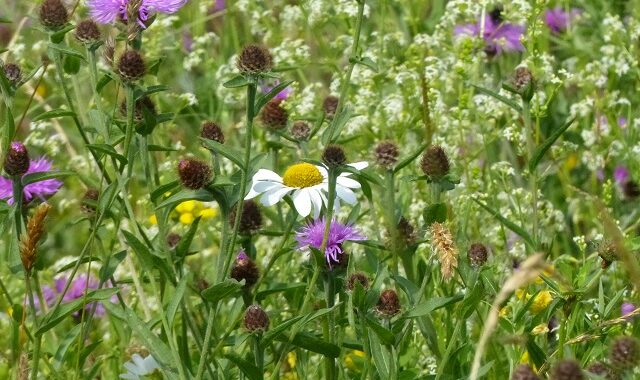
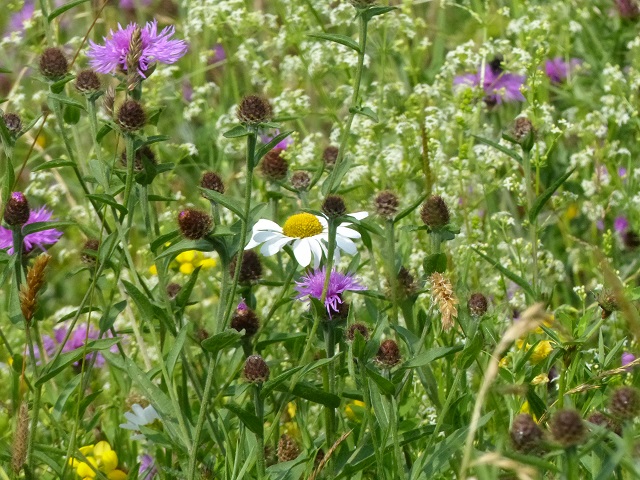
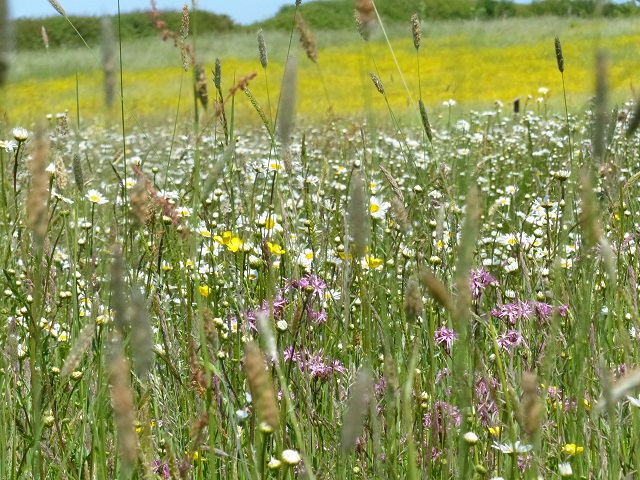
In our areas of wildflowers, the vegetation – both grasses and flowers – seems almost twice as thick and tall as it was last year.  It’s been a fairly chilly summer, with cloud hiding the sun all too often, but the regular rain has encouraged a great deal of growth.  In places the flowers have been slower to come through than the grasses, but as July opens out they are catching up well.  In this photograph you can see Hedge Bedstraw, Birdsfoot Trefoil, Common Knapweed, and an oxeye daisy proudly in the thick of it all.

Wildflowers at Sun Rising

Wildflowers at Sun Rising

When the rain holds off and the sun starts to shine, the butterflies are coming out too.  Some are in low numbers this year, notably the blues and whites, but we’ve had good numbers of Meadow Browns, various skippers, Marbled Whites, Small Tortoiseshells, and there are Painted Ladies, Brown Argus and Ringlets.  You may see some day-flying moths as well, including the Six-spot Burnet, the Shaded Broad-bar and Yellow Shell.  With such thick growth in the meadow, you’ll sometimes see them deep in amidst the vetchlings and knapweeds, lifting out into the sunshine when the clouds move along.

The Emerging Meadow

This effects of this year’s cold wet May are still very evident.  Sometimes a difficult period suddenly disappears, as nature appears to catch up with itself, but sometimes the effects are longer lasting.  Looking out over the wildflower meadows at Sun Rising, it feels to me as if we are about two weeks later than we would otherwise expect – but at last the flowers are now coming into bloom.  The mass of buttercups has, for a little while, been here-and-there splashed with the pale pink of ragged robin, or the deeper pink of red campion, but now the oxeye daisies are starting to open.  Brilliant pink grass vetchling, rich red-to-yellow birdsfoot trefoil, and now the first of the field scabious.

Early Summer Flowers in Michael's Meadow

Early Summer Flowers in Michael’s Meadow

The more established areas of meadow have a greater ratio of grasses, while the newer meadows have more flowers.  In the photograph here, you can see the fat seedheads of meadow foxtail, tall in the foreground, a grass species that was barely seen in that area of meadow last summer.

A meadow is always changing, with a slightly different balance of plants making the most of the conditions of that particular year, finding root space in the soil, responding to sunlight and warmth.  It’s a balance that we are always aware of: the flowers may be more beautiful, but the grasses draw up more water from the soil, giving it a better overall structure.  We can alter it with harrowing and re-seeding, or weeding out specific species (such as thistles), but on the whole we just need to wait and watch.

Some may be aware of the very low number of butterflies around this year.  The same is true for moths.  Despite the ongoing decline in numbers, 2020 was a fairly good year – you’ll remember that we had a very warm dry spring and early summer.  This year, the reverse is true.  With a cold wet May, butterflies are only now starting to get going, and for some it will simply be too late.  With the meadow coming into flower, we hope very much that the butterflies will also start emerging, together with all the other invertebrates who are not only dependent on such places, but add another layer to nature’s precious and wonder-full beauty.


A Muted May

Last year, by the middle of May, there had been so little rain that we were beginning to fear for our youngest trees.  The ground was dusty and cracked, seeds slow to germinate or drying up in the hot sunshine.  In lockdown, many human beings were happy to soak up the sunshine in the warmth in their own gardens, but the natural world was parched.  This year, however, after a dry April, spring has been dissolving into a rather wet summer.  The colours of nature – the cowslip yellows, the bluebells blues and all the many greens of a new season’s growth – are really rather damp and muted.

The good news is that the trees are very much happier than they were last year.  With roots in moist soil, and with lengthening days and sufficient sunshine, they are growing gently, perhaps even contentedly.  It’s not fast growth: the nights have been cold, temperatures generally low.  A few young saplings had their first leaves burnt by frost early in the month, and after losing leaves they can be cautious about pouring energy into leafing again.  And if there is much more rain, the soil at Sun Rising will start to become saturated.  But so far the trees are quite at peace with the rain.

Wildlife Pond Overflowing

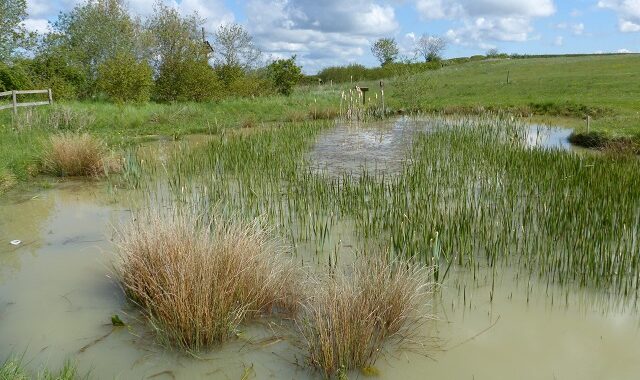
Wildlife Pond Overflowing with May Rains

And the pond is just wonderful!  We can cap the inflow, stopping the water rising if we needed to, but at the moment it is only beneficial.  As the water flows in, the ground all around the western bank is overflowing, as it is designed to do.  Toads, newts and other amphibians will be joyfully exploring the wider reaches of their temporarily extended habitat.  I’m imagining the nymphs of dozens of dragonflies and damselflies, swimming along new watery channels through the grass and buttercups, feeding on all kinds of little creatures they wouldn’t find in the pond itself – and when summer comes, and the water temperature rises, I’m hoping they’ll transform into their magical winged forms and stay to dance over the pond’s glittering sun-blessed surface.

I suspect most are yearning for some warmth and sunshine.  But perhaps, as we wait, we can acknowledge and appreciate those who love and need these watery days.

Spring Maple

I may be biased but, in this spring sunshine, Sun Rising is simply wonder-full.  Yesterday, we paused for quite some time, crouched down, taking in the beauty of little pools of clear white Wood Anemones (Anemone nemorosa) now flowering in an area of woodland where the trees are 10 – 12 years old.  These aren’t easy to grow: the little plants can take many years sorting our their roots in the soil before flowering.  They tend not to spread by seed, but instead their little roots grow underground, so small patches very slowly extend.  You can see them out in the open, but they are happier in areas where tree roots are breaking up the earth and there is dappled spring shade.

With the wild cherries now in full blossom, and the meadow bright with thousands of cowslips, the dark red hoods of the snakeshead fritillaries so captivating, it took me a moment’s consideration to decide which photograph to share on this blog.  My choice is the field maple (Acer campestre).

Field Maple Leaf Buds

Field Maple Leaf Buds

Naturally when thinking of the maple, we think of its autumnal leaf colours, and on a good year, with the right balance of rain, light and cold, our native Field Maple can be glorious.  The leaves can be a thousand hues of gold, bronze and copper, but also rich siennas, umber, all the way to burgundy.

Yet in spring, the maple is one of the most beautiful trees.  Its grey winter leaf buds suddenly break into soft reds, the bright green leaves at first almost fluffy as they open out into the spring sunshine.

Our English maples are an important tree at this time.  At Sun Rising, they appear to be coping with the changing climate better than any other – managing both drought and saturated soil.  They support a huge number of creatures, including many hoverflies, ladybirds and caterpillars.  In fact, I am quite sure they are a favourite of the Long-tailed Tits: it’s not unusual to see groups of these little birds land on the maples and, hopping about, pick off aphids and other tiny insects, chattering to each other all the while.

If you visit Sun Rising you’re eyes will be drawn to the cowslips and snakeshead fritillaries, the blackthorn and cherry blossom, even the last of the daffodils, but do pause at the wonderful Field Maple too.

The Uncompromising Blackthorn

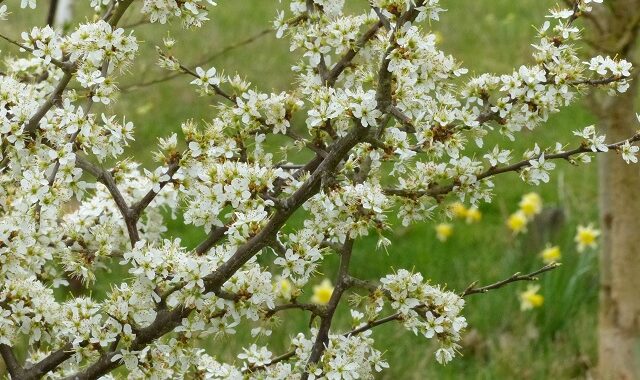
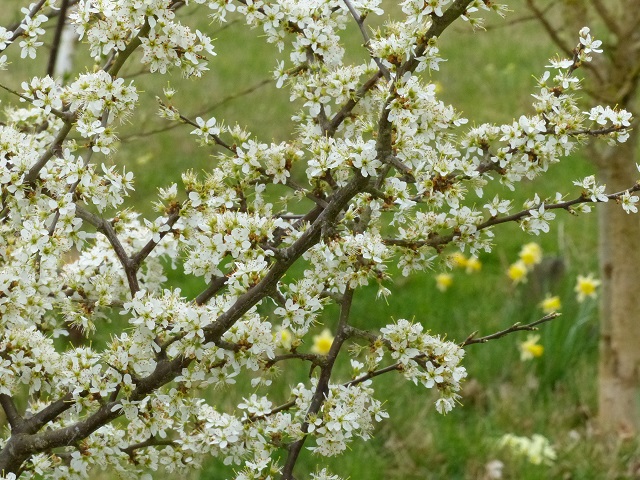
Every year, the blossom of the blackthorn amazes me.  Its white is so undiluted, as if, when its buds break into flowers, with so little colour still in the hedgerows and meadows there is nothing that can taint its purity.  Against the dark grey, almost black, of its wood, the profusion of flowers, stamens standing out proud, is just startlingly beautiful.

With a few days of exquisite sunshine, bright blue skies and such warmth, really I should have been out with my camera, photographing the emergence of spring.  Too busy, I just didn’t manage it.  When I found myself with a moment of calm today, the light was dull, the skies heavy with cloud.  Had I missed the moment?

Gazing at one of the youngest blackthorns at Sun Rising, planted as a memorial tree, and flowering with such uninhibited exuberance, I recognised that it was no less amazing than it had been in the sunshine.  With the sun’s gold in daffodils beneath and around it, I was washed through with wonder.

Blackthorn amidst the Daffodils

Blackthorn amidst the Daffodils

In the old mythology of these lands, blackthorn is sacred to the ‘triple goddess’, in other words, perhaps, reminding us of the three stages of womanhood.  By the end of the season, with tatty-brown falling leaves and long sharp black thorns, the grumpy old woman sits in silence.  Yet earlier in the year she is fruitful, the mother-figure, her branches adorned with the deep purple of sloes.  And here she is, another facet of the feminine: the maiden, in pure white, and the innocence and enthusiasm of her natural beauty.

With the blackthorn blossom at its best at Sun Rising right now, other trees are now beginning to flower too.  The first wild cherries are starting to bloom – but don’t expect the uncompromising white of the blackthorn.  In the cherry flower, I think there’s the slightest tint of cream.  The reddish vibrancy of the cherry bark can’t fail but to soften the white of their delicate petals. 

Spring Mulching

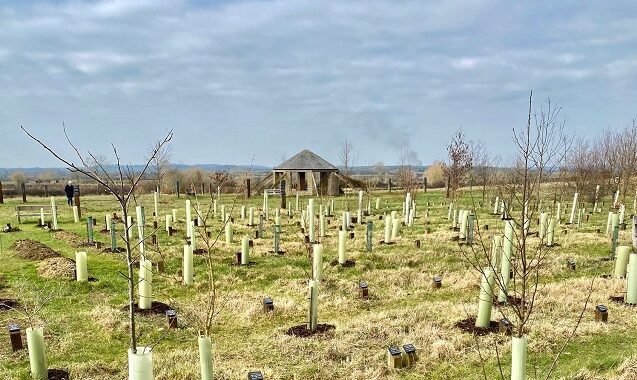
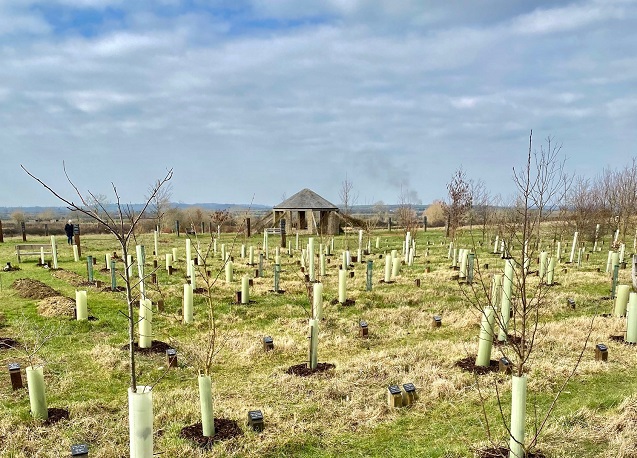
Yesterday was our second day of mulching young saplings here at Sun Rising.  With a team of 15 volunteers, we finished the job we’d begun the previous weekend, when 22 volunteers had joined us.  With gloves and buckets, socially distanced, our volunteers mulched memorial trees in woodland burial areas and trees planted in new hedgerows and plantations: in total, around 800 saplings were given their neat ‘doughnut’ of composted bark.

Young Memorial Trees mulched with Composted Bark

Young Memorial Trees mulched with Composted Bark

We are enormously grateful to all the wonderful volunteers.  The job was done over two mornings, when it would have taken us many days.  It was great, too, to have such positive feedback from volunteers: particularly for those who’ve had little contact with others throughout the pandemic, the mulching was valuable ‘ecotherapy’, being outside in the natural peace of Sun Rising, chatting now and then with others, while getting on with a really useful and satisfying task.

And it is extremely useful.  When Sun Rising opened, nearly 15 years ago, we didn’t mulch our little trees at all, and they survived.  Why we feel it necessary to do it now is a sad recognition that the climate has changed sufficiently for us to need to protect the moisture in the soil.  Though winters may be wet, the summers have been hotter and drier, and the young saplings can struggle.  The thick ring of composted bark gives another barrier against drying sun and wind.  It also helps suppress grasses and other plants that want to root around the base of the young trees.

Furthermore, when the job is done, we think it looks rather lovely.  It’s a fine expression of how much love there is – for the place, the land, the trees, and every individual who has been laid to rest here.

Secret Beauty

The alder tree (Alnus glutinosa) is a tree on our list of memorial trees that families very seldom choose.  I wonder if the reason is simply because many aren’t that familiar with it – it’s not a tree commonly planted in gardens and parks. Yet to my mind it is one of the most beautiful.

After the hazel, it is the first to flower in the year. Indeed, we have many at Sun Rising (planted in hedgerow copses) that are flowering right now. Its male catkins begin green, but open to lovely yellows, edged with deep pink.  Its female flowers begin a smoky red, as little bunches on each stalk – when pollinated, these grow into the little cones we see in winter, some remaining on the trees when the catkins open in early spring.  Trees are ‘monoecious’, a single tree having both male and female flowers.

Alder Catkins in February Winds

Alder Catkins in February Winds

You can see in the photograph above the silver-streaked bark.  The alder is, in fact, related to the silver birch and, like the birch, can be the first to colonise new ground – which makes it ideal at Sun Rising, where we are planting trees for the first time in perhaps thousands of years.  It does well in wet soil, and as such it copes with our heavy clay.  It also works with a bacterium to fix nitrogen in the soil, enriching the soil, and so allowing other trees to flourish.  Indeed, the alder is being used elsewhere for similar purposes, regenerating post-industrial land, bringing it back to nature.

It’s a truly valuable tree.  In time, we hope to plant many more at Sun Rising, helping visitors become more familiar with this secret beauty.