Heart-shaped Embraces

There are many wonderful names in the natural world.  Yesterday by the pond I spied a Spilosoma lubricipeda, the most beautiful kitten-soft little moth, with a name that describes it so perfectly: the white ermine.  Indeed, of all creatures, moths have some of the best.  How about the small elephant hawk-moth, the common lutestring, the ruby tiger or the striped twin-spot carpet moth, as a start?

As richly descriptive as those may be, meandering further into myth and legend are the Odonata: the dragonflies and damselflies.   Given that these creatures were flying over our meadows and ponds with the early dinosaurs, over 300 million years ago, I suspect they deserve a little magic in their names.  We no longer have dragonflies as big as eagles, but they are still extraordinary fliers.  With four long wings, and large eyes, they have the agility and speed to catch the midges and gnats that make up their diet.

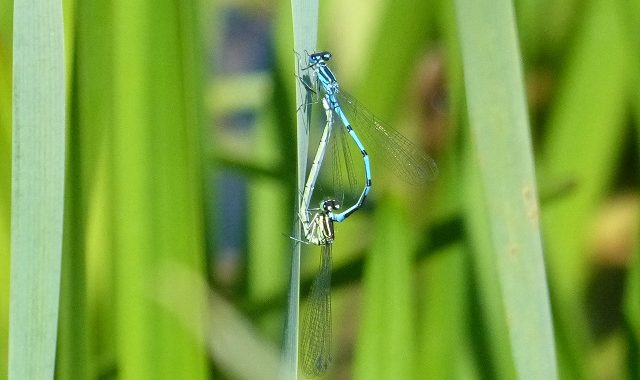
Azure Damselflies Mating

Azure Damselflies Mating

Darting around the wildlife pond, over the meadow and through the nearby shrubs, a good few Odonata can be seen at Sun Rising during the summer months.  Yesterday, the abundant species was the azure damselfly, Coenagrion puella.  Having emerged from their larval stage, the vivid blue males and olive green females were dancing over the water, pausing on reeds, and joining together in their heart-shaped embraces.  Having mated, the females then lay their eggs around the broad leaves of the pondweed leaves.
Being Ragged Robin

These last few days, with the northerly wind bringing such a deep chill, I find I’ve been putting on and taking off layers of clothes repeatedly throughout the day. In the sunshine, sheltered from the breeze, it is so beautifully warm, then a gust rises and I’m cold all through.

In nature around us, these temperature changes are equally confusing.  It’s been an extremely hard start to the year for moths and butterflies, and numbers are predicted to be low this summer.  Many invertebrates didn’t survive in the waterlogged soil of what was such a very wet winter, and those that fly have been struggling with the persistent cold winds.

The plant world seems to be in better shape though, and that is enormously heartening.  We do have a handful of trees (oak and wild cherry in the main) that sadly didn’t make it through winter, with its perpetually wet ground, and some now have new leaves burned by the heavy frost of the last few days.  The vast majority, however, are looking really very happy, with damp roots and sunshine inspiring them to leaf and grow.  If the summer isn’t too hot and dry, the trees should do well this year.

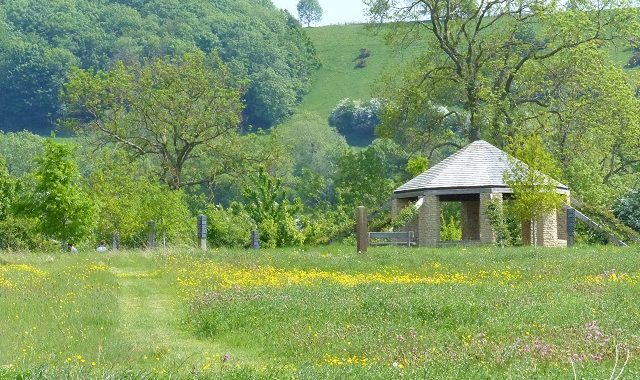
Michael's Meadow to the Roundhouse

View over Michael’s Meadow to the Roundhouse

As the trees come into leaf, the wildflower meadows are beginning to thicken up with good green growth too.  Buttercups, meadow foxtails and sweet vernal grass are in full bloom, with the first oxeye daisies and common vetch beginning to flower.  The red campion is mainly in the woodland areas, although some have sneaked into the meadow – there, the swathes of soft pink flowers are the ragged robin, with their wonderfully tatty looking petals.  I love its botanical name: Lychnis flos-cuculi, which marks it as a plant that flowers when the cuckoo can be heard.  It prefers soggy meadows, which is why it’s done so well this spring, particularly at the bottom of Michael’s Meadow where the soil is still damp.

At the moment, in the chilly winds after that long wet winter, in the midst of the COVID-19 restrictions, whether weeding the butterfly bank, pulling sowthistle or tidying graves, lifting my face to breathe in the sunshine whenever it comes, I must say I feel rather like a tatty-petalled ragged version of myself!  We’ve not yet heard the cuckoo though …

The Calming Cowslip

The cowslips at Sun Rising are now reaching their peak, and they are alive with the hum of hundreds of bees.  And that is one of the most valuable qualities of the cowslip: as a true native, growing in such abundance, it is a delight for the many insects.  They seem to fall lazily from one flower to the next, filling themselves with nectar, increasingly covered in pollen.

Cowslips

Cowslips

The name ‘cowslip’ isn’t quite so pretty!  It comes from cowpats, or cowslop – as the plants will happily grow up through a pat in the old meadow pastures.  Other names for the cowslip are Key of Heaven, or St Peter’s Keys, or Herb Peter, as they are connected with the saint.  Other names are peggle, buckle, crewel or plumrock, although why, I couldn’t say!  The botanical name, Primula veris, speaks of its emergence at this time of spring.

If it’s of interest to those stuck at home with frustrated little one, old herbalists will tell you that they are good for calming hyperactive children.  Certainly, standing (or sitting) amongst them, with the hum of bees and the soft sunshine, they add to the peace here in the wildflower meadow.

The Perfect Pink

The common colours of a Warwickshire spring are white and yellow.  In our gardens, we may strive to bring in other colours: deep blues of Anemone blanda, purples of crocuses, smoky pinks of Ribes and Pulsatilla.  This morning, the first scarlet flower of a Helianthemum opened in my garden.  Out in the hedgerows and meadows, however, there aren’t many flowers that aren’t white and yellow: the blackthorn is still brilliant in uncut hedges.  As the daffodils go over, yellow cowslips are coming into flower, the first dandelions and buttercups.

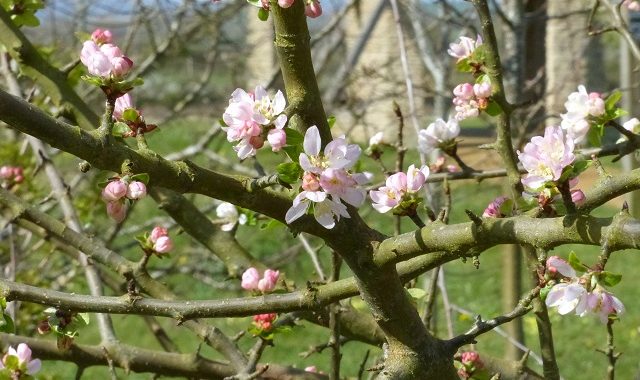
At Sun Rising, evidence is creeping in that spring is beginning to settle into the idea of summer ahead.  The deep violet bells of snakeshead fritillaries are at their prime.  The very first bluebells are starting to reveal tentative flowers.  What takes my breath away though, and without any doubt, is the crab apple blossom.

Crab Apple Blossom in Norma's Wood

Crab Apple Blossom in Norma’s Wood

To me it is the perfect pink.  There’s no hint of artificial pink, no plastic or Disney.  This is nature’s pink, an English pink: the softest touch of pink.  In contrast, its quiet glows against the grey-brown bark of the tree, still leafless.  Some crab apples are almost thorny, giving yet another balance to its beautiful, tender elegance.

For those who can’t visit Sun Rising at the moment, here’s a photograph of just one of the crab apples in flower.  You can see the roundhouse behind it.  Breathe in the peace of it, and all the fruitfulness of summer about which each little flower is whispering.

The Serenity of Cherry Blossom

The longing for snowdrops as the first sign of spring is hard-wired in my soul.  Whatever the winter, the little white bells have a purity and tenderness that glows with nature’s resilience.  After such a challenging winter – so relentlessly wet and grey – this year my heart sang when their flowers began to peak through the muddy grass.

This year, however, as we stumble into and through this pandemic, the need for some quality of resilience persists.  Whatever our circumstances, moments of purity and tenderness are truly precious right now.  Where nature’s beauty offers the reassurance of life renewing itself in the certainty of spring’s return, it is profoundly appreciated.  At Sun Rising, with the golden daffodils shimmering in the sunshine, yesterday the first of the wild cherries came into blossom.

Wild Cherry Blossom at Sun Rising

Memorial Wild Cherry in Blossom at Sun Rising

The tree photographed here is a memorial tree, planted on a grave in memory of an individual laid to rest here, a person no doubt much loved and missed.  The tree is just a sapling, five or six years old, barely six foot tall, with the elegant slenderness of a tree not yet filled out into branches.  Nonetheless, the blossom seemed to me to speak with such a gentle strength: the quiet voice of a wise grandmother, someone who’s lived a long life through many crises, and come through again and again into springtime, into peace, with the love of family and friends.

Perhaps it is daft of me to feel our loved ones in the trees planted in their memory, but I can’t help doing so!  These brilliantly white flowers, the pollen-laden anthers inviting in the first of the bees, the reddish tinge to the unfurling leaves, are worth sharing.  As cherry trees flower around the northern hemisphere, in the cemeteries of Japan, the parks of Canada, the gardens of Germany, everywhere, their strength and serenity is celebrated.  Feel free to share the beauty with others, especially those who this year can’t get out to see it.

Bright and Beautiful

At this time of uncertainty, when the human world is fearful and closing in, the daffodils are at their most beautiful. Bright with sunshine and such serenity, they dance in the breeze, welcoming the first of the big bumblebees.

Wild Daffodils around a Mulched Sapling

Wild Daffodils around a Mulched Sapling

With their soft creamy petals and bright lemon yellow trumpets, these are the native English species, not garden cultivars.  We buy them in as bulbs each October for families to plant.   You’ll see in this photo how they show up beside the rich composted bark that surrounds the memorial tree behind.

Last weekend we mulched three quarters of the young trees onsite, helped by a marvellous team of volunteers.  You can find photographs on our Instagram feed.  With the stronger folk shovelling the composted bark into bulk bags, then shifting the bags around the site, others were filling trugs from the bulk bags and encircling each little sapling.  Not only the memorial trees, but many of the structural planting was mulched as well, helping to suppress competing vegetation (mostly grass) and keeping precious moisture in the soil.  Of course, at times it was a matter of tiptoeing amongst the daffodils …

Many thanks to all the wonderful volunteers.  Thanks too to the daffodils and all those who have planted them each autumn over the past ten years or more.  Their sunlight lifts our hearts every spring, and this spring we really need their beauty, perhaps more than ever.

Weather Frowns

This last six months have been the wettest we’ve experienced since Sun Rising opened in 2006.  There have been puddles of water in the meadows for weeks, paths have grown muddy in places, and some areas are still pretty squelchy underfoot, but as I frown with anxiety I am also aware that climate change has brought crises to others on a totally different scale.

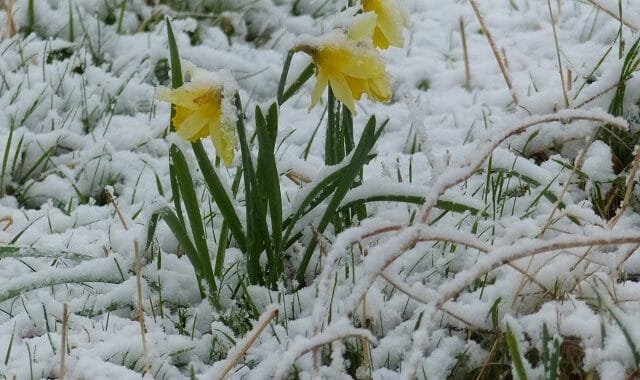
The snowdrops are now going over and spring is beckoning.  Our little native daffodils, the Narcissus pseudonarcissus, are coming into their peak, blooming with a beautiful lemon yellow in the meadow and woodland.  When the snow arrived the other day, they too seemed to frown, but today they are once again sweetly vibrant.

Wild Daffodils in the Snow

Wild Daffodils in the Snow

Who knows what the weather will be this year.  Yesterday I sat in the cabin, a rich bright blue sky above, when hailstones began to fall.  With another weather-inspired frown, I poked my head out to see a small but intensely dark cloud passing overhead.  To be fair, such erratic events are not unusual for an English spring!  The skylarks are beginning to fill the skies with melody, the dunnocks are up on the hedge tops singing their hearts out too, and the robins are scrapping: spring is coming.

Perhaps all we can hope for this year is that the dark clouds, both literal and metaphorical, pass over us quickly, and clear blue skies help to dry our drenched landscape just a little.

Our Tree Sparrow Project

The beautiful little tree sparrow used to numerous in Britain. It is now on our Red List, its population having seen a drastic reduction in the last forty years.

At Sun Rising, however, there is a small but (we believe) viable population. And when it comes to the environment, each small action makes a difference. We have now teamed up with the Banbury Ornithological Society and the RSPB in an attempt to bolster this population, perhaps to the point where it will begin to spread.

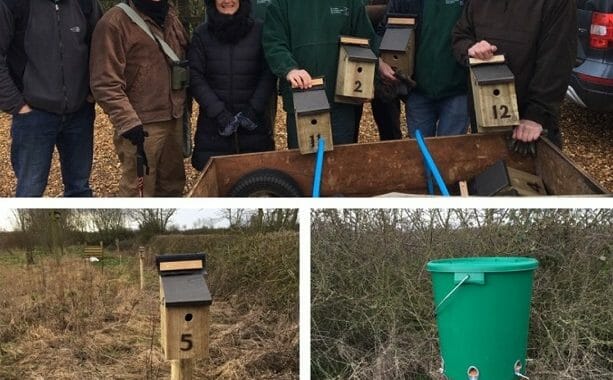
Adding to the 6 tree sparrow boxes that were already being used onsite, we have now added another twelve. We’ve also installed two large ‘farmland birds’ feeders, with seed specifically for the tree sparrows. Here’s a photo of the team, with a new nest box and seed feeder.

Tree Sparrow Team, Nest Box and Feeder

Tree Sparrow Team, Nest Box and Feeder

It’ll take a while for the tree sparrows to start using the feeders: they are particularly wary of change and slow to trust. But once they get used to them, we hope our little extra help will make a significant difference. We’ll let you know.

Check our Projects page for more information.

The Turning of the Year

Every winter has its challenges.  This year, the grey skies and rain have felt utterly relentless.  The earth is saturated and rain is puddling easily.  The winds of the last few days have been exhausting.

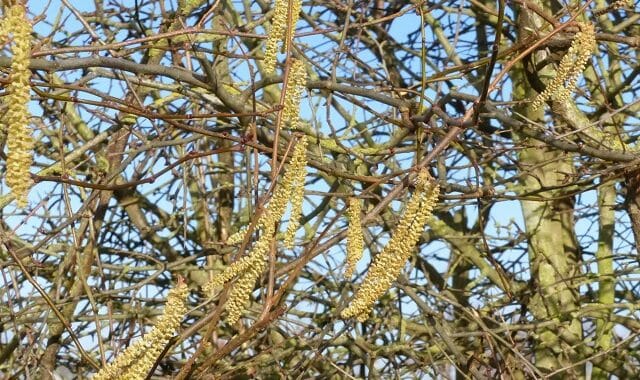
Yet there are moments of beauty all around us, nature glowing in splashes of golden winter sunshine.  This photograph of hazel catkins, dancing in the breeze, the rich blue sky behind, reminds to us how limited is our human perspective.  The cycle of the year is turning.  Indeed, yesterday I found the first snowdrops in flower at Sun Rising …

Hazel Catkins in the Breeze

Hazel Catkins in the Breeze

There are a few pockets of snowdrops planted ‘in the green’, already in flower, but the ones I found were the first of the year to flower from bulbs planted.  As snowdrops don’t like wet soil, I suspect this year there may not be as many as we would hope – which made it all more delightful to see these little ones, still low in the grass, hiding from the cold.

This week we cut the main car park hedge at Sun Rising.  Although this removes most of its chance to flower, it’s essential to keep its shape and density.  In the thick tangle of branches and twigs at its heart, tree sparrows, blue tits, dunnocks, great tits, greenfinches, wrens, chaffinches and yellowhammers are sheltering from the cold wind, fluffed up and chattering.

If you manage to visit, wrap up and wear boots that can cope with muddy soil.  Make sure you’re warm enough to be able to pause.  You may find one of our resident robins flies close.  In this cold weather, with food scarce, they don’t mind the company of other robins around the hedgerows, trees and feeders, and they will often stop to sing.  This is their secondary song – an expression of companionship, of sharing the news – and it’s quite unlike the springtime territorial concerto.  A gentle and richly tuneful warble, it fills the cold air with hope and calm.

A Year of Mushrooms

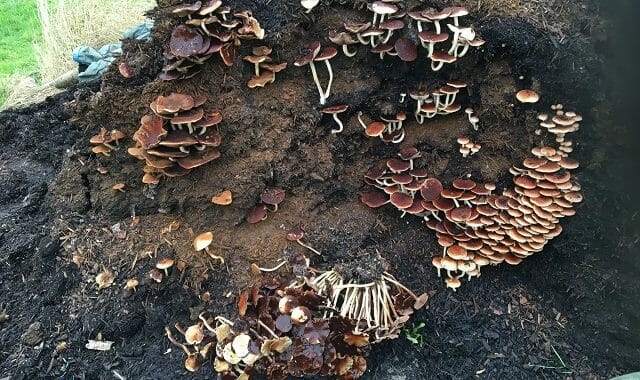
This year, with such a damp autumn, there have been some wonderful fungi at Sun Rising.  Half hidden under fallen leaves, or in areas of longer wet grass, sometimes tucked up against the post of a tree plaque, there are so many different varieties.  My ability to identify them barely begins, but perhaps that allows my wonder and delight to be undimmed by knowledge, to be childlike and free.  There are tall shaggy white ones and big fat plate-shaped ones.  There are deep russet-brown ones, dark chocolate-brown ones, pinky ones, and every hue from cream to yellow.

Yesterday, as we began our tree planting, with 42 new trees put in along the track beyond the cairn, we came across a wonderful display.  Under the tarp covering our heap of composted bark we found mushrooms to make anyone pause.

Mushrooms on Composted Bark

Mushrooms on Composted Bark

Of course, we need to be using the composted bark: over the coming three weeks of tree planting, with each tree needing its doughnut of mulch, we’ll make a pretty big dent in the heap.  But the mushrooms we see are only the ‘fruits’ of the fungi organism.  The body of the fungi is underground, as a network of mycelium – in this case, it is spreading through the composted bark.  The mushrooms will have shed their spores or ‘seeds’ into the bark.  As we break it up, putting the bark around each little sapling, we’ll be spreading the fungi around the new woodland areas.

Having written that, my mind is now full of questions!  There’s so much to learn.  I’m off to dig out a book on fungi …