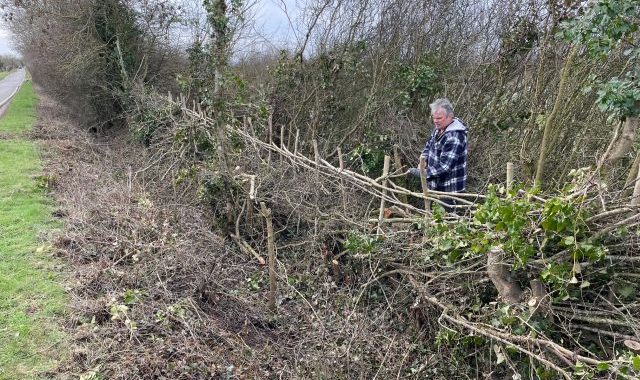
Laying the Eastern Boundary Hedge

Hedgerow Heroes

Many human-made landscape features can have negative or at least non-beneficial effects on nature, but one which has many positives is a regularly maintained and well laid hedge. Since the middle of the last century, 118,000 miles of UK hedges have disappeared through neglect, damage and removal. Around 500,000 miles remain, some in better condition than others (source: The Woodland Trust).

A healthy hedge should contain a variety of native tree and shrubs, with low, thick, bushy growth, and mature trees at intervals. It will store carbon, breathe out oxygen, provide some protection from flooding, shelter livestock from winter winds and summer sun, be a corridor for wildlife to move between habitats, be a source of food for foraging animals and humans, have places for birds, insects and mammals to live and breed, as well as having rich cultural and historic importance.
Laying the Eastern Boundary Hedge

Laying the Eastern Boundary Hedge

Hedgerows came about as a way of dividing up parcels of land and keeping livestock where it should be.  Modern alternatives – a post and wire fence, say –  will do the exactly the same job, seemingly at a fraction of the cost  and without having to wait for it to grow and be looked after. Except a post and wire fence provides none of the benefits listed above.  After 15-20 years, the posts will begin to rot and, because of the wood preservatives they contain, they can’t be recycled; the steel wire comes with a high carbon footprint due to its manufacture, transport and recycling.  However, a hazel tree, for example, might live for 80 years if left to grow naturally, but if cut in a certain way it can live, in theory, forever. One estimate suggests 40% of UK hedges are ancient – age unknown – and are of fantastic value to wildlife.

The hedge along the eastern boundary and the lane at Sun Rising is just such an ‘ancient’ hedge.  No doubt the oldest residents of the local villages remember when it was thick with elm, creating a canopy over the road.  You can see at its base that at least once in its very long history it was laid.  However, as the hedge bottom has gradually grown thinner over time, we are gradually regenerating it, improving it as habitat.

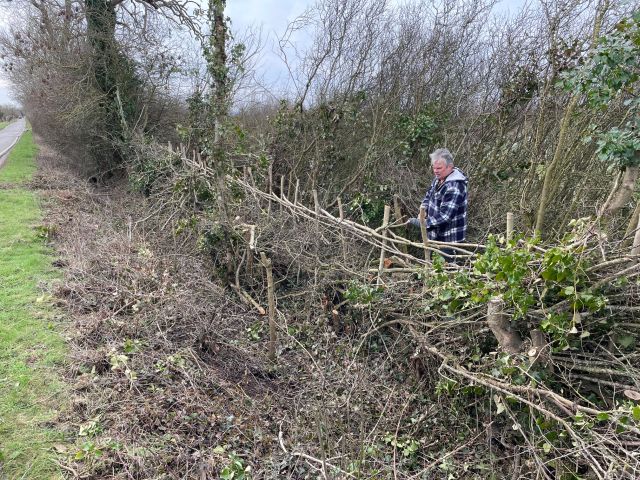
This month, our volunteer group helped us lay 40 metres of the hedge. The first step was to reduce the height of the mid-sized trees, removing a lot of side branches, to see the structure clearly.  The key then is to cut the stems so they are still attached by a thin strip of wood, then lean the tree on its side.  These are then woven through hazel stakes, and further hazel bindings along the top hold it together.  It looks rather brutal but the trees soon push up new vertical growth, and in a couple of years it will be bushy and looking great.

We were joined and advised by Myles Thornton from The Campaign for the Protection of Rural England (CPRE) Warwickshire Branch. The branch aims to lay 500m of hedges in the county this winter together with many more metres of new hedge planting CPRE Hedgerow Targets. Thank you, CPRE, for suppling hazel stakes which along with our own hazel binding rods will support the hedge in its new growth stage.

In order to minimise the impact from within the burial ground, we have kept a thick screen of blackthorn, hawthorn and rose on the inside, as you can see from the photograph above, taken in the last stages of the work this week.  Regular visitors will know that, beyond this screen, there is a belt of young trees which will further extend the hedgerow and its habitat.

Once this stretch has settled, we’ll be looking at doing the same with another section, until the hedge from our south entrance to the north entrance is properly laid once more, helping to keep it healthy for decades, perhaps hundreds of years, to come.
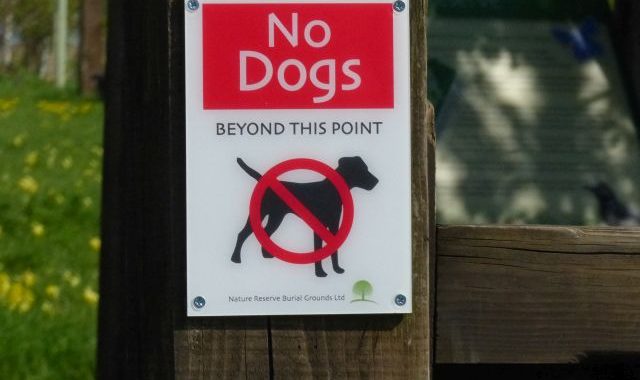
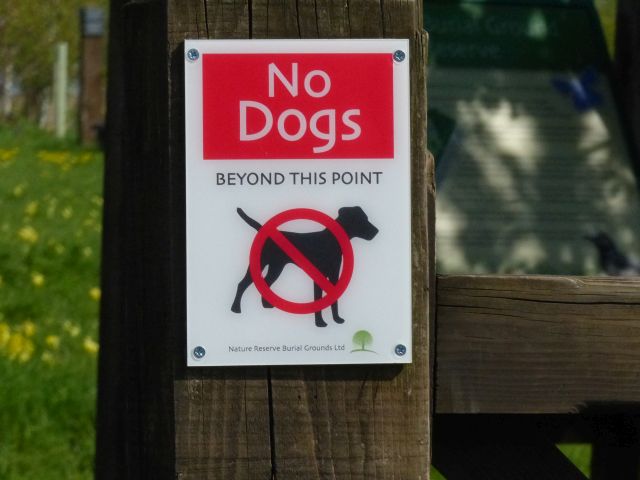
No Dogs Sign

The No Dogs Blog (Please!)

You may have noticed when visiting Sun Rising that we ask that you do not bring dogs to Sun Rising. We know that this can seem a bit draconian to some dog owners, and now and then somebody will get in touch to question the policy.  Sadly, some owners simply ignore the signs.  We promise, we do love dogs! – but the natural burial ground and nature reserve are delicate mixtures of habitat, supporting many species that thrive in the quiet, undisturbed calm of the site.

No Dogs Sign

No Dogs Sign

There are a number of reasons for the policy.  One of the main ones is perhaps the most obvious: what dogs leave behind. Although many dog owners are responsible and pick up after their dogs, the truth is that some do not. Sun Rising is a special, meaningful place to so many who have loved ones laid to rest with us. Finding dog poo on a grave, along the paths, or indeed anywhere on site, is disrespectful to their memory.  It’s as simple as that.

However, it isn’t just about faeces.  Studies have found that not only dog poo, but also urine, can impact wildlife negatively: both over-fertilise the ground. Most natural ecosystems, including our verges and wildflower meadows, are naturally low nutrient environments. Over-fertilisation reduces biodiversity, allowing vigorous plants, such as nettles and hogweed, to outcompete the more delicate flowering plants that many insects depend on, leading to an impact on all the wildlife in that food chain.

Flea treatments used on dogs can also harm wildlife, particularly in aquatic ecosystems. The insecticides used in these treatments, brushed off into long grasses, can then be washed into drain lines and on into the waterways. These chemicals are devastating to invertebrates such as mayflies, caddisflies, dragonflies, damselflies and their larvae, but are also toxic to beetles, bees and other wild pollinators.  The decline of these species then affects wildlife further up the food chain, such as birds and bats. Our pond is a wonderfully busy habitat, home to Great Crested Newts, Toads, Frogs, Great Diving Beetle, Emperor Dragonflies, Water Scorpions, and much more, all of which we are working hard to protect.

Many visitors will have seen and heard our lovely community of Skylarks at Sun Rising, singing away in spring and summer. Skylarks are ground nesting birds, building little cup-shaped nests in long grass. Dogs can harm ground nesting birds by trampling nests and eggs, causing adults birds to abandon a nest, or even worse, attacking the birds.  There are other birds, such as Meadow Pipits, Yellowhammers, Red-legged Partridge, Whitethroat, Chiffchaff, Robin, all of whose nests can be badly stressed and otherwise affected by dogs.

We understand why visitors would like to bring their dogs to walk at Sun Rising – it’s a beautiful place!  However, our duty is to protect Sun Rising, to respect the memory of those laid to rest with us and to ensure the grounds’ long-term protection as an established and ecologically-valuable nature reserve.  So, we respectfully ask that visitors please do not bring their dogs with them.

There are some lovely local walks, such as the Tysoe Windmill Walk, where you can look down and see Sun Rising below you.  Use your search engine for hikes around Tysoe.

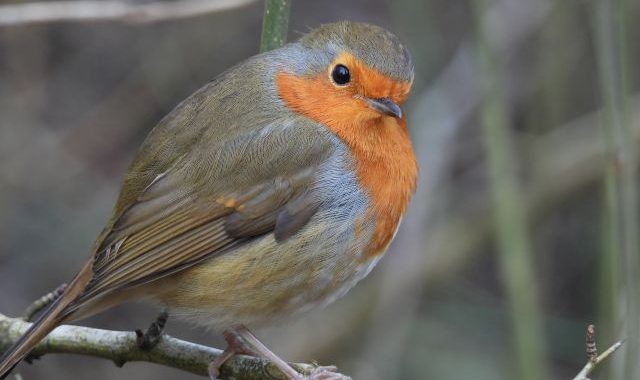
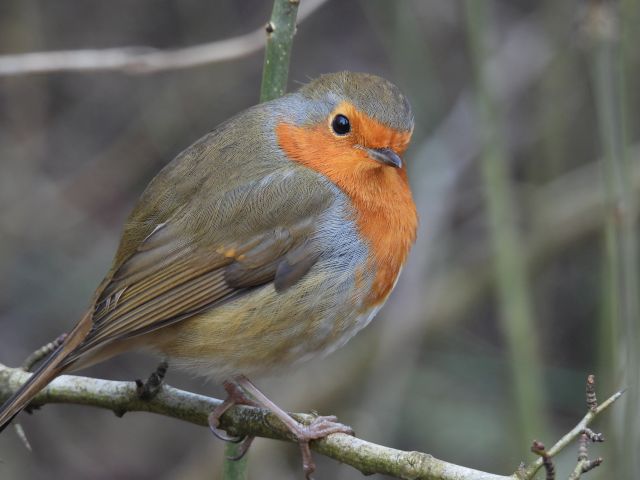
Robin

Finding a Way through Christmas

As Christmas approaches, my heart sinks.  What makes it worse is that I’m aware that my complete inability to be excited about it (or even to make the effort to pretend to be excited about it) is a downer for those around me.  With twinkly lights, sparkling tinsel and talk of Christmas shopping, my sadness is unwelcome.  My mind keeps returning to my tiny, frail, crinkly-faced mum who, with eyes open wide, whispered, “Could I please have just one very small roast ‘tato?”.  And tears stream down my cheeks.  I miss her so deeply.

For me, the last two years have been filled with grief, both my parents passing away.  My mum’s funeral was just before Christmas last year, and the foggy-headedness and bewilderment was still overwhelming.  This year, a year later, I am conscious of the oncoming festivities far more acutely, and every part of me longs to run and hide.  I tremble at the very notion of bright colours, noisy chatter and easy laughter.  I long for solitude, the sort of solitude that comes when outside amidst trees and a cold breeze, where it is easy to weep yet feel held by nature, where the song of a robin is utterly captivating and somewhere eases the despair.

Robin

Robin

For some, being surrounded by loving family, and particularly the younger generations of children, grandchildren and even great grandchildren, is exactly the support they so desperately need when the crashing waves of grief are still coming, and what a blessing such families can be.  For others, though, a supportive family either doesn’t exist, or simply cannot help.  The roiling emptiness of loss, like a dark storm in the belly, tearing at the heart, shaking the fabric of reality, can only be held by stillness.  When even the simplest question, asked with sincere kindness, feels like an unbearable demand, the answer is to find quietness.

For me, one of the most valuable aspects of Sun Rising is its gentle community.  As we walk alone down a path between leafless trees or winter meadow, we see another solitary soul making their own pilgrimage to a loved one’s grave.  No words need be shared, but there is a comfort in knowing we are not the only ones coping with the desolation.  Our own parents, their parents before them, those before them, generation before generation, have had to manage death, again and again.  We survive, learning, albeit tender and bruised.  Standing quietly, allowing our eyes to focus on the distant horizon of hills, fields and woodland, we make it through.

If this Christmas you are coping with grief, you have my profound empathy.  I hope you are able to find the support, or silence, that you need, with or without the twinkly lights and laughter.

Yellow Field Cap Mushrooms

A Matter of Death, and Life!

We would be in trouble without fungi. One reason for this is that, without fungi, we would be buried under tonnes of decaying matter.  When something dies – whether a plant, animal, even us humans – fungi play an important role in breaking down the physical matter into useful things, like nutrients and minerals.  They are also integral to how the majority (some 90%) of plants and trees grow.  Don’t bother to try to dig up a wild orchid to grow in your garden, unless you are prepared to bring a substantial amount of the surrounding earth with you, undisturbed, as this will contain the microscopic mycorrhizal network without which the orchid will not survive.  You can find out about this amazing relationship in Peter Wohllenbens’ The Hidden Life Of Trees.

This month we hosted a fungi walk at Sun Rising, looking for the fruiting bodies of fungi that push up above ground, typically at this time of year, which we know as mushrooms (or toadstools – the terms are interchangeable). There are an estimated 15,000 species of fungi in the UK, but without mature woodland and ancient pasture, Sun Rising is not yet as rich in fungi as we’d like.  We are discovering new species every year, however: we’ve recorded about 30 species so far.

Yellow Field Cap Mushrooms

Yellow Field Cap Mushrooms

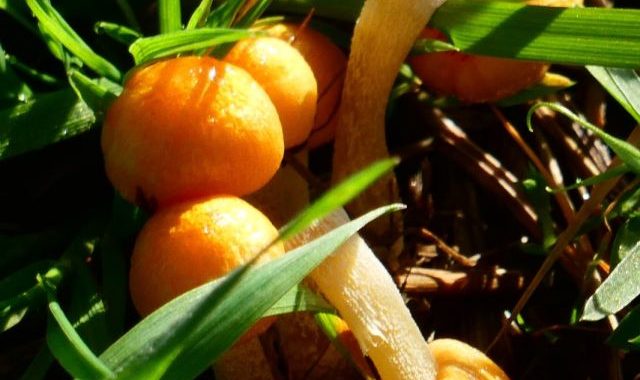
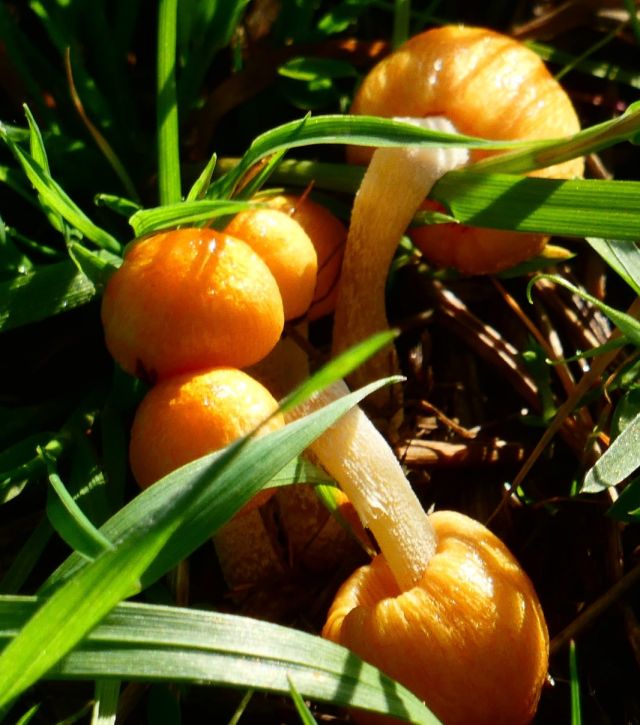
One mushroom found across the nature reserve this year has been the Snowy Waxcap (Cuphophyllus virgineus) which is a nice indicator of healthy grassland.  Another is the Weeping Widow (Lacrymaria lacrymabunda).  This has been found on a good number of last year’s graves, clearly favouring disturbed ground; the name comes from the black watery droplets which can be seen on the cap and gills when it’s moist.  The Yellow Fieldcap (Bolbitius titubans) is a bright yellow mushroom which prefers richer soil, and won the prize for being the most colourful – it’s also called Egg Yolk Fungus.

There has not as much variety as last year in terms of fungi at Sun Rising, probably because of the dry summer and recent frosts.  However, we saw about 10 species on the walk, and a couple of new ones.

Thank you to Peter Landsman for the wonderful photograph above.

Sloes and Haws in the Hedgerow at Sun Rising

It’s Nuts Out There!

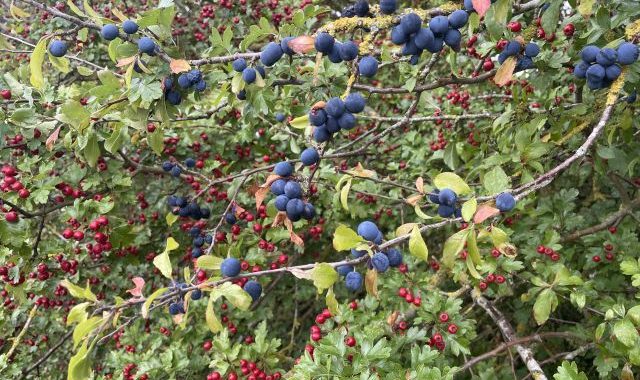
Over the last few weeks, Sun Rising has transformed into autumn. The air has cooled, the ground bathed in morning dew, the leaves so many bright jewel colours now falling to the woodland floor.  Mists have begun to roll in as the northern hemisphere of this beautiful planet prepares for its winter sleep.  As the season has turned from warm and dry to chilly and damp, an abundance of berries, seeds and nuts have appeared in the hedgerows and trees.  Indeed, the Woodland Trust has confirmed that 2025 is what is known as a ‘Mast Year’, an event that seems to occur roughly every five years, the last being in 2020.

Folklore declares that a bumper crop of nuts, seeds and berries means a cold winter is on the way. However, this isn’t the case: nature doesn’t predict the future. Mast years are one way in which a tree ensures its species’ survival.  When a tree produces a large crop of nuts, the animals that eat them such as jays, badgers, mice and squirrels, can’t eat them all, so more are likely to germinate and become new saplings the following year.  The fruits eaten, of course, provide plentiful seeds, deposited in little packets of fertiliser.

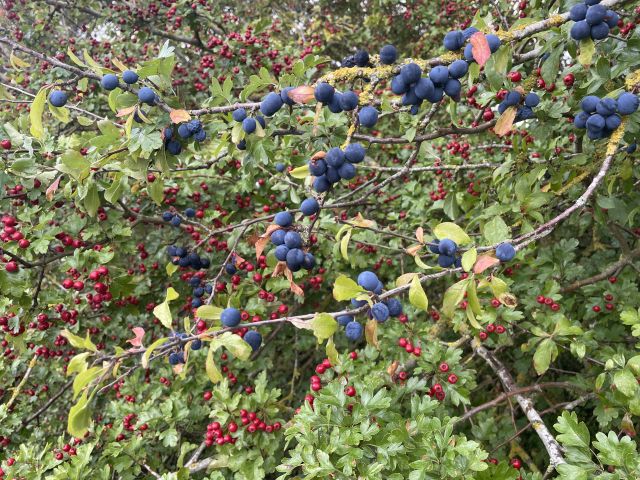
Sloes and Haws in the Hedgerow at Sun Rising

Sloes and Haws in the Hedgerow at Sun Rising

With trees across vast areas having large fruit crops in the same year, in a mast year it can look as if they have synchronised their behaviour. Science is now certain that trees do communicate, using chemical signals within underground fungal networks, through which roots connect with roots, the extent of their communication is still a mystery.

However, a key factor that’s easier to understand is the weather.  How much fruit a tree can produce is, in part, based on the weather conditions of its flowering period. This year saw a very warm, dry spring – perfect conditions for flowers to bloom and insects to come out in numbers to pollinate, and as any gardener knows, plenty of pollinated flowers means a good crop of fruit. Yet, producing so many nuts, seeds and fruit takes a lot of energy; they can’t do it every year, which means next autumn there is likely to be considerably less, regardless of what weather comes in the spring.

A mast year doesn’t just provide us humans with the means for extra fruity fruit pies: it can be seen right across ecosystems.  The increase in fruit means a significant increase in food for wildlife, particularly small mammals such as the wood mice and field voles that live at Sun Rising.  This will give a hearty boost to their populations, with a knock-on effect of also increasing the numbers of their predators, such as kestrels, owls and stoats.  With a smaller crop next year, those increases will be kept in check once again.

However a mast year comes about, it showcases the resilience of our trees and woodlands, and why they are so important. Enjoy the sight of the bountiful crops this year, and remember: every acorn, maple seed, hazel nut, rose hip, cherry, privet berry, blackberry, crab apple, sloe and haw will grow the next generation, not only of trees and shrubs, but also of small mammals, birds and insects.

Celebrating the Pond

The pond at Sun Rising is a favourite spot for many of our visitors.  After the gentle walk down there, it is a quiet place to sit down and enjoy the peace of the nature reserve. The shelter from the mature shrub bank of dogwood, with the willows behind, feels holding and safe, while the soft buzzing of life dances on the water’s surface.  In the summer, you can watch damselflies darting amongst the rushes and reeds, and dragonflies sweeping back and forth across the water.  Great crested newts, toads, whirligigs, pond skaters and water scorpions, together with so many others who call the pond home, can be spotted going about their busy lives. The rest of the world seems somehow further away, softened by the gentle pause this corner offers its guests.

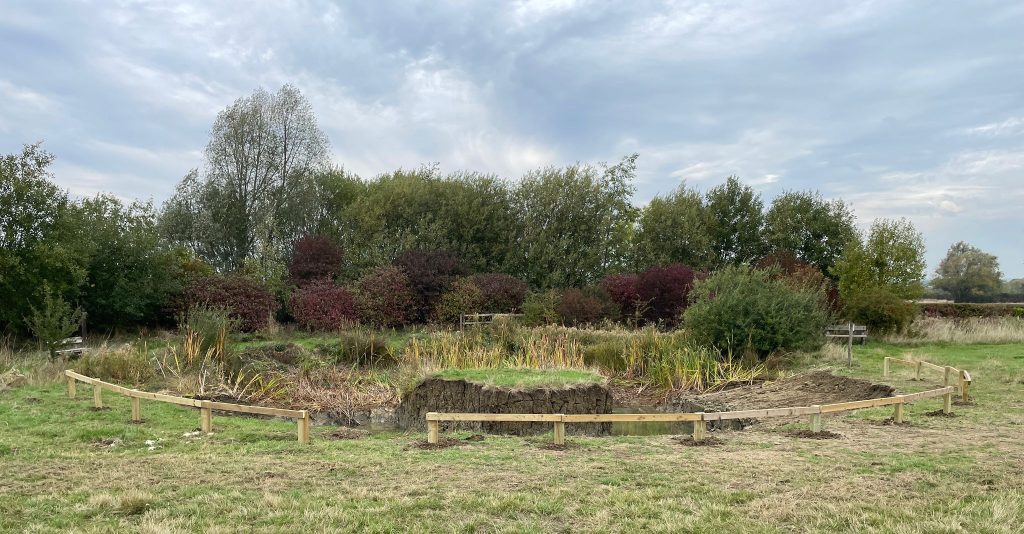
Over the last few weeks, there has been some excitement and action in this typically tranquil spot, as we undertook the long awaited process of expanding the pond.  The diggers have been around to shape out the new half, almost doubling it in size. Archie’s Island now stands in the centre, a future refuge and nesting spot for moorhens or ducks, safe beyond the reach of the foxes and neighbourhood farm cat!

The Newly Dug Pond Extension, now Fenced

The Newly Dug Pond Extension, now Fenced

As we wait for the rains to come and fill the pond back up, the lack of water may feel a bit alarming (or at least it did to me!). But be assured, at this time of year the newts will be sheltering under some cosy log for the winter, having finished their breeding season over the summer.

The lack of water does, however, show off the careful shaping of the pond: a gentle slope down to the deeper loop, allowing deer, badgers, foxes and other mammals easy access to the water, making it safer for amphibians to come and go, and giving space for marginal vegetation to grow.  It looks bare at the moment, but with a little time the edges will soften, the water mint and marigolds, irises and meadowsweet, sedges and reeds will green it up once again.

The importance of the pond to people that love Sun Rising has been expressed through the great number of people who so kindly donated towards the crowd-funding of this project! We were overwhelmed by people’s generosity and we (the staff and the thousands of creatures who live in and around our pond) want to extend a huge thank you to everyone who has played their part of getting the work done.

Four-spot Orb Weaver Spider

24 Hours of Wildlife

On Tuesday 5 August we held a lovely event – a bioblitz. This ran all day from 7am – 10pm, with the help of a great bunch of enthusiastic volunteer wildlife spotters. A bioblitz is a collaborative event during which participants attempt to find and document as many species of plants, fungi, animals and other living organisms as possible. This gives us a snapshot of the biodiversity at Sun Rising, which is really important, giving us a better understanding of the wildlife we are protecting on site and the wildlife we are missing!

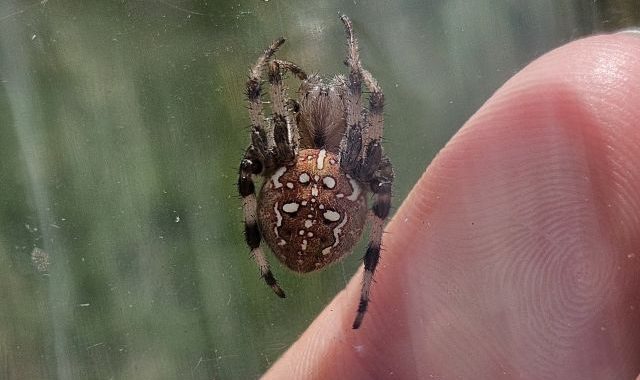
Four-spot Orb Weaver Spider

Four-spot Orb Weaver Spider

We were lucky with the weather which, although rather windy, was warm and dry. Despite the wind, we managed to spot a wide range of wildlife species, including many butterflies out bravely soldiering through the gusts.

The day started with a beautiful collection of moths that our fantastic specialist moth-er, Alan, caught in his moth trap over the previous night. These included species such as the Blood-vein, the Drinker, Canary-shouldered Thorn, the Magpie and Poplar Hawk Moths. Our volunteers enjoyed an up-close and personal experience with our moths before we let them go safely into the undergrowth.

A morning bird walk followed, with the sounds of Bullfinch, Greenfinch, Long-tailed Tit, Linnet, Wrens and many more! We spotted Kestrels, Red Kites, Buzzards and Sparrowhawks, searching for their breakfasts.

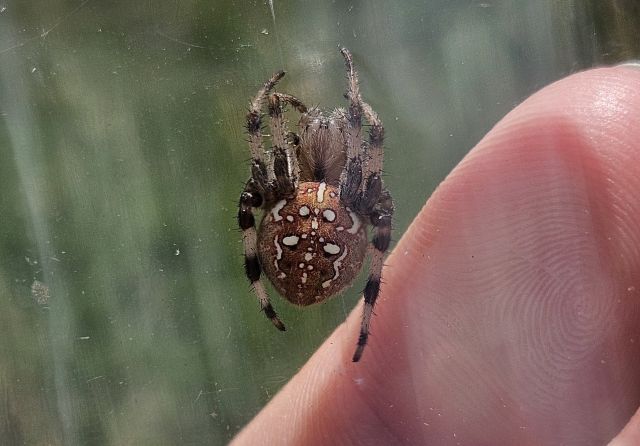
Volunteers then had a chance to walk around the site on their own to see what they could spot; some were interested in lichens and fungi, some decided to search for insects in the meadow grasses. We found an amazing array of insects such as the Four-spot Orb Weaver spider, Common Carder Bees, Swollen-thighed Flower Beetles, Ruddy Darter dragonflies and Azure damselflies, various ladybirds, grasshoppers, hoverflies, lichens, galls and much more!

We counted eleven butterfly species with beautiful Gatekeepers, Green-veined Whites, Small Coppers, Speckled Wood and Common Blues amongst them.
There was pond dipping with diving beetles, pond skaters, dragonfly and Mayfly nymphs.

Our mammal traps didn’t capture anything which is frustrating, as there are so many little voles and mice around the site.  However, a quick look under one of our refugia sheets unearthed a rather surprised Field Vole, and once dusk arrived later in the day we were able to make out Soprano Pipistrelle Bats flying around the pond.

In all it was a thoroughly enjoyable day, very much helped by the community spirit and enthusiasm from our volunteers.  Our final count was almost 300  species, which was pretty impressive given that most of our exploring was not methodical or systematic!

We aim to repeat the Bioblitz every 2-3 years, which will let us build up a good overview of what we have on site, what we are missing, what might be new as the nature reserve matures, and what we might lose as climate change impacts biodiversity.  As a 24 hour snapshot, it will be a fascinating addition to our regular surveys and transects.

Thank you to the volunteers who came along and helped to find and count such an wonderful number of species!

An Evening with Anton Lesser

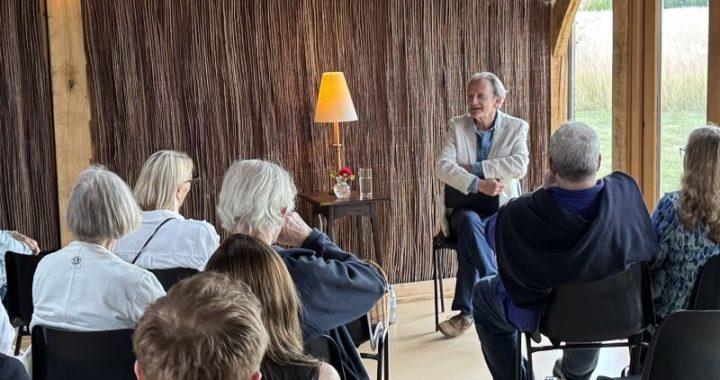
On Sunday 27 July, we held a wonderful evening in the Longhouse with celebrated actor, Anton Lesser.  Known for his roles in films and television series such as Andor, Wolf Hall, Endeavour, Game of Thrones and The Crown, but perhaps even better known locally for his part in so many Shakespeare plays at the RST in Stratford, it was an honour to have him with us at Sun Rising.

Bringing his beautiful calm, his mischievous vitality, and his warm generous smile, Anton answered questions from the audience, weaving his answers into anecdotes, mostly with laughter, sometimes with tenderness, but always with a self-effacing honesty.

With canapes and good wine, a gentle warm evening, people spilled out over the grass behind the Longhouse before he began and during the pause at half time. It would have be tempting to carry on for another hour into the night, but as the sun set, casting a golden light into the building, we knew it’d soon be dark.

The event raised almost £1200 for The Friends of Sun Rising, our charity that will provide care and protection for the grounds into the long-term future.  We are so grateful to Anton for giving us his time, to all who bought tickets for the event, to the family who so kindly covered the cost of drinks, and to our trustees who provided the canapes and helped put it together.  Thank you!

Large Skipper on Musk Mallow

Buzz Words

Towards the end of June, during the Royal Entomological Society’s National Insect Week, here at Sun Rising we devoted a day to insects and spiders.  Most people still think of insects and spiders as creepy crawlies – unpleasant at best, and terrifying at worst! – but we were all about celebrating the amazing creatures we have here in Britain and raising awareness about the importance of their role in the environment.  Given their crucial role in every ecosystem, and how populations are still decreasing so fast with climate change and habitat destruction, understanding these flying, creeping, crawling, humming, buzzing, scampering, transforming, colourful and ingenious insects and spiders is really important.

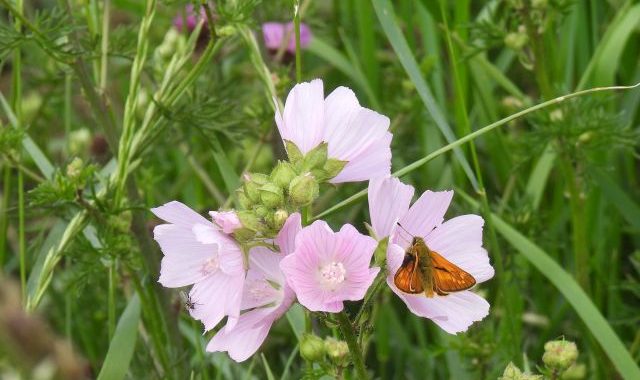
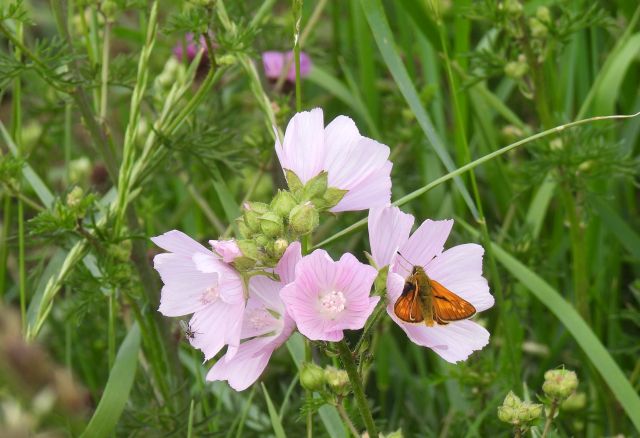
We were lucky on the day, with the sun shining brightly, which certainly helped to bring out the insects and spiders.  We had a fantastic array, including hundreds of butterflies all out enjoying the warmth. Those who came along to the event were lucky enough to spot at least eleven different species of butterfly, including Ringlets, Painted Ladies, Marbled Whites, Gatekeepers, Commas, Brimstones, Meadow Browns, Speckled Woods, Peacocks, Small Tortoiseshells, skippers and whites.

Large Skipper on Musk Mallow

Large Skipper on Musk Mallow

Our list of insects was far from comprehensive, as we saw many that we didn’t or couldn’t identify.  There were moths, honeybees, mason bees, sweat bees, Red-tailed Bumblebees, white-tailed bumbles, ladybirds, soldier beetles, shield bugs, hoverflies, damselflies, dragonflies and perhaps thousands of grasshoppers and crickets.

We spent time looking at the different habitats we have on site, including the wildflower meadows, hedgerows, woodland and grassland. It was particularly interesting to move from one habitat to the other and note the change in insect life. Shield bugs and Speckled Wood butterflies were aplenty in the woodlands but stayed out of the wildflower meadows which were the domain of the Meadow Brown butterflies and Swollen-thighed Flower Beetles – a reminder that diversity in habitats is so important for the diversity of insect communities.

Participants also tried their hand at pond dipping, unearthing a few different beasties such as water scorpions, dragonfly nymphs, diving beetles, pond skaters and even a diving beetle larva who gave us a show as it caught, and ate, a water boatman!

With regard to spiders, we were privileged to have with us Richard Pearce from Moreton Morrel College, who carried out our first official and comprehensive spider survey.  We’re awaiting his data with anticipation and will share it in another blog when it comes.  We also had Carl Portman, whose areas of expertise is tropical spiders (he brought along the large, furry shed skins of some of his tarantulas which were fascinating to see up close!), but whose enthusiasm for all creeping and crawling creatures was wonderfully contagious.

Funeral at Sun Rising Natural Burial Ground

Green Living, Green Dying

This week is Great Big Green Week and all across the UK, communities are coming together to swap knowledge and skills for improving sustainable living. It’s a wonderful opportunity, not just to send a loud message to those in power that we sincerely care about our planet’s future, but to remember that individually we can each make a difference too!

While much of the Great Big Green Week focuses on green living, here at Sun Rising our area of expertise is green dying: how to have the most environmentally-responsible funeral possible. How can you make sure that your death doesn’t literally cost the earth?

Funeral at Sun Rising Natural Burial Ground

Funeral in the Peace of the Nature Reserve

Arguably, the most significant choice you can make is to choose a natural burial – not a cremation. Cremation is the most polluting decision that can be made in the funeral process. Crematoria generate huge amounts of climate-changing CO2, when we know we must all reduce our carbon footprint.  They also pump out significant and dangerous levels of pollution, increasing acid rain and worsening breathing difficulties and allergies.  Further, they consume huge quantities of energy: at an average of 1000°c for 75 minutes per person, an entire household might use this much energy in a month!

The ashes themselves are toxic to native wildflowers, potentially harmful to wildlife, polluting water systems if scattered irresponsibly. Many people choose to scatter ashes in beautiful natural areas because they deeply appreciate the peace and serenity that nature brings – yet, by being cremated, they are badly damaging that very beauty they loved so much.

A natural burial is by far the most low-impact type of funeral. A simple and clean return to the earth, with a biodegradable, sustainably or locally-made coffin, free of the poisons and plastics you get from embalming or using a veneered chipboard coffin made with formaldehyde resin. Burial is carbon capture: rather than releasing CO2, it takes your body’s carbon safely into the earth. Living memorials such as trees and wildflowers take away the need for unethical and expensive headstones, and instead create and protect a green space in the land for wildlife and nature.

In the spirit of Great Big Green Week, we encourage you to share all your green tips with your friends and neighbours.  But don’t just talk about gardening for pollinators, or recycling, upcycling, fixing and mending: we ask you to share these facts about cremation.  With large corporations spending millions advertising direct cremation for their own profit, we need each one of you to choose natural burial and encourage others to do so too.  Let’s leave our grandchildren a world greener and cleaner than our parents left us!

If you are interested in knowing more about green funerals, please feel free to get in touch.