Snowdrops

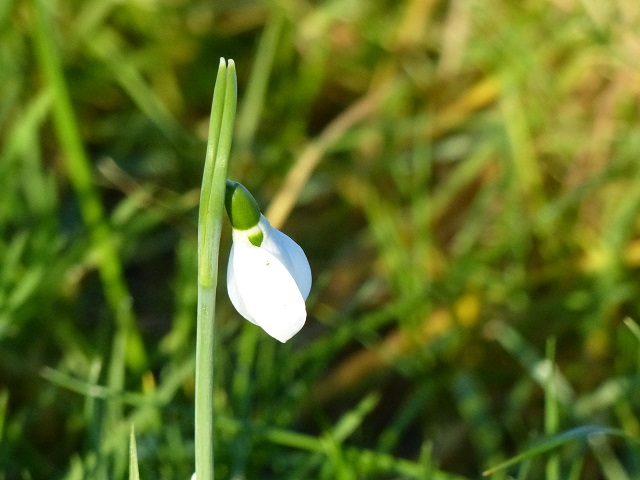
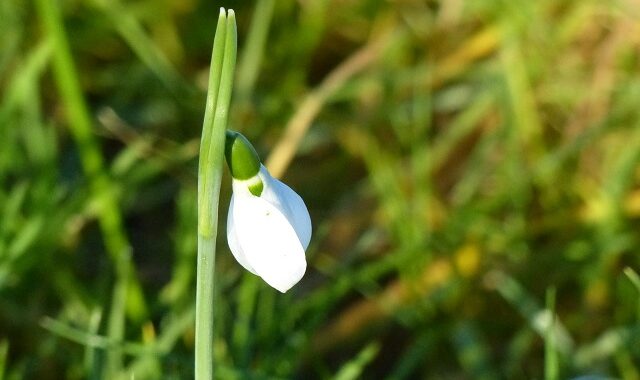
Each year, the arrival of the first snowdrops feels magical.  Whether they reach up through messy wet mud, tatty winter grass, the crust of frost or indeed a layer of snow, they appear so extraordinarily pristine.  At Sun Rising, the very first are now coming through, in twos or little clusters of half a dozen.  Some are opening into full flower, and some still little buds, almost impossibly white.

One of the First Snowdrops

One of the First Snowdrops

With recent rains, the paths and grassy areas near new graves are a bit muddy.  With fewer visitors because of the pandemic, it is easier than perhaps it might be if there were free movement.  But the muddy grass only goes to show the snowdrops as more beautiful.

As we clamber through the winter, tired of cold winds, grey skies and long dark nights, the snowdrops are perfect little gifts of hope.  You still might miss them if you look for them now, but over the next few weeks there’ll be more and more.  Spring will come …

Winter’s Stillness

It’s hard believe how time has flown by recently.  It has been on my mind to write another blog for what I now realise is over two months.  I do apologise to those of you who rely on these blogs for news and photographs of Sun Rising.

Since my last post, we have planted over 160 trees at Sun Rising, most of those being memorial trees for loved ones laid to rest in the growing woodland.  Further saplings were planted around the top car park, as part of the gentle development in that area.  Another dozen were planted near the butterfly stones, where in time we hope they will provide a break in the prevailing wind, adding to the valuable shelter of the stones, for butterflies and other invertebrates too.

Then came Christmas, and for Sun Rising that means festive wreaths!  However, this year we have been delighted to see how many families used our Approved Florists, and how many others created their own 100% biodegradable tributes.  The amount of rubbish that had to go to landfill was down to half a bag this year: thank you, everyone!

As the new year opens before us, it is often January when the cold really kicks in, and this last week or so has proven that.  Today, after a few days of freezing fog, Sun Rising was softly blanketed in a covering of snow.

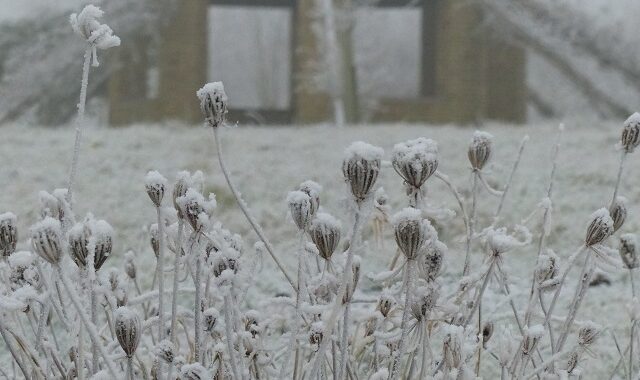
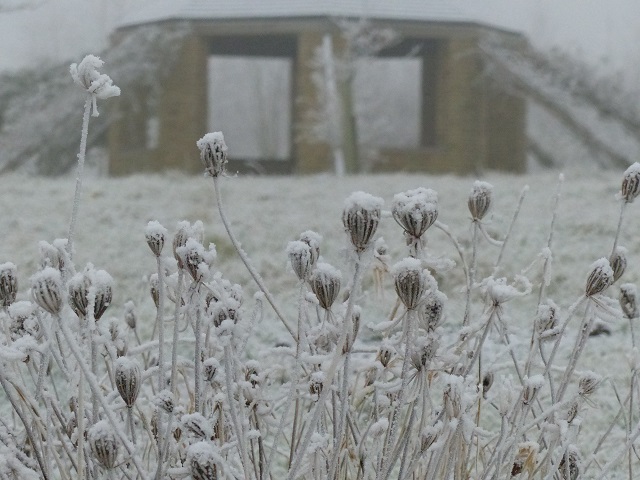
Snowy Wild Carrot Seedheads

Snowy Wild Carrot Seedheads

Yesterday’s hoar frost had not melted at all, and the new snowfall simply coated the frost, making a thick fluffy layer of pure white on branches and old seedheads, such as the wild carrot (Daucas carota) in the photograph here.  Time may be slipping by, but the snow lent a strong sense of stillness.  We scattered birdseed for the wild birds, but little was moving, not even the wind.  It was beautiful.

I did spot the first flower buds of snowdrops, hidden in the frosty grass …

Viburnum Reds

How good the autumn leaf colours will be is actually rather hard to predict.  There are so many variables: day temperatures, night temperatures, winds and rainfall as October comes to its final weeks, as well as the health of the trees, how dry or wet, hot or mild, the preceding summer, and so on.  Nature is skilled at surprising us.

This year, most of our field maples are yellow: there are very few golds, bronzes and coppers there.  The silver birch are a beautiful pale yellow.  The cherries, which struggled the most during this past year, with its hot dry spring, have been losing leaves early; only one or two have the beautiful array of deep caramels and russet.  With a fairly chilly autumn, the wild service trees are undecided: some have gone from green straight to yellow, a few are displaying a range of reds, and some are all a soft toffee-gold.  Fascinating, however, is that each wild service tree has just its own colour, while in other years a tree might display leaves of all colours.

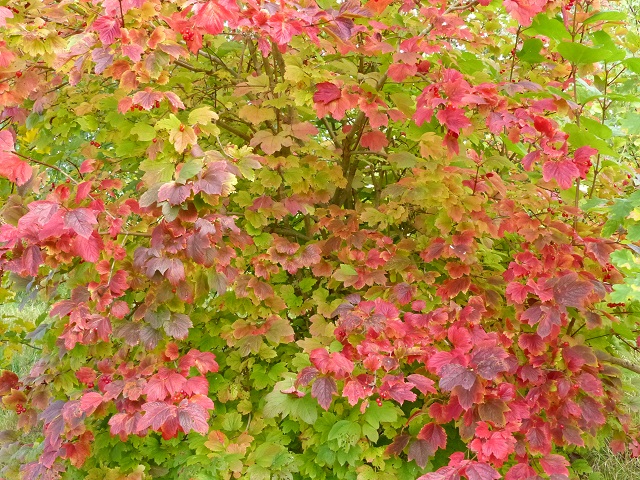
Guelder Rose in Peter's Wood at Sun Rising

The beautiful autumn reds of a Guelder Rose in Peter’s Wood at Sun Rising

The guelder roses have often lost their leaves by this time, but this year we have some exquisite colours.  This native viburnum, Viburnum opulus, is such a happy addition to our memorial woodlands, with its spring flowers, bright red berries and explosion of reds from August to October.  In the past week, I have seen a good number of Sun Rising visitors stop and stare at the guelder rose in the photo above, a smile on their face, time gently slipping by.

The yellow leaflets of the ash are now littering the paths, there are windfalls beneath the crab apples, and with the slightest gust of a breeze leaves are lifted on their journeys, floating and dancing to the ground.  Autumn is at its best, teaching us, inspiring us, that it is possible to let go with grace.  In another fortnight, I expect the woodlands and hedgerows will be almost bare once more.  A little stopping-and-staring at this autumn’s beauty is well worth doing before then.

Rain

After a spring and summer of anxiety about how very dry the soil is, striving to keep alive the youngest saplings through months of drought, at last we are having some rain.  It isn’t yet seeping down, though heavy parched earth, far enough into the ground to last very long, but it is a start.  The difference is already showing, the trees beginning now to perk up, leaves looking a little fresher.

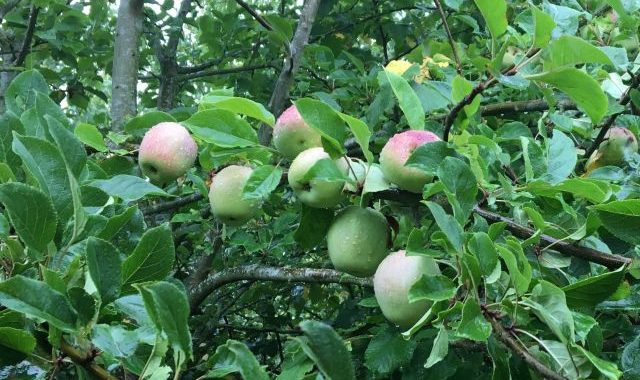
Rain-wet Apples

Rain-wet Apples

This rain will help the production of fruit in the older trees too – apples, blackberries, rose hips, haws and sloes, all needing some moisture to plump up and sweeten.  After so much dry, it is a delight to feel the rain on one’s skin, and walking through the woodland areas I can almost feel the same relief in the trees around me.

Of course, while more rain is still needed, we would like it to pause, allowing us time to cut the wildflower meadows, and feel the sun on our faces, warm and bright, before the autumn comes in.  Oh, how complicated it is, longing for balance between wet and dry …

Bringing in the Hay

As we slide into August each year, I become very aware of how tatty and tired everything looks around me.  Perhaps because I too feel tatty and tired!  The grasses are drying, much of the wildflower meadow is stiff stalks and seedheads – which means, whenever anyone ignores our requests to stick to the paths and tracks and walks into the meadow, their footprints remain.  Plants don’t stand up again.  With the current heat, everything is looking parched.  The lush green of England is faded.  As the crab apples swell, the hawthorn berries redden, the verges yellowing, we all long for cool fresh rain …

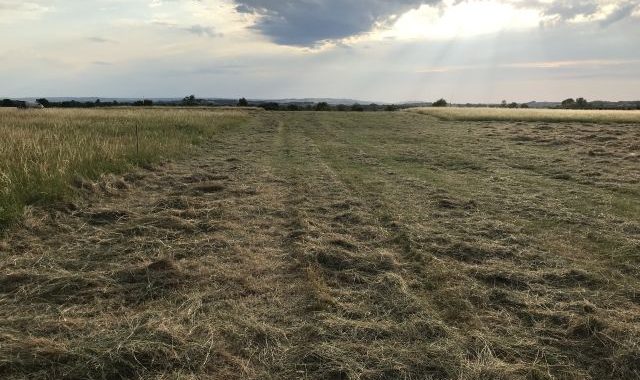
The Torch Mown looking to the West

The Torch Mown looking to the West

Except, of course, not in the middle of haymaking!  It’s at this time at Sun Rising that we begin to cut the grassland.  This year, James brought in a perfect-sized tractor to cut small sections of the grassland that in years to come will become woodland, leaving plenty of grass entirely undisturbed, where moths and butterflies still dance in the heat, little grasshoppers and crickets humming.

Then he went right down what we call the Torch: the area down the middle of the northern grassland which we are beginning to transform into wildflower meadow.  You can see it in the photo above.  Either side of the cut area will, in decades to come, be planted with shrubs and trees, while over time this central stretch will be enriched ecologically with more and more widlflowers.

This year the grassland was gathered into small bales and went as fodder for livestock at a local organic farm.   And now, to be honest, with our hay safely brought in, frankly we’d be more than happy to see some good rain …

Moving towards Harvest

Perhaps because we have not been able to hold our usual summer events, the year seems to have slipped past very quickly.  Looking around at Sun Rising, we are very definitely moving now into late summer.  The wildflowers first to flower are now seeding, and the meadows are filled with the later flowering plants: yarrow, knapweeds and bedstraws.  The little pink flowers of field bindweed are scattered along the verges.  The air feels heavier, as the drying grasses move in the breeze.

Wildflower Meadow to Young Woodland

Wildflower Meadow looking towards Growing Woodland

Over the next few weeks, areas of grassland will be cut, lined, dried and turned, then baled to be taken off to feed winter livestock on a nearby organic farm.  We cut small sections, of a third to a half acre each year, leaving other areas untouched for the wildlife.  And there’s plenty of it out there in the grassland: hares, linnets, skylarks and goldfinches, the butterflies like meadow browns and marbled whites, countless moths and humming grasshoppers, as well as little newts, voles, beetles, crane flies, spiders.

Wouldn’t it be lovely (in my eyes) if we could have folk come and scythe the grass, allowing the process to be slower, quieter, more careful, care-full, perhaps even creating old fashioned hayricks.  However, there are no such teams moving through the landscape as there were a century ago, and I’m not the one who would be doing the very hard work that is scything … so a young fellow called James will be coming with his tractor.  I’m hoping that in my next blog post I can show you the result.

Of course, we’ll need to wait until the rain passes in order to cut the grass.  While dreary grey days and drizzle can be wearying to the soul, and they continue to delay the haymaking, we are  grateful for these wet days too.  Some of the youngest trees here suffered considerably through the months of heat and drought earlier in the summer.  Some which we thought might have died are in fact now recovering beautifully, and may well be tougher because of the experience.  Some haven’t really got going this year – but, if the next nine months are less challenging than the last, they have a good chance of thriving.  No doubt, at the moment, some of us feel the same about many other things in life.


Managing the Wildness

With Midsummer now behind us, we have reached the point in the year where the vibrant green growth of summer is slipping past its peak.  Indeed, after the heat of the last few months, some areas are already starting to look really rather wild, a good two to three weeks earlier than usual.  The meadow won’t be cut until the end of August, when all the wildflowers have gone to seed, but where there are more grasses than anything else, we are beginning the process of cutting.

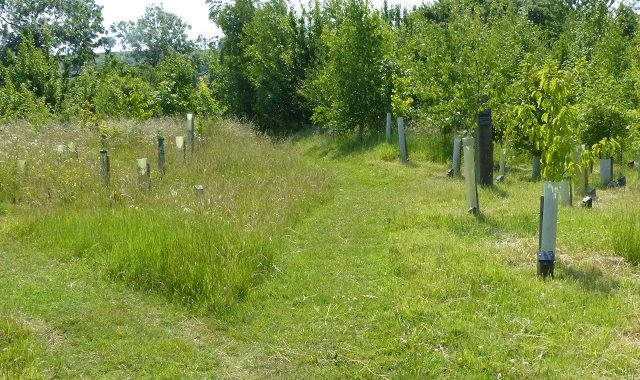
In woodland burial areas where the trees are still very young, this means ‘topping’: we strim down to around 10″, raking off the heavier cut, and leaving the finer arisings to mulch down.  We start around the youngest saplings, and work back to where the trees are themselves suppressing the grass growth.  Where the short grass is dry, it will green up and grow again but, as it has already seeded, this second surge of growth won’t have the density of the first.  Nor will it take up so much water, leaving the moisture in the soil for the little trees.

Grass Cut at Different Levels by Peter's Wood at Sun Rising

Grass Cut at Different Levels by Peter’s Wood at Sun Rising

Parts of the broader grassland areas will be cut over the next month too.   In the northern part of the site, where there will be woodland in time, our management map divides it into 1/3 – 1/2 acre sections, cut in cycles of 3 or 4 years or longer.  Each year, 3 or 4 such small sections are cut, the arisings left to mulch down, adding some fertility and texture to the soil. Where there will be wildflower meadow in the future, the cuttings will be baled and taken off.

The third type of grass management is, of course, the mown paths and verges.  These different approaches make for three different grassy habitats, for invertebrates, birds and mammals.  You’ll see hares using the mown paths as easy ways to move around the site, diving into the long grass to hide when need be.  Wagtails enjoy the shorter grass too, picking out flies, spiders and beetles.  Over the uncut grass, you’ll see skylarks, linnets, goldfinches and other birds, taking both flies and seeds.  There are skylarks and partridge nesting in the long grass.  And on the mown paths, you’ll see daisies, clover, hop trefoil and cut-leaf geranium, making the most of the light.

An Update on Tree Sparrows

One of the key reasons why tree sparrows have lost so much ground, their population crashing so badly over the past decades, is that they are such shy, cautious little birds.   Unlike the house sparrows, which have evolved to live amidst the clamour and clatter of human beings, their cousins the slightly smaller tree sparrows have found themselves increasingly with less space and fewer resources.  With a small colony of breeding tree sparrows at Sun Rising, earlier this year we began a determined effort to help.

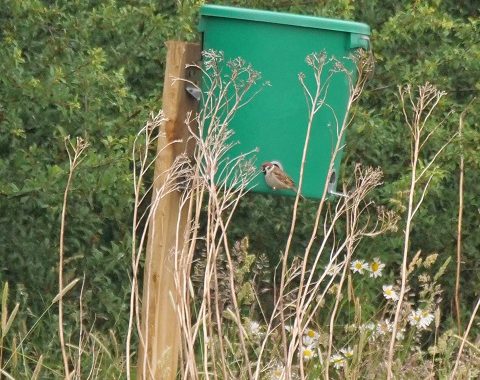
Tree Sparrow on the Field Feeder

Tree Sparrow on the Field Feeder

Because they are nervous creatures, we knew it would take them a while to trust the new feeders and nestboxes.  While we have been watching their progress from afar, COVID-19 lockdown has meant the professionals haven’t had a chance to monitor them properly.  That is now gradually changing, and this week Mike from the Banbury Ornithological Society was able to confirm that there are breeding pairs on site.  The picture here shows one of the little sparrows at a new field feeder filled will red millet, the tree sparrows’ preferred grain.  They can also be seen flying in and around the wildflower meadow, catching insects for their chicks.

Thanks again to all of you who have donated towards the costs of the project, and let’s hope they find increasing confidence at Sun Rising, and their numbers steadily grow.  This means, of course, that visitors should stay well away from feeders and nestboxes – you can safely watch at a distance, but please do not get close!  For more information, have a look at the project webpage.

A Sea of Daisies

There’s an extravagance of oxeye daisies here at Sun Rising at the moment.

Oxeye Daisies in Michael's Meadow

Oxeye Daisies in Michael’s Meadow, looking towards the Roundhouse

This is in the area known as Michael’s Meadow, the acre and a half which we have been working on to establish new wildflower meadow.  It’s been a challenge from the start: having sown the meadow in October 2017, the problems started with the tremendous icy storms of March 2018, when seed-rich topsoil washed away with the melting snow.  That summer we had drought, when the earth baked dry, leaving large patches of bare soil, which were happily populated with groundsel and thistles.  With a little fresh seed in the autumn of 2018, the summer of 2019 was really its first season, and many of you will have seen the rich displays, notably of oxeye daisies and yarrow.

However, when rain began in late summer, it was persistent, continuing for some seven long wet months.   A wildflower meadow needs grasses, and as yet few have really taken hold in Michael’s Meadow.  The grasses are important to the habitat, not only providing a richer ecosystem, but also helping to create and maintain a good soil structure.  Without grasses, this meadow became very waterlogged through the winter.  As spring came, we hoped for a little more balance – but we’ve had virtually no rain since March, and the scorching heat has created deep cracks in the clayey soil.

As a result, we have oxeye daisies in great abundance.  These sturdy plants can cope with very tricky conditions, and they are thriving where other wildflowers have found it harder to take hold.  Indeed, often a year or two of thick oxeye daisies mark the start of a developing wildflower meadow: they are quick to get themselves established.  However wonderful the sight is, this is actually only a stage in the process of creating a successful meadow  In time, the many other species we are nurturing will begin to come through: the scabious, trefoils and vetches, agrimony and sorrels, with their beautiful flowers, but also the grasses.  As the meadow establishes, this amazing display won’t be an annual feature.  Instead, it will be far richer mix of plants, colours and textures, with all the associated richer biodiversity of bees, butterflies and other invertebrates.  Until then, let’s enjoy the fantastic exuberance of the oxeye daisies.

Happy Mothing

On Wednesday last week, we hosted our first moth survey in seven months.  Indeed, it was the first time our principal recorder, Alan Prior, had been out recording in seven months.  During particularly bad winters, there may be short periods when it isn’t worth heading out, but this gap was unprecedented.  For Alan, who has been seriously mothing for over 18 years, it was the first time such a gap has been enforced: primarily by what he called the ‘truly relentless atrocious weather’ – persistent rain and winds – compounded then by the COVID-19 lockdown.

Setting up the light traps while serenaded by a garden warbler, he was keen to see what effect the winter had had on moth numbers at this his ‘favourite place’.  The other surveyor, Martin, kept the requisite distance, manning his own traps and Alan tells me that, as they ate their lunch (around midnight) ‘there were a lot of bats zooming about’ – no doubt themselves lunching on the moths!

By the time the last trap light was turned off at 3.45 am, they were both ‘very satisfied with a wonderful night’s moth recording’.  They’d counted in the region of 90 species, including at least 5 new for Sun Rising.  When at last Alan made it to bed, he was ‘aching all over from not having done anything much for months,’ but ‘happily dozed off quickly with a big smile on my face’.

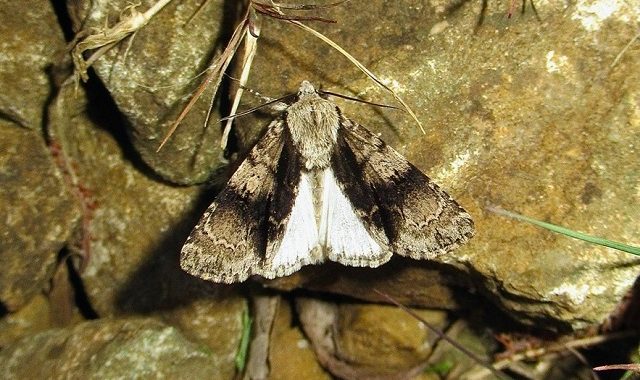
Alder Moth at Sun Rising

Alder Moth at Sun Rising

Nature doesn’t make science easy: there are so many variables for each situation.  In this case, worried as we were about the winter’s effect, a beautifully calm and warm night produced a very good result in terms of numbers and species.  We know that the developing nature reserve is helping to build numbers on site; for example, this alder moth was seen for the first time, perhaps because of the alder trees we’ve planted which are now doing so well.  It’ll take a few more months of surveys and data to give a clear picture.  Hopefully, we’ll see some resilience and many more beautiful moths.