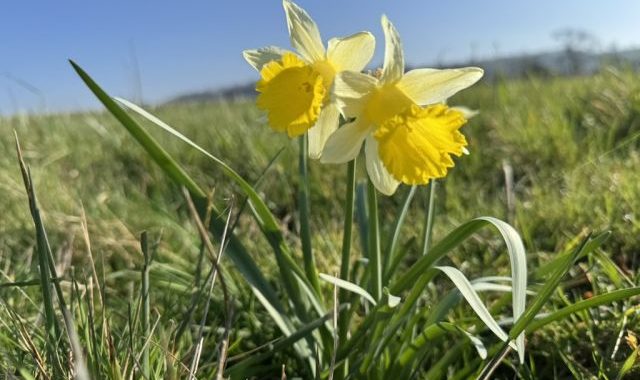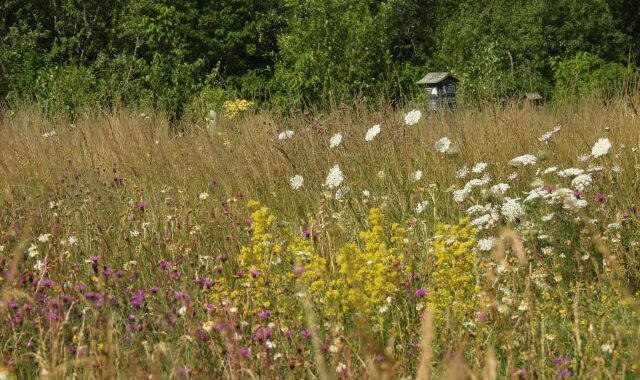
It is a sad but often-quoted fact that Britain has lost 97% of its wildflower meadows in the past century. Although, to be more accurate, these precious meadows were not ‘lost’: that suggests we don’t know where they’ve gone, and one day we might stumble across them again. In reality, our wildflower meadows were ‘destroyed’, and occasionally simply ‘neglected’ to the point where the habitat broke down.
At Sun Rising, we are creating new, flower-rich meadows in what was previously a field of agricultural grass. About a hectare (2.5 acres) is currently devoted to this habitat. Our vision is to increase this area by at least half as much again, so that almost a quarter of our 16 acres will be beautiful, insect-filled meadow, shimmering with colour from spring to mid-summer.
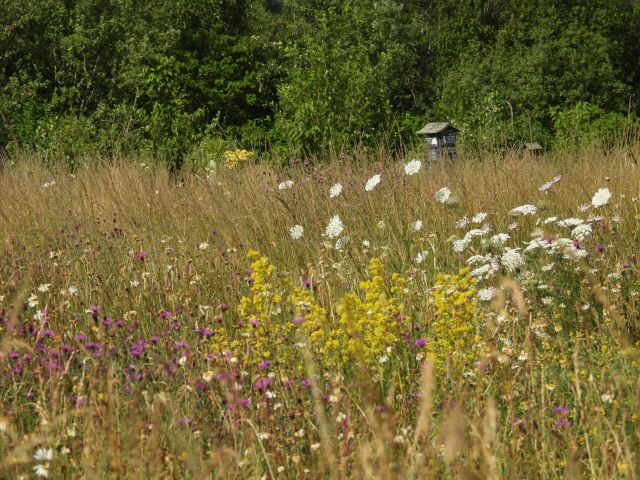
July Wildflower Meadow at Sun Rising
Unfortunately, creating a wildflower meadow is not as simple as scattering a few bucketfuls of seed and hoping for the best! While native seed sown on tilled earth might well germinate into a good mix of wild blooms, alongside them come tougher plants, such as thistles, docks, nettles and grasses, particularly if the soil is too rich – and these need to be weeded out. They do contribute to the diversity of the nature reserve, but we keep them where we can control them, mostly along the boundaries. Left unmanaged, they would readily proliferate, taking over the meadows, and quickly giving way to bramble and scrub.
Traditionally, livestock were taken off the old meadows in late March, allowing the wildflowers to flourish. Then in late June or early July the meadows were cut for hay to feed the animals through the winter. After the cut, the animals were returned to the meadows to graze the late summer growth, nibbling down the sturdier plants, their feet exposing and disturbing the soil, giving fallen seeds a chance to establish the following spring. But grazing is not an option at Sun Rising, with its copses, paths and burial areas. Instead, we cut our meadows in August with tractors, mowers, flails, strimmers and scythes, after the flowers have set seed. Our wonderful band of volunteers then help spread the hay, shaking out the last of the seeds.
Removing the cuttings is essential. If left to rot, they would enrich the soil, which encourages the more vigorous grasses, nettles and docks. Keeping the fertility of the soil low gives a wider variety of wildflowers a chance. However, our meadows are also challenged by the process of burial itself. When we are laid to rest in the nature reserve, our bodies do feed the soil – which is lovely for woodland areas, allowing us in time to merge with the beautiful trees as they reach for the skies. In the meadow, even the action of digging a grave, breaking up the clay and stone, brings a richness into the soil. Our regular soil testing helps us to understand the changing nature of the earth itself.
Needless to say, climate change is bringing further challenges to our meadows. In mild winters and cold springs, the meadow grasses get going before the wildflowers, allowing them to thrive and dominate, reducing biodiversity. Hot, dry summers bake our clay soil hard, and seeds shed by the wildflowers lie on the surface, instead of snuggling into damp soil, getting blown in the winds, or washed away in the first rain shower, or falling into cracks too deep to germinate.
Consequently, we need to be aware of where our established meadows need help to reseed, and where grasses have become too thick we look at regenerating. This we do by cutting the vegetation as short as possible, using a collection bag on the mower. Where the ground is uneven, often the blades ‘scalp’ the high spots, creating bare soil. Our dethatching machine can then be run over the cut area, its small teeth loosening the soil enough to allow new seed to bed in and germinate. Using our lighter, battery-powered machines helps to lessen the ground compaction. And in some areas we may use metal soil rakes to break up the ground further. This allows us to address areas where thicker grasses are doing too well. Our seed mix does include yellow rattle, a useful ally that parasitises grasses, reducing their vigour; however, it has little effect on the tough grasses like false oat grass and tall fescue, so at times we may even dig out stands of heavy grass, exposing more bare soil and creating more space for wildflowers.
Then when the rains come in October or November, we’ll sow fresh seed, now and then including a new species to see if it takes.
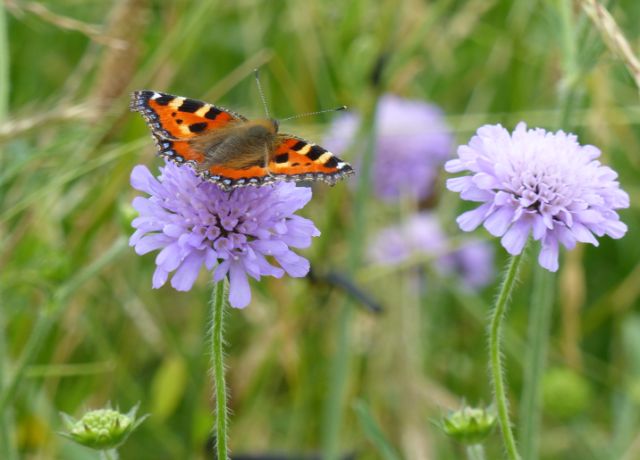
It’s a lot of work, but looking over the summer meadow, alive with butterflies, hoverflies and bees, we know it is a job worth doing well