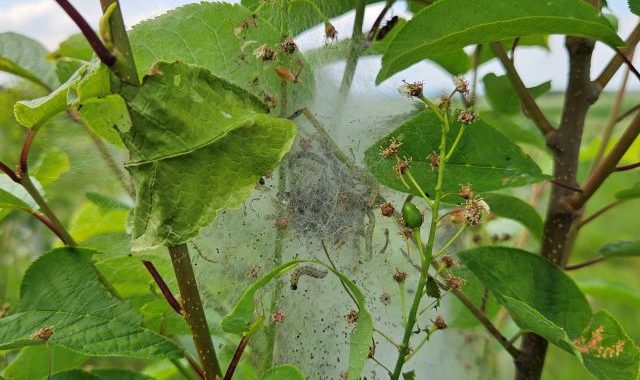
Bird Cherry Ermine Moth Caterpillars in their Web

Big White Webs

Springtime heralds the emergence of the wonderful insects we have here at Sun Rising, waking from their winter hibernation, or appearing freshly hatched from eggs.

This year, we have noticed an abundance of white, fluffy webbing on our Wild Cherry trees (Prunus avium).   This webbing looks like spider webs, but is, in fact, a cocoon spun by the caterpillar of the Bird-cherry Ermine moth (Yponomeuta evonymella) to protect itself from predators.

Bird Cherry Ermine Moth Caterpillars in their Web

Bird Cherry Ermine Moth Caterpillars in their Web

The Bird-cherry Ermine moth is a small moth, native to Britain, with white wings and five rows of black spots.  The caterpillars are creamy-white in colour with broken black markings down their length on either side.

We see these caterpillars every year here at Sun Rising, you may well have seen them yourself whilst out on local walks!

This year there appear to be a lot about. This may be due to the warm and sunny spring and the lack of rain to wash them from leaves. The warmer, sunnier weather also allows the cherry trees to grow plenty of leaves, which the caterpillars eat.  In turn, the caterpillars are eaten by insectivorous birds, spiders, wasps and ladybirds.

We keep an eye on all our trees here at Sun Rising and have been monitoring the effects of the caterpillars. On a few trees that were quite heavily populated we removed some of the cocoons to prevent too much damage. Trees that have had some defoliation will flush back through with new growth as spring becomes summer, by which time the caterpillars will have started their pupation stage before becoming adult moths.

The relationship between the moth and tree is natural, part of the vast interconnected web of nature!  If you have a cherry planted as a memorial tree here at Sun Rising and you are concerned, do get in touch.
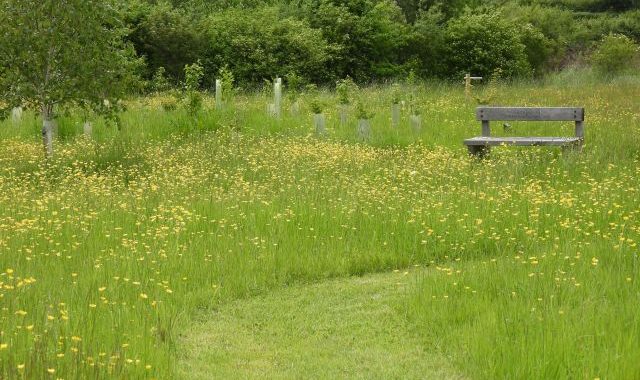
Path through Unmown Meadow

No Mow May

The campaign for No Mow May has generally been amazing.  All around the country there are local councils who, over the last few years, have agreed not to mow road verges, banks and roundabouts, leaving areas in parks and cemeteries, through the month of May.  Individuals and families have been inspired to leave their own lawns for a month, or allow areas of the garden to stay wild for a while.

To the uninterested eye, a verge or lawn that has been left unmown may simply look messy.  But curiosity inspires us to learn.  Even if there are no flowers in the grass, there will almost certainly be quite a number of different grass species, species which may look fairly similar when all you see is short green leaves, but which are wonderfully diverse in their flowering and seeding.  Each species has adapted to a specific habitat, and has any number of other species that will benefit from it.

Path through Unmown Meadow

Path through Unmown Meadow

Structure is an important aspect of No Mow May too.  Having areas of tall vegetation provide for a wider range of invertebrates.  For example, some spiders hunt from the tops of tall grasses, while some prefer half way up, and others like the dark low levels.  Taller stands of grasses and flowers offer better shelter in wind and rain, or from sunshine that’s too hot.  The ground will stay damper at the base of tall grasses, keeping the soil healthier through periods of early summer drought.

If there are wildflowers in the grass, all the better.  They will not only make it prettier to our eyes, they will be hugely valuable to all those creatures who use the sweet energy of nectar and pollinate the area as they go.  If you’ve left an area without mowing one year to find there is nothing but grass, why not add wildflowers in the autumn, ready for next May.  It isn’t easy but it’s certainly possible with a little guidance and advice.

The great benefit of No Mow May can, however, be destroyed if the area is cut to an inch on the first day of June!   In fact, the original campaign is now changing to encourage us to leave areas wilder, unmown, untidy, for most of the summer.  It isn’t just about May: why not leave the vegetation until it’s gone to seed in July or August?

Of course, at Sun Rising we have huge areas of meadow which are not mown from March to September, and areas that we mow throughout.  An excellent way of making sure a wild area looks purposeful and cared for is to mow a verge on the edge: that’s what we do at Sun Rising.  Or a path mown through it will give access, allowing a way of exploring what’s in the middle of the wild patch, learning more and enjoying more.  A mown area beside or through taller vegetation is also another kind of habitat, so you can keep the common daisies, dandelions and speedwells that prefer the shorter grass.

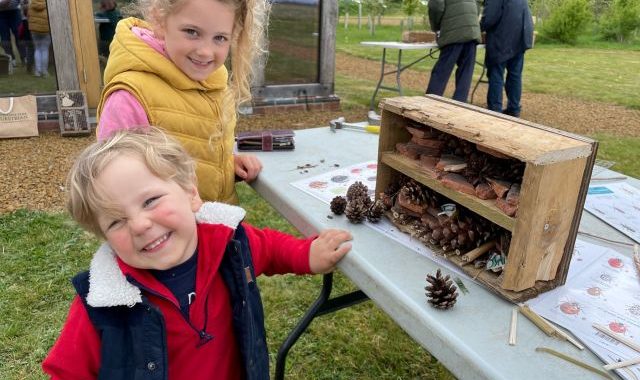
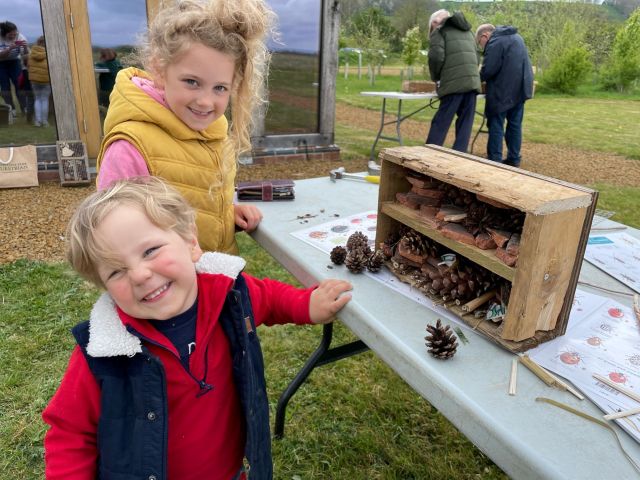
Happy Folk at the Insect Hotel Event, April 2025

Air-Bee-n-Bees

Yesterday morning, a lovely group of adults and children gathered at the Longhouse to create what are generally called insect, bee or bug hotels.  Previously, we’d prepared a number of frames out of scrap wood, and yesterday was the time to fill the frames: we had old bamboo canes, young green bamboo canes, the hollow stems of hogweed, teasel and other dried plants from last year, old teasel heads and pine cones, broken flower pots and crockery, some bits of old bark and rotting wood, and chunks of larger wood with holes drilled into them.  Some also use straw, sheep’s wool and other materials, indeed anything that will add to the warm, dry, dark space the ‘hotel’ is offering.

Happy Folk at the Insect Hotel Event, April 2025

Happy Folk at the Insect Hotel Event, April 2025 (published here with kind parental permission)

Insect hotels are used by a wide range of insects.  If placed in a dry, sunny spot, it is more likely to be used by wild solitary bees, for nesting and raising their young.  Butterflies may use it as a place to shelter or overwinter.  Ladybirds and lacewings will use it for shelter too.  If you place it in a darker spot, it is likely to attract beetles, centipedes, spiders and woodlice.

The advantage of these boxes is not just to the insects, but to the nature reserve as well.  If we protect our pollinators, they will better play their part in the ecosystem, pollinating the trees and wildflowers, keeping the meadows and woodlands healthy. But all insects have a place in nature: pest predators like ladybirds and lacewings feed on aphids, many beetles eat decaying matter, centipedes eat smaller insects.

It’s far easier to feel terrible about potential extinctions of larger creatures like polar bears, or even hedgehogs, but with bees and other insects we really can do something to help, in our own gardens and of course here at Sun Rising.  If you’d like to know more about how to make your own insect hotels, have a look at this link: Build-a-bug-hotel.pdf.  Large ones can have some value, but smaller ones are often thought to be better, reducing the risk of shared parasites and moulds.  Avoid plastics, as these hold moisture in a way that encourage moulds, give it a solid back and put on a good roof.  Hotels also need to be positioned where they will have good sunlight, protection from wind and rain, and secured so it doesn’t shake or sway in the wind.  It may also be useful to put it in a cool dry space over the winter to protect any overwintering occupants!

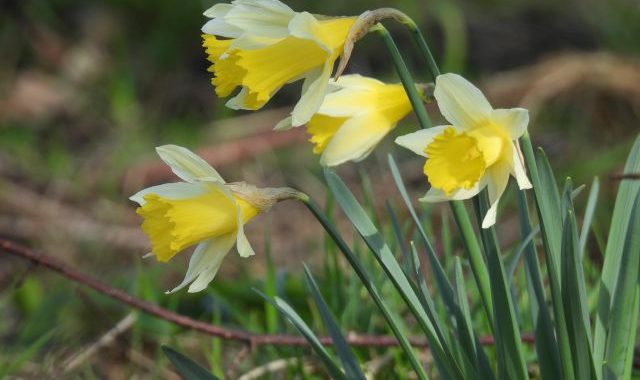
The Wild Native English Daffodil, Narcissus pseudonarcissus

A Time For Everything

In the last week, it certainly has felt as if spring is truly here.  There’s a light freshness in the air and, while the snowdrops are past their very best, the daffodils are glowing with sunshine, even when the skies are cloudy.  In the coming days, however, we’re heading back towards frosty nights and much lower temperatures.

The start of spring differs according to which measure you use.  Meteorology, the study of weather, tells us it is 1 March.  Astronomy, the study of celestial objects, would say the vernal equinox, which this year is 20 March, when the tilt of our planet gives a day and night of equal length.

But have you heard of Phenology?  From the same etymological route as ‘phenomenon’, this is the study of nature’s cycles.  It’s a science that is becoming more important year by year.  With climate change, understanding when and how ecological processes happen is critical for agriculture, forestry and biosecurity, which have ramifications across the world.

The Wild Native English Daffodil, Narcissus pseudonarcissus

The Wild Native English Daffodil (Narcissus pseudonarcissus) at Sun Rising

At Sun Rising, we have thousands of ecological records from many years.  They may not have global significance, but they are part of the broader statistics.  The ‘first for the year’ sightings are always interesting.  This year, the first flowering snowdrop was seen on 22 January.  The first butterfly was on 4 March, a butter-yellow male brimstone.  The first summer migrant last year was the chiffchaff, on 18 March; we’ve heard them in local meadows but not yet at Sun Rising.

The science of phenology is close to 300 years old.  Robert Marsham began recording the first events of spring back in 1736, but naturalists have been using their annual sightings as sources of learning for millennia.  As an indicator of climate change, observations show spring is a month earlier now than in the 1980s.  In fact, we can no longer use some of the old indicator species: for example, wild primroses can now be seen flowering in December, and daffodils cultivated for the garden can be bred to flower at the turn of the year.

Of course, it’s not all about springtime.  We also record the first ripe blackberries (31 August 2024) and the arrival of the first winter migrants (the fieldfare on 1 November 2024).  You can find out more about Nature’s Calendar and seasonal indicators at: https://naturescalendar.woodlandtrust.org.uk.

Harvest Mouse on the Stone Track

Hidden Homes

The grasslands at Sun Rising provide food and nurseries to moths and butterflies, but they are also home to a vast collection of little mammals. In the past we’ve found plenty of evidence of voles and wood mice, but now we find that they are also home to Europe’s tiniest (and therefore cutest) mammal: the harvest mouse.

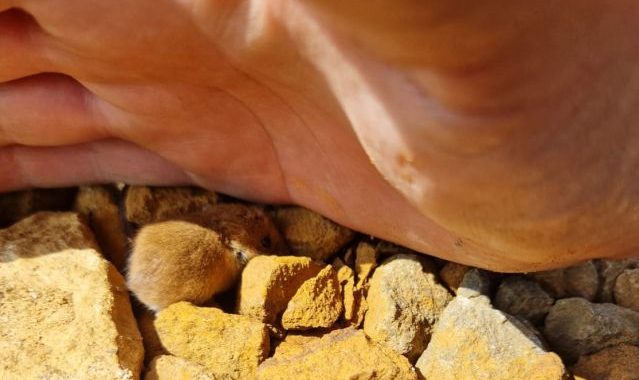
While mowing last summer, Steve was vigilant enough to spot some tiny creatures scurrying out of his way. Smaller than a wood mouse, they had golden brown fur and a long tail. A video captured that tail, which ruled out the possibility of a vole whose tail is only half the length of its body. A harvest mouse’s tail, on the other hand, is roughly the length of its own body.  Being prehensile, it acts as a fifth limb, allowing the mouse to spend its life climbing the grasses. The photograph here shows the little mouse next to Steve’s hand for a size comparison.

Harvest Mouse on the Stone Track

Harvest Mouse on the Stone Track

While a survey for harvest mice in 2023 came up with nothing, it’s brilliant to see that just over a year later and with the help of volunteers we’ve been able to find 2 breeding nests and 5 smaller, individual ones.  But finding them is hard!  Gently combing through the tangled mess of grasses, bent, soaked and bowed under the weight of winter, we searched for the tightly woven nests. We joked that it’s hard enough searching for a needle in a haystack, but here we’re searching for a mini haystack in a big haystack!

The weaving of the mouse’s nest is intricate and fastidious. They create a beautifully neat and cosy tennis-ball sized grass house that is so structurally sound, it holds its shape even if you bounce it in your hand. The fluffier, looser weave of a vole’s nest easily falls apart upon handling.

By this time of year we may all be feeling sick of the long dark evenings, the bitter winds and sleep-scruffy landscape. Yet the promise of spring is building and finding these little treasures in the wet grass was so exciting: even though the mice had long vacated these homes, it brought the promise of their return.

Hoar frost at Sun Rising in January 2025

Magical Valuable Frost

Frost is so beautiful, it never fails to leave me gazing in wonder.  It is often true to say that there are no straight lines in nature, but frost’s tiny ice flakes remind us that in far smaller scales than we usually perceive there are marvellously geometric patterns with perfect lines and sharp angles.

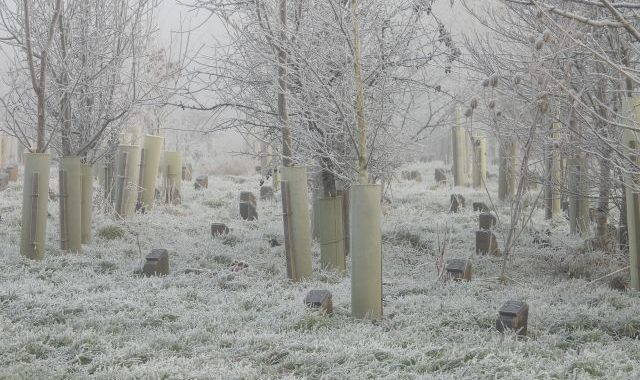
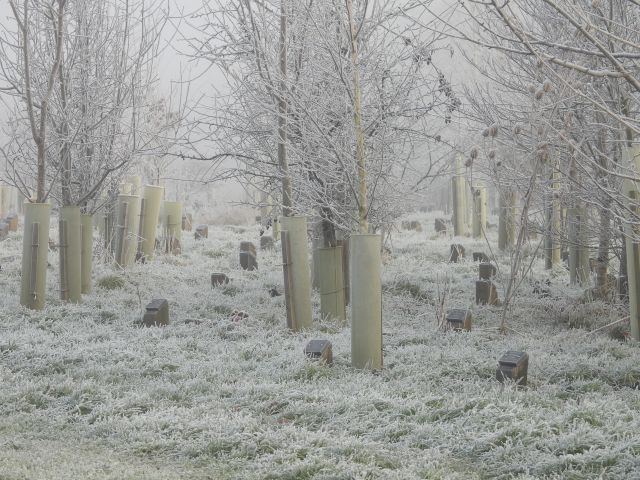
Dreary, damp, grey winter days beneath vast stratus clouds have been too common over this winter and last, making days with blue skies and crispy hard frosts even more of a delight, even if they are achingly cold.  The short period of deep cold we had earlier in the month this year covered Sun Rising in hoar frost that lasted most of the day, and felt utterly magical.  The soft white fog was so thick at times it was impossible to see the roundhouse from the car park gate, some 60 yards away.

Hoar frost at Sun Rising in January 2025

Hoar frost at Sun Rising in January 2025

Frost is such an important part of the health of our environment here in England, as well as our own wellbeing.  Frost puts into dormancy not just trees and smaller plants, but insects and fungi, allowing them to conserve energy through the winter, ready for the next cycle of growth.  Frost also kills off moulds and pests that need warmth, stopping the spread of diseases from southern climes.

Some of our native plants won’t germinate without frosts.  Primroses, cowslips, yellow rattle, meadowsweet, some bellflowers, all need alternating cold and warmth in order to break open the seeds in the spring.  Bluebell bulbs need frost to set their internal clocks, allowing them to begin their growing season.  After mild winters, we see noticeably fewer wildflowers in the meadow at Sun Rising.

The soil benefits enormously too, particularly our heavy clay.  Frost splits up the soil particles, breaking up clods of earth, helping to create top soil and allowing its own wildlife to move and thrive, keeping the soil healthy.  As such, it helps graves settle, and look tidier, easing our own journeys of grief.

Milder winters may feel more comfortable in terms of temperature, but without cold and frosty winters we’ll have plenty of problems that will need to be overcome.  It’s another reminder to do all we can to protect our precious environment from climate change.

Frosty Young Winter Trees at Sun Rising

The Flexible Twist

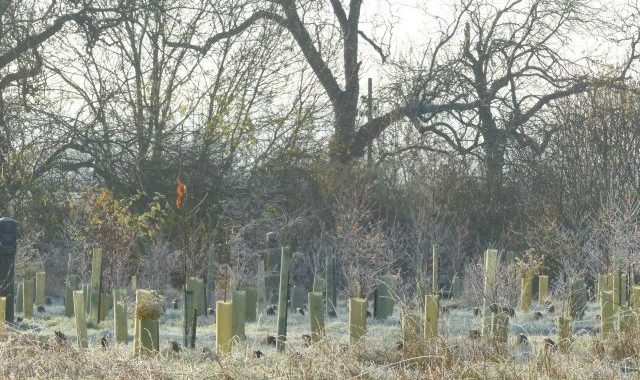
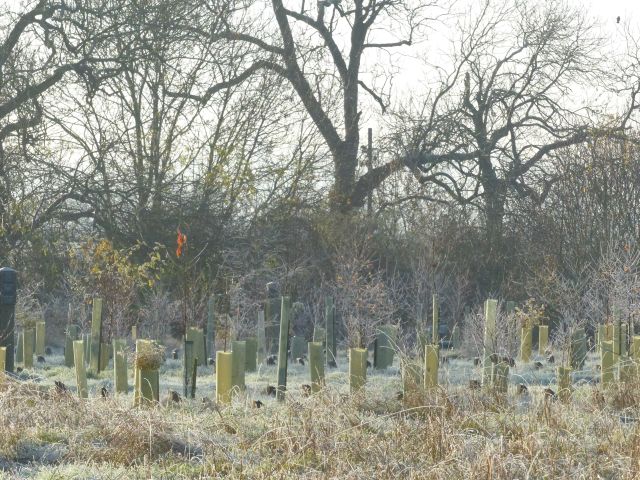
During December this year we planted over 100 more memorial trees here at Sun Rising.  Each year, the new additions are wonderful to see, extending woodland burial areas and helping us imagine the woodland in years to come.  All but 14 were planted with families and friends attending, some days beautifully calm and bright, but others were planted in the midst of Storm Darragh, with winds of nearly 60 mph.  Two weeks before we were under 4 inches of snow, so it’s been an interesting end to the year!

Frosty Young Winter Trees at Sun Rising

Frosty Young Winter Trees at Sun Rising ( – I’m amazed to find I have no photos of trees in the wind.  No doubt I simply wasn’t out with my camera!)

Most reports say that trees can be uprooted in winds over 55 mph, but thankfully, apart from a few broken tree stakes, and some very wind-blown visitors, the storm left no damage at Sun Rising.  Some families were worried nonetheless – it’s hard to see a precious tree bending in high winds.  Yet, having evolved over millions of years to stand still (not run for shelter like us animals), trees are generally extremely resilient.

Our tree guards mainly protect the young trees from being nibbled, most commonly by deer.  They also provide a warmer damper microclimate for their first years.  To some extent, they also keep the youngest saplings out of the wind.  However, trees exposed to wind from an early age grow to cope with it.  In exposed areas, without shelter from buildings or other trees, they grow thicker in the trunk instead of putting on height.  They may add a clever twist to the grain of the wood, in order to give some additional flexibility.  Furthermore, trees grow structural roots deeper on one side and grow roots broader (branching out) on the other, allowing the tree to be better anchored according to the prevailing wind.

All of which suggests that they are a great deal better adapted than we are, as we struggle to wrap up, anxiously looking about for damage or danger.  I particularly like the twist in the grain: that’s something that we humans really should work on!

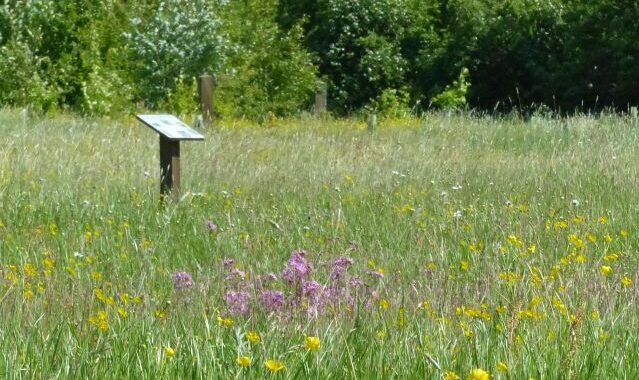
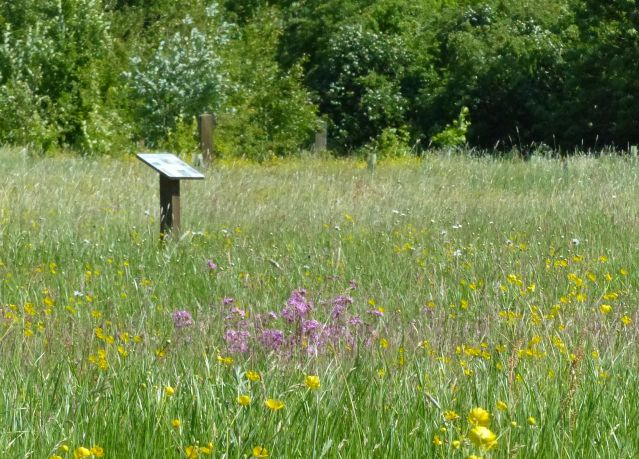
Meadow with Ragged Robin and Habitat Interpretation Board

A Perfect Job

When asked about my occupation and I reply that I work at a natural burial ground, a common response is a pause, followed by, “But what do you actually do?”  In reality, the job we do here is wonderfully rich and varied, and so profoundly worthwhile I can’t think of a more perfect job.There are many meetings with families, in what may be the worst days of their lives, but the opportunity to support people through the necessary steps is a tremendous honour. Equally, meeting with individuals who are facing their own mortality, through age or illness, requires sensitivity and strength, but is deeply rewarding. Arranging, co-ordinating, preparing and supporting families through funerals is also filled with a poignancy and sadness but the opportunity to be there for them is an honour.

Meadow with Ragged Robin and Habitat Interpretation Board

Meadow with Ragged Robin and Habitat Interpretation Board

But those tasks are not all the job entails. There is paperwork, of course, and designing memorial plaques, growing wildflowers from seed, planting bulbs, planting trees, pruning roses, arranging memorial benches, installing plaques, ordering coffins, counting butterflies, creating habitat interpretation boards, weeding the meadows, organising open days, running workshops, tidying graves, giving talks, doing flora surveys and tree surveys, looking for harvest mice, giving time to those visiting graves, managing volunteer days, designing leaflets, working with celebrants, funeral directors, naturalists, and so much more!

As I look to be taking a step back in order to focus on our charity, The Friends of Sun Rising, we’re now looking for someone to take my position. We aren’t expecting to find someone with years of relevant experience, but we are determined to find the perfect person: someone who is really keen to work for an ethical company, who is sensitive to others’ needs, and who is deeply passionate about nature.

… We are delighted to say that this position had now been filled.

Planting in a Woodland Burial Area

Planting Some Colour

It is only looking at my photographs of summer 2023 that I recognise just how dreary this past year has been.  Perhaps that has been an extra incentive for families to attend our Planting Weekend this year.  Over eighty families got in touch, keen for native bulbs and perennial wildflowers to be planted on plots all around the burial ground, with over seventy families coming along to plant themselves, and others asking us to plant on their behalf.

Planting in a Woodland Burial Area

Planting in a Woodland Burial Area at Sun Rising

Wild daffodils, snowdrops, snakeshead fritillaries and English bluebells were planted, with a good selection of wildflowers, many of which we brought on from seed: hedge bedstraw, hedge woundwort, agrimony, meadow cranesbill, field scabious, greater knapweed, selfheal and plenty more.

Over this past week and this coming week, with the sterling work of families and volunteers, we have been planting nearly a thousand English bluebells in the older woodland areas, and over 400 daffodils around Jean’s Crescent near the longhouse, and along Molly’s Hedge and the oak tree that honours the late Queen.  Over two hundred snowdrops went in along the woodland edge of the north car park.  We have a few dozen kidney vetch to plant along the lane bank, and two dozen birdsfoot trefoil to plant along the verges, two dozen red campion along the bunds, and lots of little meadow saxifrage for the meadow edges.

We really are hoping for a little more sunshine next summer, in anticipation that our planting will be successful, and those lovely rich summer colours will return.  Thank you to everyone for all they have done in helping with this part of our work, improving the nature reserve for next years butterflies and bees – from seeding and potting on the plants, to preparing the barrows of our special soil mix, arranging the schedule of families attending, and of course the planting itself. Well done, all!

Next week we’ll be starting one of the less exciting winter tasks: washing the old plant pots ready for next year.  Any volunteers?! …

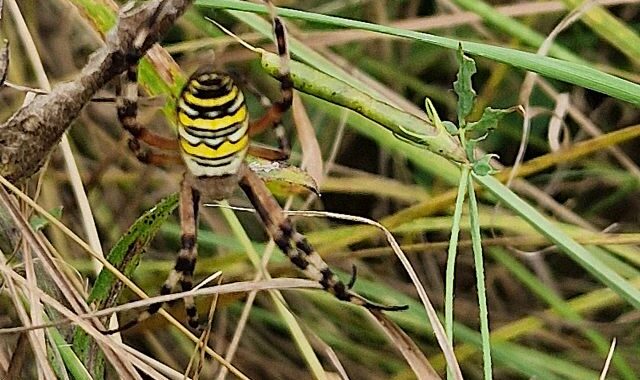
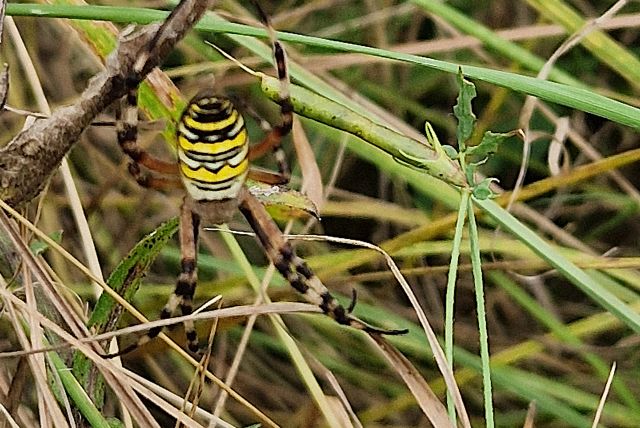
Wasp Spider

Comings and Goings (and Climate Change)

There is a small non-descript bird that visits the UK every spring to breed. It is the Willow Warbler and, despite the name, it is widespread across a variety of habitats with trees. It closely resembles a Chiffchaff and it’s difficult to tell the two apart: the difference is in leg colour (Chiffchaff black, Willow Warbler light brown). That’s if they stay still for long enough for you to see. The easiest way to tell them apart is actually by the song.  The Chiffchaff calls its name over and over and the Willow Warbler sings a descending phrase ending in a flourish. We have heard both at Sun Rising for many years but in 2024 sadly no Willow Warbler. It would appear that climate change may be affecting these birds – they are declining in England and Wales, but increasing in Scotland and Northern Ireland. This has led to the bird being on the Amber list of Conservation Status.

Wasp Spider

Wasp Spider

On the other hand, the climate warming has brought the arrival of new species, and in late August two new species were added to our records. The female Wasp Spider is a striking (but harmless) minibeast with yellow and black stripes mimicking a wasp, a defence against predation. They are orb-weavers, like our familiar garden spider, and we found one in the long grass around the Roundhouse. They have found their way to the UK  from the Mediterranean area and are now not uncommon in southern England.  Spreading north, they have now reached South Warwickshire.

The Jersey Tiger moth has a similar story.  Concentrated in southern counties, we were pleased to get one in our moth trap at an evening event. It is another striking creature and it treated us to a display of its colourful orange hindwings. The caterpillars like to feed on nettles and dandelions so a wild and weedy patch in your garden might help them head your way too.